
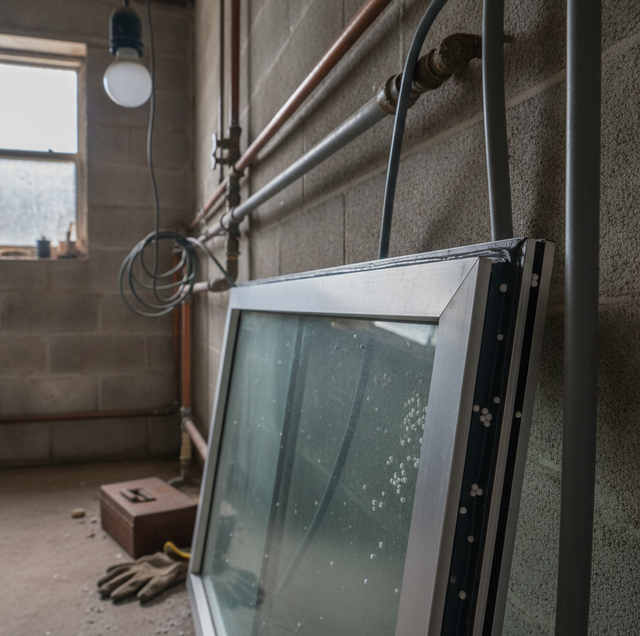
Quick Answer: Fog inside a dual-pane window means the edge seal on that insulated glass unit has failed and let humid air into the sealed gap, so moisture condenses between the panes where a cloth can't reach. It's not urgent unless the glass is also cracked, but it does hurt the window's insulating value. The lasting fix is to replace the sealed glass unit, often while keeping your existing frame and sash. "Defogging" only clears the look temporarily; it doesn't restore the seal or the argon fill.
You reach for the glass cleaner, wipe both sides, step back, and the haze is still there. Wipe again, harder, and nothing changes. That is the moment most people realize the cloudiness is not on the window at all. It is inside, sealed in a space you cannot reach, and no amount of scrubbing will touch it. What you are looking at is a single, familiar failure, and once you know the part that broke, both the cause and the repair fall into place.
What a Dual-Pane Window Actually Is Inside
Strip a dual-pane window down, and it is a sandwich. Two panes of glass sit parallel with a gap between them, and that gap is the whole point. Around the edge runs a hollow metal or composite spacer bar, and inside that spacer sits a desiccant, the same kind of moisture-absorbing bead you find in the little packets tucked into a new pair of shoes. The perimeter is sealed shut with a sealant, so the gap forms an airtight chamber. That chamber is usually filled with argon, a dense, still gas that carries heat far more slowly than ordinary air. The whole assembly is called an insulated glass unit, or IGU.
When it is new, the desiccant keeps the sealed gap bone-dry, the argon slows heat from crossing, and the two panes stay optically clear. You look through it and never think about the engineering. It only announces itself when it breaks.
Why the Fog Shows Up Only Between the Panes
The fog is condensation, and its location tells you everything. When the perimeter seal loses its grip, outdoor air carrying humidity begins seeping into the sealed gap. The desiccant does its job at first, pulling that moisture out of the incoming air, but it has a finite appetite. Once it saturates, there is nowhere left for the water vapor to go. So on a cool morning, or when a hot afternoon drives a sharp temperature swing across the glass, that trapped vapor condenses on the inner faces of the two panes.
Those inner faces are the two surfaces no cloth will ever reach. That is precisely why you can scrub the room-side and the outdoor-side until they squeak and the haze stays put. Over time, the condensation can dry and redeposit as a faint mineral film or streaking, and repeated cycles can etch the glass, making the cloudiness permanent even on a dry day. The pattern that gives it away: fog or haze that comes and goes with temperature and humidity, worst in the morning or after a swing, and completely immune to cleaning.
What Broke the Seal
Edge seals rarely fail from one dramatic event. They wear out from a daily rhythm. Every time the sun hits the glass, the sealed gap warms and the trapped gas expands, pushing outward on the seal. Every evening it cools and contracts, pulling back in. Picture a bellows that worked open and shut thousands of times a year. That constant flexing fatigues the sealant at the corners until a gap opens.
Several things speed that clock. Age is the baseline; every unit has a service life. A hot climate is the accelerant that matters most here. Intense solar load and large day-to-night temperature swings mean the glass expands and contracts more rapidly and more often, and prolonged UV exposure degrades the sealant chemistry itself, so the material becomes brittle sooner than it would in a mild climate. Water is another culprit: if the frame design or a failing exterior seal allows water to pool along the bottom edge of the unit, that standing moisture attacks the seal from the outside. And some units simply leave the factory with a weak or thin seal bead, which shortens their life no matter where they are installed. When the seal opens, the argon that made the window efficient drifts out, and ordinary humid air drifts in, which is the same breach that lets the fog form.
First, Rule Out the Fog That Is Not a Failure
Before you conclude the unit is shot, confirm the moisture is actually trapped inside. Not all window fog indicates a broken seal, and the test is simple: try wiping it.
If the haze wipes away from the room-side surface, that is indoor humidity condensing on cool glass, common when a bathroom or kitchen runs humid, and the window is cold. It is a signal to ventilate or run an exhaust fan, not a sign the window failed. If the fog sits on the exterior surface on a cool morning and clears as the day warms, that is ordinary dew, which means the glass is insulating well enough to stay cooler than the outside air. Only the haze that sits between the panes and refuses to wipe from either side is a seal failure. Sorting this out first saves you from having to replace a unit that was doing its job.
Is a Foggy Window Actually a Problem
In most cases, it is not an emergency. A window with a failed seal still keeps the weather out, and the glass still holds together, so there is no rush, as there would be with a crack. Two real costs remain, though.
The first is the view. Permanent haze on a picture window or a row of matching windows is hard to ignore and drags down the way the whole room reads. The second is quieter and shows up on your utility bill. Once the seal opens and the argon escapes, the gap loses much of its insulating power, allowing more outdoor heat to enter the room. In a climate where the cooling system already works hard for much of the year, a failed unit on a sunny wall makes that system fight a little harder every day. The one situation that does raise urgency is a foggy unit that is also cracked or has a compromised outer pane, because then you have a structural problem on top of the cosmetic one, and that unit should be looked at sooner.
The Fix That Lasts, and the One That Only Looks Like a Fix
Here is the part that surprises most people: a fogged window almost never means tearing out the whole window. The failure is in the glass unit, so in most cases, the glass unit is what gets replaced. A glass shop measures the existing opening, orders a matching sealed IGU, removes the fogged one, and sets the new unit into your existing frame and sash. The frame, the operating hardware, and the trim all stay. This is often called glass-only or IGU replacement, and when the frame and sash are sound, it is the right answer, because it restores both the clear view and the argon-filled insulating gap without the cost and disruption of a full window swap.
Be skeptical of "defogging" services. The pitch sounds tidy: they drill a small hole in the unit, dry out the trapped moisture, sometimes add a coating, and reseal the hole. It can clear the visible haze for a while. What it does not do is rebuild the original edge seal or replace the argon that leaked out, so you are left with a window that looks clearer but still insulates like a failed one, and the same breach that let moisture in the first time is still open. Treat defogging as a cosmetic patch, not a repair. If the inner glass surfaces are already etched from long moisture cycling, no drying process will remove that anyway, and the unit needs replacing regardless.
Full window replacement is reserved for the cases where the frame or sash itself has gone bad: rot, warping, corrosion, water damage, or a frame so old it no longer holds a unit squarely. If the glass fogged but the frame is solid, replacing the whole window is more than the problem calls for.
How to Tell Whether Your Frame Is Fine
Since the fix depends on the frame's condition, it helps to check it yourself before anyone quotes work. Run a hand along the sash and frame and look for a few things. Press on the frame material; sound aluminum, vinyl, or wood feels firm, while a frame that you can flex or dent, or one that feels soft and spongy on a wood sash, is degrading. Look for standing water stains, swelling, or peeling along the bottom rail, which indicate a drainage or water problem that will affect a new unit too. Check that the sash still closes square and the window locks and operates smoothly; a sash that binds or sits crooked in the opening has moved out of true. Finally, check whether the glass simply lifts out or the whole assembly is distorted around it.
If the frame is firm, square, dry, and operating well, you are almost certainly a candidate for glass-only replacement. If several of those checks fail, the frame is likely part of the problem, and a full window makes more sense. A glass professional can confirm which path fits after seeing the unit, but knowing what to look for gives you a rough idea of what to expect going in.
Frequently Asked Questions
Run two quick checks. First, try to wipe it from both the inside and outside faces; between-the-pane fog will not come off either face because it is sealed in the gap you cannot reach. Second, watch how it behaves with room humidity: surface condensation flares up while you shower or cook and clears once the air dries, whereas a failed unit stays hazy even in bone-dry indoor air and does not track with what you are doing in the room. Fog that persists in dry air and resists a cloth on both faces is a seal failure, not moisture you can ventilate away.
Because they treat the symptom, not the breach. A defog kit drills a small port, dries the trapped moisture, and reseals the hole, which can clear the look for a season. What it physically cannot do is rebuild the bonded edge seal or pump the gap back full of argon, so the chamber is still open to outside air. Humid air works its way back in, and the unit re-fogs, often within a year, and because the argon never came back, it keeps insulating like a failed unit the whole time. You have paid to reset the clock on a seal that is still broken.
More than the height and width. To have a sealed unit built that drops into your existing frame, a shop records the overall thickness of the unit, the thickness of each individual pane, and the spacer or air-gap width between them, since those add up to that overall dimension, and the new unit has to seat the same way in the channel. They also note whether the original is Low-E coated and argon-filled so the replacement matches its performance, and whether the glass is tempered or annealed, which is set by code for the size and location and cannot be downgraded. Getting those specs right is what makes a glass-only swap sit flush and perform like the original.
It does, through two mechanisms. Large day-to-night temperature swings make the sealed gas expand and contract harder and more often, and that repeated flexing fatigues the edge seal like a bellows worked back and forth. Separately, prolonged high UV exposure degrades the sealant material itself, making it brittle sooner than it would be in a mild climate. West- and south-facing windows, which take the most sun and the biggest swings, tend to fog first for exactly these reasons.
Enough to move it back toward acting like a single pane. The insulating performance of a dual-pane unit comes from the still, dead-air-or-argon gap between the panes, not the glass itself; the glass barely resists heat on its own. When the seal fails, the argon drifts out, and the gap fills with ordinary air that convects and carries heat across more freely, so the unit sheds much of what sets it apart from single-pane glass. On a sun-struck wall that raises the cooling load every hour the sun is on it, which is most of the day for much of the year here.
Test three things: how it operates, how it holds together, and how the hardware behaves. Open and close it a few times; a sash that drags, drops on its own, or sits crooked in the opening has racked out of square and will fight a new unit. Press the frame and sill for soft, spongy, or swollen spots, and look for peeling paint or standing-water stains at the bottom rail that signal rot or a drainage problem, since those attack a fresh unit the same way. Then work the lock and any balances or rollers; if the hardware still latches and glides smoothly, the frame has held its geometry. Pass all three, and you are a strong glass-only candidate; fail a couple, and a full window usually makes more sense than setting good glass into a failing frame.
Book a free consultation for a foggy window — get a clear look at whether glass-only replacement fits before you commit to anything. Luxe Residential and Commercial Glass serves the Las Vegas Valley. Call (702) 825-7463.
