
Why Do Commercial Storefronts Use Tempered Glass?
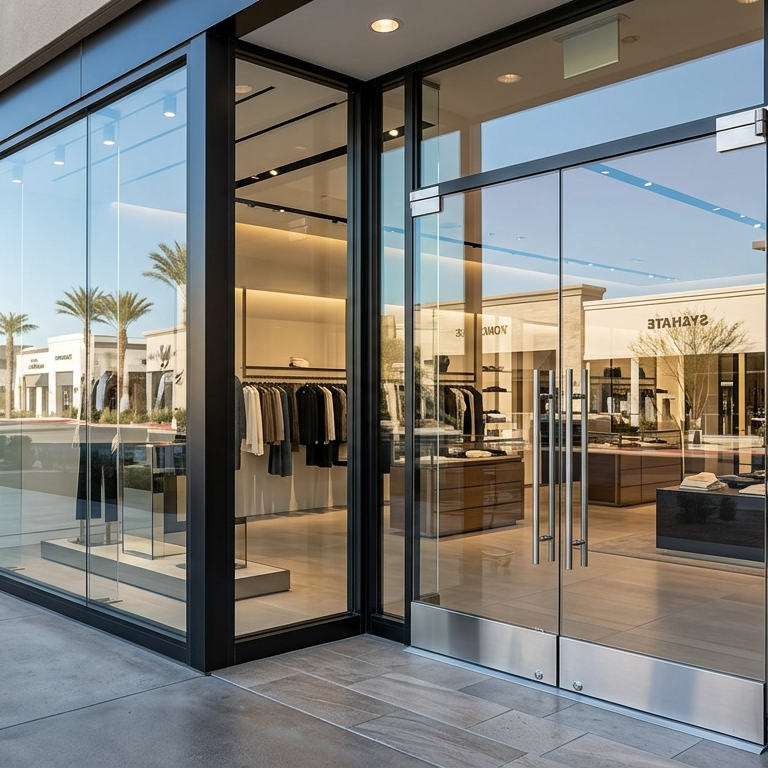
A shopping cart slips free in a parking lot and rolls straight into the front of a store. The glass shakes, takes the hit — and holds. Or it doesn't. The way it fails is what makes all the difference between a quick sweep-up and an injury that shuts your business down for the rest of the day.
That's the core reason commercial storefronts use tempered glass. Not because it's unbreakable — it isn't — but because of what happens when it does break. Understanding that distinction is worth your time if you own a commercial property, manage a retail space, or are planning new construction.
What Tempered Glass Actually Is
Tempered glass starts the same as any other glass: a flat sheet of standard float glass, cut to the required size. The difference happens inside a furnace. The sheet is heated to around 1,200°F, then blasted with jets of cold air on both surfaces at the same time. That rapid cooling process is called quenching — and it's where all the properties come from.
The outer surfaces cool and harden first, while the inner core is still contracting. When the core finally cools, it tries to shrink but gets locked in place by the already-rigid outer layers. This creates a panel under permanent internal stress: the outer surfaces sit in compression, the interior sits in tension. Think of a pane that is always pressing inward on itself.
That internal stress state is everything. The surface compression makes the glass 4 to 5 times more resistant to bending and impact than standard annealed glass. And when tempered glass does break, it breaks all at once — the stored energy releases in an instant, shattering the panel into thousands of small, roughly cubic pieces with blunt edges.
This is called dicing. It's the defining property that classifies tempered glass as safety glazing.
Why Broken Glass Type Matters Near People
Standard float glass — the kind used in picture frames or untempered windows — breaks into large fragments with sharp edges. A 1/4-inch sheet under impact can produce shards several inches long that come loose at high velocity. In a door panel, that's a serious laceration risk to anyone nearby when it fails.
Building codes recognized this problem decades ago. The International Building Code (IBC), Section 2406, requires safety glazing in all hazardous locations. That list includes glass in doors and door frames, glass within 24 inches of a door's latch-side edge, glass panels within 18 inches of the floor when the panel exceeds 9 square feet, and glazing in railings and barriers.
Practically every glass panel in a commercial storefront meets at least one of those criteria. The door itself. The sidelites flanking it. The large display windows that run close to grade. The code maps directly onto the places where glass and people interact most often — and where the consequences of breakage are most severe.
But that's the floor. Code compliance is the minimum, not the full explanation.
The Real Reason Storefronts Need More Than the Minimum
A commercial entrance sees traffic that no residential door faces. The door swings hundreds of times per day. Shopping carts, delivery hand trucks, luggage carts — all of it passes through or near the glass on a repeated cycle. Thermal expansion from a desert climate means the glass contracts on cool mornings and expands on hot afternoons. UV exposure, grit from windborne dust, the occasional rock kicked up by a passing car.
Annealed glass that was technically compliant with code fail under ordinary commercial use within two years. Door panels especially — the vibration from repeated openings works into any existing surface nick, and then one moderate impact finishes the job. Standard glass gives no warning. It just goes.
But the frame is where things actually start. Annealed glass in a rigidly clamped commercial frame has no slack to absorb dimensional changes. Edge stress accumulates at the corners and cuts until something gives. Tempered glass tolerates that punishment because the compression layer on the surface absorbs the edge tensile stress before it reaches crack-initiation territory.
That's not a selling point. That's the physics of why this material belongs in a commercial application.
How Desert Heat Cycling Matters for Storefront Glass
This mechanism doesn't get enough attention in most glazing discussions. In climates with intense, prolonged sun exposure, a west- or south-facing storefront panel can reach surface temperatures above 150°F in summer. That same glass may drop below 55°F on a winter night.
Glass expands and contracts with temperature at roughly 0.000005 inches per inch per degree Fahrenheit. Over a large panel — say, a 48-inch-wide display window — a 90-degree temperature swing produces real dimensional movement. If the glass is tightly restrained by commercial framing, that movement becomes stress rather than expansion.
Annealed glass develops edge cracks from this thermal cycling alone. The cracks typically start at the corners, where stress concentrates, and spread inward over successive cycles. They usually look like impact damage at first. By the time they're obvious, the panel is already compromised.
Tempered glass handles this much better. The surface compression layer absorbs a significant portion of the thermal tensile stress before it reaches the margin where cracks initiate. It's one of the reasons tempered is the default specification in markets where summer surface temperatures are extreme — the safety breakage pattern is just part of the story.
To verify that a storefront panel is actually tempered, look for the ANSI etch mark in one corner. Code-compliant safety glazing must be permanently marked with the ANSI Z97.1 classification, the manufacturer's name, and the glazing category. No etch mark almost always means the glass is not code-compliant safety glazing.
The Security Misconception: Tempered Is Not Security Glass
Tempered glass is strong. It is not security glass. That distinction matters more than most business owners realize.
The same property that makes tempered glass fail safely — the stored internal stress — also makes it vulnerable to a single focused point impact. A center punch, a glass-breaking tool, a pointed hammer blow to a corner: any of these can bring a full sheet of 3/8-inch tempered glass down in about two seconds. Smash-and-grab thieves know this well.
Laminated glass is the answer when penetration resistance is the goal. Laminated glass consists of two or more glass plies bonded around a polyvinyl butyral (PVB) interlayer that holds the broken fragments together after impact. The glass may crack, but it doesn't open. A thief has to work through it repeatedly, which takes time and generates noise. Most give up.
For storefronts where both code compliance and security matter — jewelry stores, dispensaries, high-end retail — the right specification is laminated tempered: a tempered ply bonded to a laminated ply. You get the safety breakage characteristics that satisfy code, combined with penetration resistance that actually deters break-ins.
| Property | Annealed | Tempered | Laminated | Laminated Tempered |
|---|---|---|---|---|
| Impact strength | Low | 4–5× standard | Moderate | Very high |
| Breakage pattern | Sharp shards | Small pebbles | Holds together | Holds together |
| Meets safety glazing code | No | Yes | Yes | Yes |
| Can be cut after production | Yes | No | Yes | No |
| Penetration resistance | Poor | Poor | Good | Excellent |
How Thickness Gets Chosen for Storefront Applications
Not all storefront tempered glass is the same thickness. The selection follows panel size, wind load calculations, and the application type.
For doors — which most commercial codes require to be at least 3/8-inch tempered — the thickness provides the stiffness needed to resist bending under a firm push or door swing. A 1/4-inch door would flex visibly under normal foot traffic loads.
Fixed sidelites and large display windows are typically 1/4-inch or 3/8-inch tempered, with the choice driven by the panel's unsupported span and local wind load requirements. Larger panels require more thickness to resist the bending moment at their centers. A 1/4-inch panel that performs fine at 24 inches by 36 inches won't carry adequate structural load at 48 inches by 96 inches.
In new commercial construction, the glazing engineer or architect specifies thickness based on structural calculations. For replacement work — when a business owner replaces a broken panel without pulling a full permit — the standard practice is to match or exceed the original specification. Going thinner to save money on fabrication cost is a mistake that creates a liability problem, not a savings.
One More Failure Mechanism Worth Knowing About
There's a rare but real failure mode in tempered glass that most glazing articles skip over. During the tempering process, small contaminants called nickel sulfide inclusions can become trapped in the glass. These tiny particles — sometimes as small as 0.1 millimeters — are chemically unstable. Over years, they slowly change phase and expand slightly.
In a tempered panel, that expansion provides exactly the trigger the stored internal stress is waiting for. The panel shatters spontaneously — no impact, no visible cause. This is what business owners describe when they say their storefront glass "exploded on its own."
It doesn't happen often. But heat cycling accelerates the phase change, which is why the failure rate is higher in climates with extreme temperature swings. The mitigation is a process called heat soaking: after tempering, panels are held at around 290°F for several hours, which forces any defective panels to break in the factory rather than at your storefront. Heat-soaked tempered glass costs more, but for installations where a surprise failure is especially problematic, it's worth specifying.
Frequently Asked Questions
Sometimes. Tempered glass can show a subtle optical waviness at oblique angles — a faint distortion from the furnace rollers. But the reliable test is the etch mark in the corner. All code-compliant safety glazing must be permanently labeled with the ANSI Z97.1 designation, the manufacturer's name, and the safety glazing category. If your panels have no corner marking, they may not meet current requirements. A glazier can confirm in about 30 seconds.
No. A single sharp impact at the right point — corner or center — can shatter a full tempered panel quickly. Smash-and-grab thieves specifically exploit this. If your business handles high-value merchandise or cash, laminated glass or laminated tempered is what you need. Tempered alone satisfies the safety code. It does not satisfy a security requirement.
Most commercial glazing projects specify at least 3/8-inch tempered for door panels. Higher-traffic doors or larger panels often call for 1/2 inch. The exact requirement depends on door size, framing, and local building code. This matters because tempered glass cannot be re-cut after production — the spec needs to be right before fabrication. Get it confirmed in writing before ordering.
All glass that falls within a "hazardous location" under IBC Section 2406 must be safety glazing — and tempered is the most common way to meet that requirement. Laminated glass is an accepted alternative in many applications. In practice, nearly every ground-floor commercial glass panel qualifies as a hazardous location, which is why untempered glass is essentially never correct for a storefront built to code.
That's typically nickel sulfide inclusion failure — a manufacturing defect where a microscopic contaminant slowly expands inside the glass until the stored internal stress releases. There's no visible cause because the trigger is internal. It's more likely to surface in climates with significant heat cycling. If it happens at your property, replace with heat-soaked tempered glass to reduce the odds of a repeat.
Keep foot traffic away from the opening. If it's tempered, you have a pile of small pebbles — easier and safer to clean up than standard breakage, but still a slip hazard and a security gap. If it's after hours, board the opening to secure the space before calling for a repair. Commercial storefront replacement typically takes one to three days: template, fabricate, install. A board-up goes in the same day. The permanent panel follows within 24 to 72 hours.
Schedule storefront glass replacement or emergency repair — Luxe Residential and Commercial Glass handles commercial storefront glass installation, replacement, and emergency repair throughout Las Vegas, Henderson, North Las Vegas, and the surrounding metro. Call (702) 825-7463 (License #0090853) to schedule.
