
You scrub the track, rinse it clean, and three days later there's a pink ring growing at the bottom again. The grout on your tile walls stays reasonably clean. The glass clears up with a squeegee. But the track — that shallow metal channel running along the bottom of your shower door — seems to generate grime faster than you can eliminate it.
It's not bad luck. It's physics, chemistry, and water quality working against you all at once. Here's what's actually happening in that channel.
What's Actually Building Up in There
The gunk in a shower track is a mixture of at least four different things: soap scum, hard water mineral deposits, body oils and skin cells, and biological growth — including a bacteria called Serratia marcescens, which is the pink or orange slime you see near the bottom.
None of these things are unusual to find in a shower. They accumulate in the track faster than anywhere else because of a simple geometry problem: tracks are horizontal channels that hold water. Every other surface in your shower sheds water downward. The track collects it.
When water sits in that channel and evaporates, everything dissolved in it stays behind. Minerals, soap residue, skin proteins — they all deposit on the surface. Add warmth and humidity, and biological growth colonizes the residue. Then you shower again.
The Hard Water Factor
Soap scum isn't just leftover soap. In chemistry terms, soap is made of fatty acids. When those fatty acids contact calcium and magnesium ions in hard water, they react to form calcium stearate and magnesium stearate — thick, waxy compounds that don't dissolve in water. That white or gray film isn't soap you forgot to rinse off. It's a mineral-soap compound that behaves more like wax than anything a simple rinse will remove.
The harder your water, the faster soap scum forms and the tighter it bonds. Desert water tends to be extremely hard. The Colorado River watershed carries heavy dissolved mineral loads by the time it reaches treatment plants. Water hardness is measured in grains per gallon (GPG) — anything above 10.5 GPG is classified as very hard. Many Southwest metro water systems test between 12 and 18 GPG or higher.
Hard water also carries iron and manganese. Those produce a different kind of stain — yellow or orange discoloration that doesn't respond to the same cleaners as calcium scale. If you're seeing rust-colored streaks in the corners of your track, that's iron from the water supply, not the hardware corroding.
Why the Bottom Track Is Worse Than Everything Else
Framed and semi-frameless shower doors both have a bottom track — a U-shaped or J-shaped aluminum or stainless steel channel the door rides in. This channel sits at floor level and collects everything that slides down the glass during a shower: soap, conditioner, shampoo, shave gel, body wash.
Gravity does the work. Whatever coats the glass ultimately drips to the bottom edge and rolls into that channel. Over a week of daily showers, a significant volume of personal care product residue has drained through it. And because the track's interior walls create corners a sponge barely reaches, anything that settles in there is protected from casual rinsing.
The rollers or glide wheels that carry a sliding door sit in that same channel. When mineral scale or debris builds up enough to interfere with them, the door starts dragging, then sticking. Getting it to slide requires more force, which stresses the hardware anchors. Those can loosen over time.
What That Pink Slime Is
The pink or orange film that colonizes shower tracks and floor corners is Serratia marcescens, an airborne bacteria that feeds on soap residue, shampoo, and body oils. It grows fast in warm, humid environments — the temperature range of a typical shower, 77–104°F, suits it well.
Serratia marcescens is not mold, though it behaves similarly. It responds to chlorine bleach or hydrogen peroxide. Black or dark mold — typically Cladosporium or Stachybotrys species — is a different situation. It needs more time to establish, usually indicates standing water that doesn't dry out between uses, and requires a dedicated antifungal cleaner. If mold has spread into the surrounding grout or behind the caulk joint at the track perimeter, that's no longer a surface cleaning problem.
Why Cleaning Doesn't Last
Most people clean shower tracks with a general-purpose bathroom spray. These products remove surface film but often don't touch the mineral base underneath. Calcium carbonate — the primary component of hard water scale — is alkaline. Most bathroom sprays are also mildly alkaline. Alkaline on alkaline doesn't dissolve scale.
Acidic cleaners do. White vinegar, citric acid solutions, or dedicated descaling products dissolve calcium carbonate on contact. Without an acid step, you're cleaning the soap film off the surface of a mineral base that rebuilds within a few showers.
The track material also matters for choosing the right cleaner. Most residential tracks are anodized aluminum. Bleach is fine on aluminum in short exposures but shouldn't be left to soak — it can cause pitting over time. Chrome tracks are more sensitive to acidic cleaners; extended vinegar soaks can dull the finish. Stainless steel handles both acid and bleach well in reasonable concentrations.
Fill the track with undiluted white vinegar and let it soak for 20–30 minutes before scrubbing. The acetic acid in vinegar dissolves calcium carbonate without damaging aluminum or stainless steel. Follow with a baking soda scrub in the corners for mechanical abrasion, then rinse.
When Track Buildup Becomes a Structural Issue
A few weeks of grime is cosmetic. A few years of it is a maintenance problem.
Sliding door rollers that jam in a scale-packed channel are only the beginning. When someone forces the door, the stress transfers to the screw anchors in the tile surround. Anchors that were solid eventually loosen. At that point, you're looking at hardware replacement, and possibly re-drilling into tile.
The caulk joint at the perimeter — where the track meets the shower pan — is the other concern. That joint is the only thing keeping water from migrating behind the tile. There are plenty of track systems where the rollers weren't the presenting problem — the caulk joint had been failing for a year, quietly sending water behind the tile, and nobody noticed until the grout started cracking or tile started flexing.
Caulk cracks over time, especially in a bathroom that sees daily temperature swings. Once a year, press along the perimeter caulk. If it's pulling away from either surface, cracking, or has visible dark mold growing into it, re-caulk it. That's a 30-minute job that prevents a much bigger one.
How Often to Clean
- Weekly: Wipe the track with a damp cloth or old toothbrush to remove loose debris before it hardens.
- Monthly: Deep clean with an acid descaler — vinegar, citric acid, or a commercial product. Let it dwell 20–30 minutes. Scrub, rinse, dry.
- Quarterly: Lubricate the rollers (if present) with a silicone-based spray, and inspect the perimeter caulk.
- Annually: Re-caulk any sections showing separation or discoloration.
The Long-Term Fix
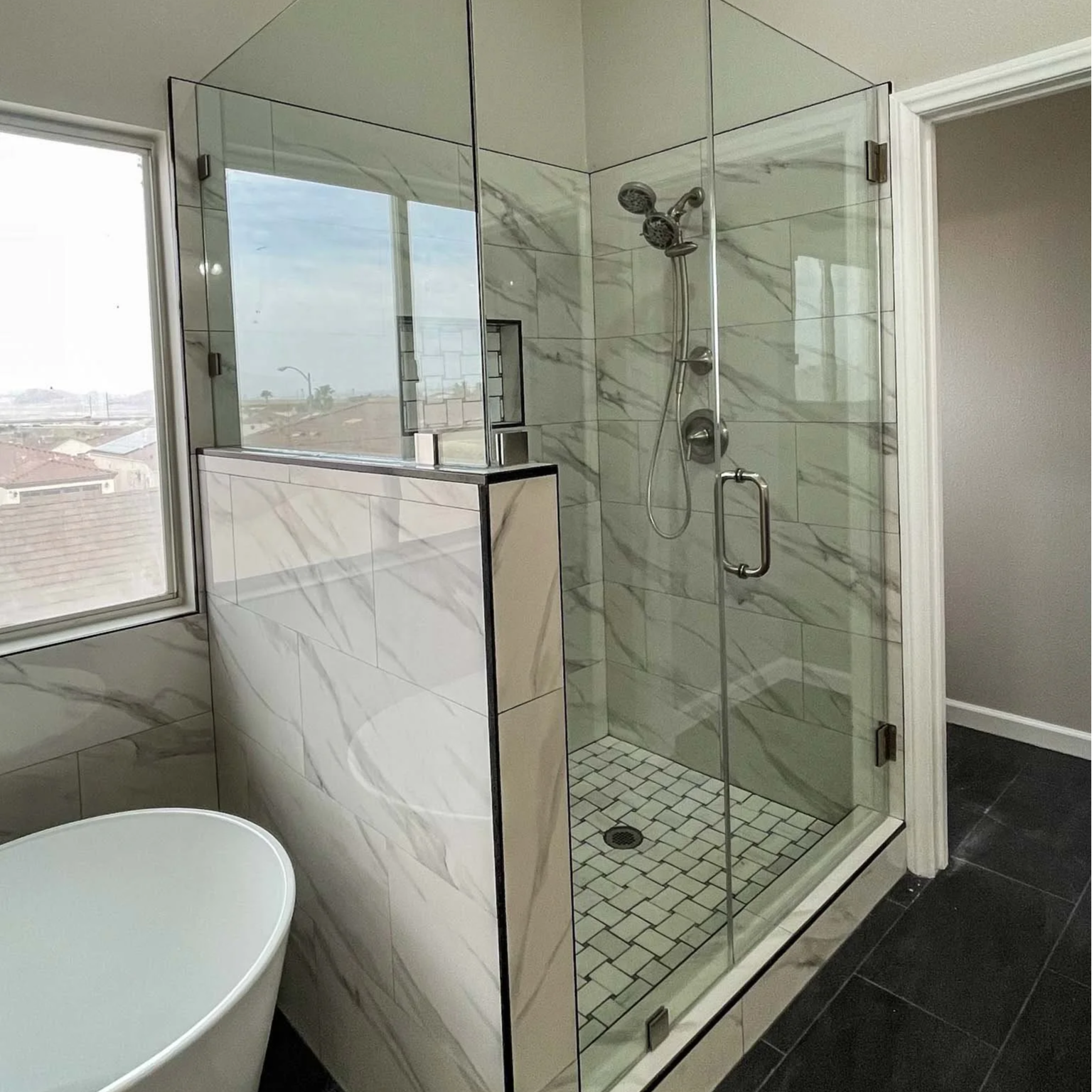
If you are tired of the cycle, the root cause is the track itself. Frameless shower doors don't use a bottom track — they hang from wall-mounted hinges or floor-mounted pivots, and the only hardware at the base is a small pivot cup or nothing at all. The floor of the shower stays fully accessible, drains freely, and has nowhere for debris to accumulate. Cleaning a frameless door takes a fraction of the time.
And it's worth having a glazier look at the current setup if the rollers are dragging or the caulk is failing. Sometimes the right call is a track replacement and reseal. Other times, the smarter investment is replacing the whole door with a frameless configuration that removes the problem instead of managing it.
Frequently Asked Questions
The track's horizontal geometry collects soap and mineral deposits with every shower. In hard water areas, minerals concentrate wherever water pools and evaporates — and the track is ground zero. Cleaning removes the surface layer, but the mineral base that remains re-coats within a few showers.
It's usually *Serratia marcescens*, an airborne bacteria that feeds on soap residue and body oils in warm, humid environments. It's not mold, but it looks similar. Chlorine bleach or hydrogen peroxide kills it, though it returns quickly if the underlying residue isn't managed.
Bleach handles biological growth like pink slime and mildew, but it doesn't dissolve mineral scale. For a thorough clean, descale first — white vinegar or citric acid — then follow with bleach to address any bacterial or mold growth. Avoid extended bleach soaks on aluminum tracks.
Many bottom tracks have small weep holes at each end to let water exit rather than pool. If yours doesn't — or if those holes are clogged with scale — water stays in the channel longer, accelerating mineral buildup and biological growth. Clear them out during monthly cleaning.
Sometimes. If the perimeter caulk is cracking or pulling away, water may be migrating behind the tile. Look for soft grout, discolored caulk lines, or any flexing in the tile near the track base. Those are worth investigating before they turn into a substrate repair.
Yes, directly. Frameless doors don't use a bottom track. Without a channel to collect debris and hold standing water, the maintenance situation changes completely.
When to Call a Pro
Persistent track grime isn't always just a cleaning issue. Dragging rollers, failing caulk at the perimeter, or loosening hardware anchors all point to something that needs hands-on attention. A glazier can assess whether the existing track system needs a repair and reseal — or whether a frameless conversion makes more sense for the long term.
Assess and advise on shower door repair or frameless upgrade — Luxe Residential and Commercial Glass handles shower door installation, track repair, and frameless enclosure upgrades throughout Las Vegas, Henderson, North Las Vegas, and the surrounding metro. Call (702) 825-7463 (License #0090853) to schedule.
