
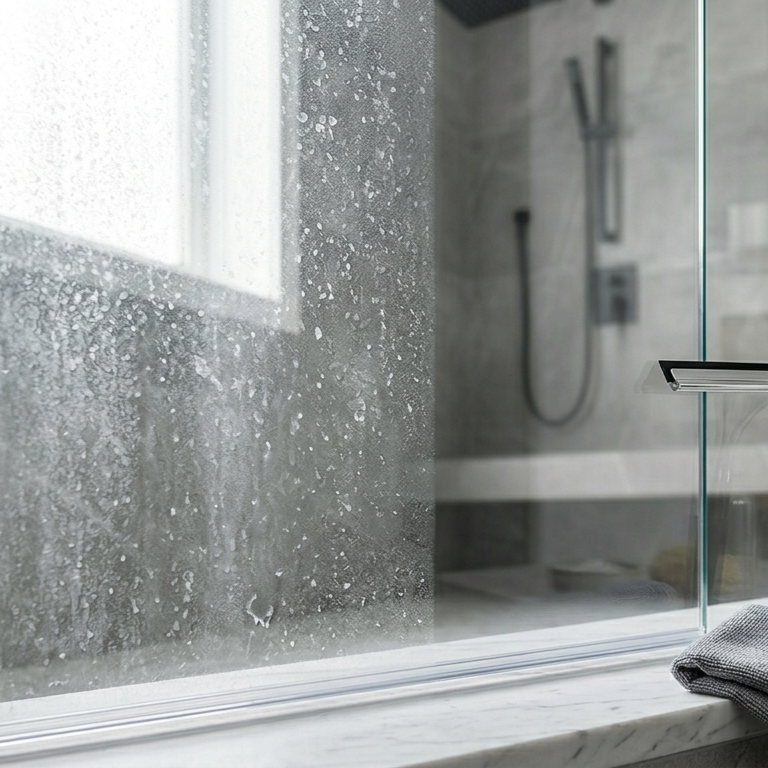
You step out of the shower, the light catches your door at an odd angle, and the glass looks like someone dragged a wet rag across it. You cleaned it three weeks ago. It didn't look this bad last month.
That haze is mineral residue — calcium carbonate and magnesium hydroxide deposited every time water evaporates off the glass. The more minerals dissolved in your water, the faster it builds. In areas with very hard water (180 ppm and above), a visible film can develop in two to three weeks without any preventive routine.
The good news is that most hard water haze is removable. The frustrating part is that the right approach changes depending on how long the buildup has been sitting there. Use the wrong method at the wrong stage and you'll either waste your time or damage the glass surface trying to fix it.
What's Actually Happening on the Glass
Hard water doesn't stain glass the way a spill stains fabric. It's a deposition process. Every time water sits on glass and then evaporates, the dissolved minerals don't leave with the water vapor — they stay behind and begin bonding to the silica surface.
The deposits are primarily calcium carbonate from dissolved limestone in the water supply, along with smaller amounts of magnesium hydroxide and trace silica compounds. Fresh deposits are held by weak ionic bonds and respond quickly to mild acids. Older buildup forms stronger covalent bonds with the silica matrix in the glass itself. That's when it stops being a cleaning problem and starts being a structural one.
There are three distinct stages, and each requires a different response:
| Stage | What It Looks Like | What's Happening | What Works |
|---|---|---|---|
| 1 — Fresh film | Light haze, wipes easily | Calcium carbonate film, surface-level | White vinegar or mild acid cleaner |
| 2 — Established crust | Thick white deposits, rough texture | Mineral compounds partially bonded to silica | Vinegar + baking soda, or 0000 steel wool |
| 3 — Etched glass | Permanently cloudy even when dry and clean | Glass surface physically altered | Cannot be reversed; requires replacement |
Run your fingernail across the cloudy area. Stage 1 feels smooth. Stage 2 has a gritty, crusty feel. If the glass looks cloudy even when completely dry and there's nothing rough to the touch — that's Stage 3 etching, and no cleaning product will help.
Soap Scum vs. Hard Water Deposits: Not the Same Problem
Before you start scrubbing, it matters which problem you are actually dealing with. Soap scum is a grey-white film that forms when fatty acids in bar soap react with calcium and magnesium ions in the water. Hard water deposits are white or chalky and feel rough or gritty.
They require different approaches. Soap scum responds to dish soap, warm water, or a dedicated scum-cutting spray. Hard water deposits need acid — vinegar, CLR, or a mineral-removal formula. Most shower glass has both, layered together. Address the soap scum first; it can mask the mineral crust underneath and make it harder to judge what you're actually dealing with.
Method 1: White Vinegar for Stage 1 Deposits
White vinegar runs at about pH 2.5 — acidic enough to dissolve calcium carbonate deposits without damaging glass or standard coatings. This is the right starting point when the buildup is relatively fresh (less than two to three months without cleaning).
Use undiluted white vinegar in a spray bottle. Spray the entire surface generously and let it sit for 15 to 20 minutes. Most people rinse too soon — contact time matters more than scrubbing pressure. For heavier spots, soak paper towels in vinegar, press them flat against the glass, and leave them in place for 30 minutes.
After soaking, wipe with a microfiber cloth using overlapping strokes. Rinse with clean water, squeegee from top to bottom, and dry with a second cloth. If the haze clears completely and the glass looks transparent again, you are done.
If it doesn't clear after two attempts with straight vinegar, move to Method 2.
Method 2: Vinegar and Baking Soda for Established Buildup
Stage 2 deposits need acid and mild abrasion working together. Baking soda alone doesn't dissolve minerals — it's the combination of an acid-softened deposit and the gentle abrasive action of the paste that breaks it free.
Spray the glass with undiluted vinegar and let it sit for 10 minutes. Mix three parts baking soda with one part water into a thick paste. Apply the paste over the vinegar-soaked surface with a damp sponge, scrubbing in small circular motions with light pressure. Spray with vinegar again over the paste — the fizzing reaction helps lift the softened mineral crust from below.
Let the fizzing slow, then rinse thoroughly, squeegee, and dry.
For recessed or textured glass panels, a wet electric toothbrush head reaches into surface detail better than a sponge does — and without scratching.
Method 3: 0000-Grade Steel Wool for Stubborn Stage 2
This is the one people don't believe until they try it. Steel wool sounds like it would scratch glass — and any grade coarser than 0000 absolutely will. But 0000-grade (also called super fine or four-zero) steel wool is finer than glass on the Mohs hardness scale (~5.5), and when used wet, it won't scratch the surface.
Wet the glass first. Work the steel wool in small circular strokes over the mineral crust, keeping the surface wet throughout. Rinse and inspect. Stubborn Stage 2 deposits that resisted vinegar will usually come away with this approach.
If the glass has an applied anti-fingerprint or hydrophobic coating, test on the lower hinge-side corner first. The coating layer is typically softer than the glass underneath it. A quick test there before working the full panel saves you from finding out the hard way.
The Point of No Return: Etching
Some homeowners come in after two hours of scrubbing, convinced they're doing something wrong. But when you look at the glass in proper side-lit light, you can see what's actually happened: the surface texture has changed. It's not a film sitting on top of the glass — the silica matrix has been chemically altered at the surface level.
This is etching. It happens when mineral deposits — particularly silicate compounds in hard water — are left in contact with glass long enough to disrupt the SiO2 surface structure. It typically develops after 12 to 18 months of neglect in very hard water conditions, though it can come faster on lower-quality glass or glass without any protective coating.
The glass isn't dirty. It's damaged.
But not every glass that looks etched actually is. Heavy Stage 2 buildup can produce the same appearance. That's why the fingernail test matters — if you feel roughness, there's still something to remove. If the surface is smooth and still looks cloudy when completely dry, you're looking at etching. A glazier can confirm it in a few minutes under proper lighting.
Do not use green or blue Scotch-Brite scrubbing pads on shower glass. These pads are coarser than glass and will create micro-scratches that scatter light the same way etching does. You'll create permanent cosmetic damage while trying to solve a different problem.
Protective Coatings and the Squeegee Habit
Once the glass is clean, keeping it that way comes down to two things: surface protection and water removal.
A hydrophobic coating — products like Rain-X or nano-ceramic shower glass sealants — reduces the surface energy of the glass so water beads and rolls off instead of sheeting across and evaporating in place. Apply to clean, completely dry glass with a folded microfiber cloth, let it haze, then buff off. Most coatings last three to six months under daily shower use before needing reapplication.
A daily squeegee habit handles the rest. Takes about 20 seconds after your shower. It removes most of the standing water that would otherwise evaporate and leave mineral residue behind. Combine a hydrophobic coating with consistent squeegee use and deep cleaning becomes a monthly task rather than a weekly one.
Frequently Asked Questions
With a squeegee habit and a hydrophobic coating, every four to six weeks is typically enough for most households. Without either, visible buildup can develop in two to three weeks. If you find yourself scrubbing heavily every couple of weeks, the glass likely has no protective coating — or the coating has worn off and needs reapplication.
Yes, for Stage 2 deposits. CLR and similar products have a lower pH than vinegar and often include chelating agents that bind to mineral ions more aggressively than acetic acid alone. Follow label directions carefully — most recommend leaving it on for no more than two minutes and rinsing immediately. On coated glass, test a small area first.
0000-grade steel wool is safe on standard tempered glass when used wet. Most frameless shower doors are standard 3/8-inch or 1/2-inch tempered glass, so yes. If the door has a factory-applied nano-coating or anti-fingerprint treatment, test the lower hinge-side corner first — the coating is typically softer than the glass and may respond differently.
Dry the glass completely and look at it at a low angle in natural light. Run your fingernail across the cloudy area. If you feel roughness — any gritty texture — there's still mineral buildup to remove. If the surface feels smooth but still looks cloudy, you're looking at etching. That distinction tells you whether you have a cleaning problem or a replacement problem.
Mild etching can sometimes be reduced with cerium oxide and a rotary buffer, but it's slow, labor-intensive work and the results depend entirely on how deep the damage runs. Shallow etching can improve noticeably. Deep etching rarely makes polishing cost-effective — replacement glass is usually cheaper than the labor to polish it out.
Right at installation, before the glass sees its first shower. A coating applied to clean, bare glass bonds more strongly than one applied to a surface that's already seen some mineral film. If you're having new shower doors installed, ask the glazier to apply a coating at the time of the job. Clean glass at installation is the easiest surface they'll ever work with — and it's the best head start you can give your new doors.
Schedule a shower door assessment or replacement — Luxe Residential and Commercial Glass handles frameless shower doors, glass enclosures, and custom shower door installation throughout Las Vegas, Henderson, North Las Vegas, and the surrounding metro. Call (702) 825-7463 (License #0090853) to schedule.
