
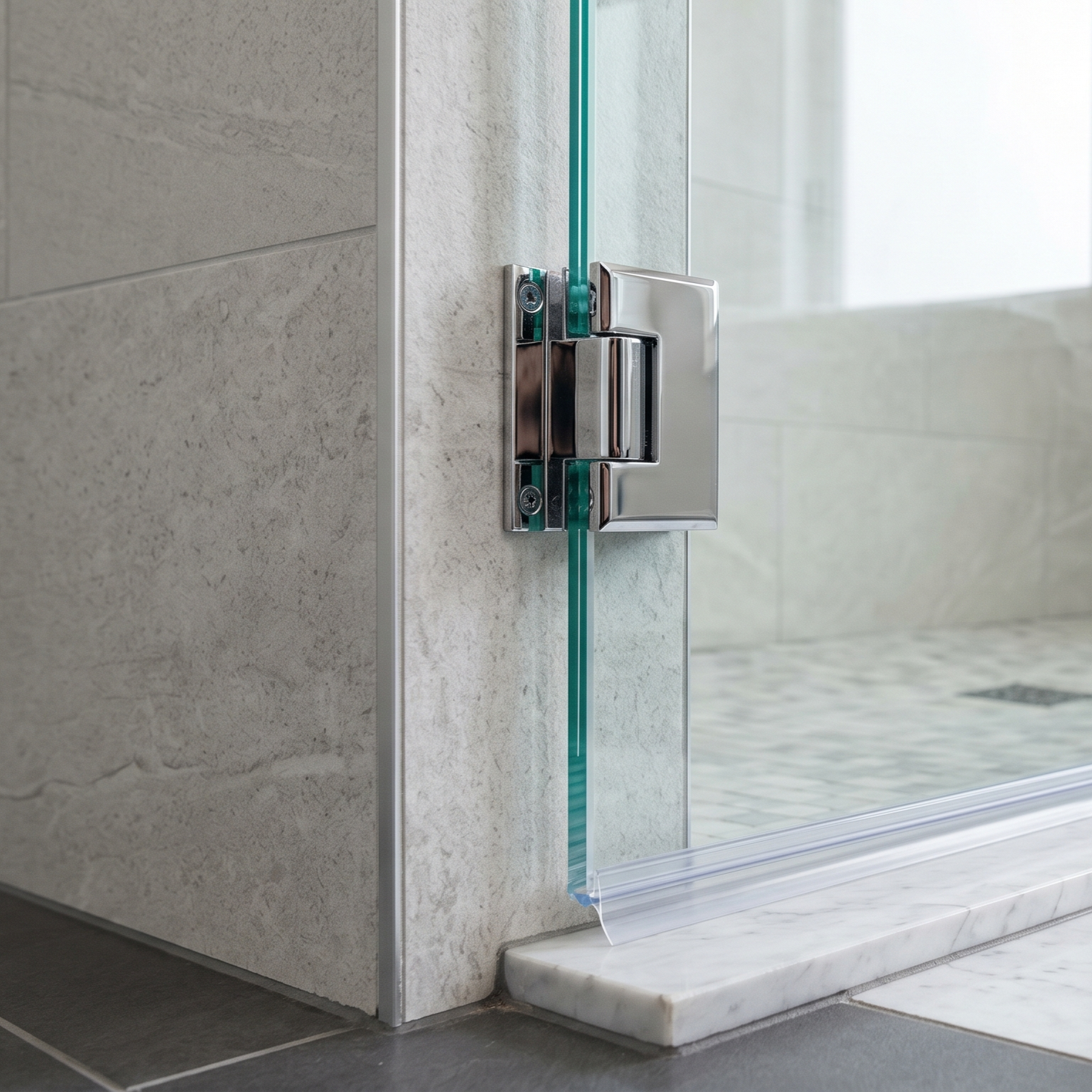
You have probably seen one somewhere — a hotel room, a renovation photo, a friend's remodeled master bath. A panel of clear glass hanging in a shower opening with no visible frame, no track at the bottom, and apparently nothing holding it to the wall except a few polished hardware pieces. The whole thing looks like it's floating.
The question most people have when they see one: what's actually keeping that attached, and how does water stay in the shower without a track to contain it?
But the engineering is simpler than it looks — and more robust than most people expect.
What Makes It "Trackless"
A traditional framed shower door is relatively lightweight — thin glass in a metal frame that slides along a bottom track, steadied by a top rail. The track does structural work: it carries the door's weight, keeps it aligned, and helps channel water back into the shower pan.
A trackless door works on a different principle. Instead of guiding a lightweight door along a channel, it uses heavy glass — typically 3/8-inch or 1/2-inch tempered panels weighing 50–100 pounds or more depending on size — and mounts that glass from purpose-built hardware anchored directly into the wall. The door's mass and the strength of its hardware together do what the track frame does in a conventional setup.
No channel at the floor. No rollers. No bottom obstruction to clean around. But the hardware has to be correctly sized and properly anchored to carry that weight safely.
The Hardware That Makes It Work
Hinges.
Most frameless shower doors use commercial-grade glass-to-wall hinges — heavy, polished or matte-finish fittings that clamp directly to the glass edge and bolt into the wall behind the tile. A standard residential frameless door gets two or three of these depending on door height and glass weight. They're not cabinet hinges — they're rated for 100–300+ pounds per pair and engineered specifically for 3/8" or 1/2" glass.
The hinges fasten to the glass through a clamping grip, then anchor into the wall with lag bolts into studs or steel anchors into concrete backer board. When a hinge mount fails, it's almost never the hinge itself — it's the anchor pulling out of inadequate backing. The wall has to be ready for what's going into it.
Pivot hardware.
Some trackless doors use a pivot system instead of side hinges. A pivot door has a top pivot point anchored into the ceiling or door header, and a bottom pivot cup set into the floor or shower pan. The door rotates around those two vertical axis points. This works well for extra-wide or extra-tall panels where multiple side hinges would look cluttered — and pivot doors can swing in both directions, which is useful for accessibility.
Getting the pivot alignment right matters. A small error in vertical alignment between the top and bottom pivot points creates a door that opens easily one way and drags the other.
Wall channels.
Many designs include a narrow U-channel on the hinge side — not a track in the sliding sense, but a slim aluminum guide filled with a rubber gasket or silicone that grips the glass edge gently. This holds no weight; it provides side stability and helps seal the gap between the glass edge and the wall. Typical width is 1/4 to 3/8 inch.
The Glass Itself
Trackless shower doors don't use ordinary float glass. The material is tempered safety glass — a panel heated to around 1,200°F and then rapidly cooled in a process that puts the surface layers in compression and the interior in tension. This makes the glass four to five times stronger than annealed glass under bending loads and changes its fracture behavior: when tempered glass breaks, it shatters into small, rounded pebbles rather than long, sharp shards. That's why it's required for shower enclosures.
Standard frameless doors use 3/8-inch (10mm) glass as a minimum. Many glaziers prefer 1/2-inch (12mm) for panels over about 24 inches wide — it's heavier, stiffer, less prone to the subtle flex you feel when you grab the handle, and it reads as more substantial in the space.
Some people ask about low-iron glass: a formulation with reduced iron oxide content that produces a clearer, less green-tinted panel. Standard glass has a slight green cast at the edges that becomes visible on large frameless panels, especially against white tile or bright fixtures. Low-iron glass runs roughly 20–30% more depending on thickness and size, but the visual difference on a full-height panel is real.
How Water Is Controlled Without a Track
The track on a conventional door acts as a physical barrier. Without it, three things do that work:
The door sweep.
A flexible vinyl or rubber strip runs along the bottom edge of the glass and contacts the floor when the door closes, forming a seal without needing a channel. Sweeps typically last three to five years before wear causes them to lose their seal. Replacement is straightforward — $15–40 depending on the design — and doesn't require removing the door.
Enclosure geometry.
Frameless enclosures are designed so the glass door overlaps the shower opening or returns to a fixed panel perpendicular to it. A four- to six-inch overlap on the hinge side, combined with a gasket or magnetic catch on the handle side, directs water away from the opening. Good geometry does most of the containment work before any sweep is even needed.
Shower pan slope.
Standard slope is 1/4 inch per foot toward the drain. A properly pitched pan keeps water moving toward the drain rather than sitting at the door threshold. When a frameless shower leaks at floor level, it's usually a worn sweep, an insufficient pan slope, or both.
What the Wall Has to Be
Because the door's full weight loads directly into the wall anchors, the wall construction matters.
Most residential shower walls are tiled over cement backer board — adequate for the tile, but hinge anchors for heavy frameless glass need to reach solid structure behind it: studs, concrete backer over studs, or a solid concrete wall. Bathrooms tiled over standard drywall (not uncommon in older construction) aren't adequate backing without modification.
Before installation, a glazier checks for stud position, knocks on the wall to assess what's behind the backer, and sometimes requests to see original construction details. This step isn't optional. An anchor into a hollow or weak backing is how hinge mounts pull out. That's not a minor problem — it's 80 pounds of glass, potentially dropping.
Maintaining a Trackless Door
Frameless doors are marketed as low-maintenance, which is mostly accurate compared to framed doors with tracks. But "lower" isn't zero.
The hinges develop water spotting and mineral deposits like any hardware in a hard-water environment. Wipe them down after use or clean weekly with diluted white vinegar and a soft cloth. Keep abrasive pads off polished finishes.
The door sweep wears down. Watch for water appearing at floor level outside the enclosure — that's the sweep telling you it needs replacing.
Silicone joints along the wall channel and hinge wall should be inspected annually. Cracked or separating silicone lets water migrate behind tile. Re-seal it before it becomes a substrate issue.
Apply a hydrophobic glass coating — Rain-X or a dedicated shower door product — every three to six months. It dramatically reduces water spotting and mineral buildup. A quick squeegee after each shower keeps the glass clear for months at a time.
Clearance and Swing Path
One thing people sometimes discover late: frameless hinged doors swing open. They need clear floor space — typically 24–30 inches in front of the threshold, depending on door width. In a tight bathroom, that can conflict with a toilet, a vanity, or another door's swing.
It's not unusual to see frameless installations where the homeowner didn't think through the swing path until the door was hung. It's fixable — a pivot stop, a different hinge configuration, or an outswing-only setup — but it's better to sort out during the quote stage than after installation. If space is genuinely limited, bring it up early.
Frequently Asked Questions
Usually, yes. "Trackless" emphasizes the absence of a bottom channel; "frameless" emphasizes the absence of a surrounding metal frame. Most frameless shower doors are also trackless, using only the glass, hinges, and a floor sweep to form the enclosure.
Most showers can accommodate one, but wall construction matters. The hinge side needs solid backing behind the tile — studs, concrete backer over studs, or a solid concrete wall. Hollow or weakly backed walls require blocking before installation.
Most use a magnetic catch, a tension-fit handle assembly, or a glass-to-glass magnetic latch when a fixed panel is present. The door's weight and the bottom sweep keep it from drifting open on its own.
A 24"×72" panel in 3/8" glass weighs roughly 50–60 pounds. In 1/2" glass, more like 65–80 pounds. Custom tall or wide panels can exceed 100 pounds. That's why backing matters.
The panel can lean or fall. This is rare with proper backing and correctly rated hardware, but it does happen with inadequate wall substrate or undersized hinges. The hardware should always be rated above the actual glass weight with a meaningful safety margin.
A true sliding door needs a top rail and usually a bottom guide, which reintroduces a channel. Top-hung sliding systems with a ceiling rail and a small floor guide pin exist, but they're less common in residential work. Most "trackless" designs are hinged or pivoting.
What to Ask Before You Install
Understanding how the hardware works makes you a better customer. Ask any installer about glass thickness options, hinge ratings relative to your glass weight, and what's behind your wall — specifically whether the wall substrate can take the anchor load. An installer who brushes past those questions is a signal to push harder.
Measure and quote a frameless shower door installation — Luxe Residential and Commercial Glass handles frameless and trackless shower door installations throughout Las Vegas, Henderson, North Las Vegas, and the surrounding metro. Call (702) 825-7463 (License #0090853) to schedule.
