
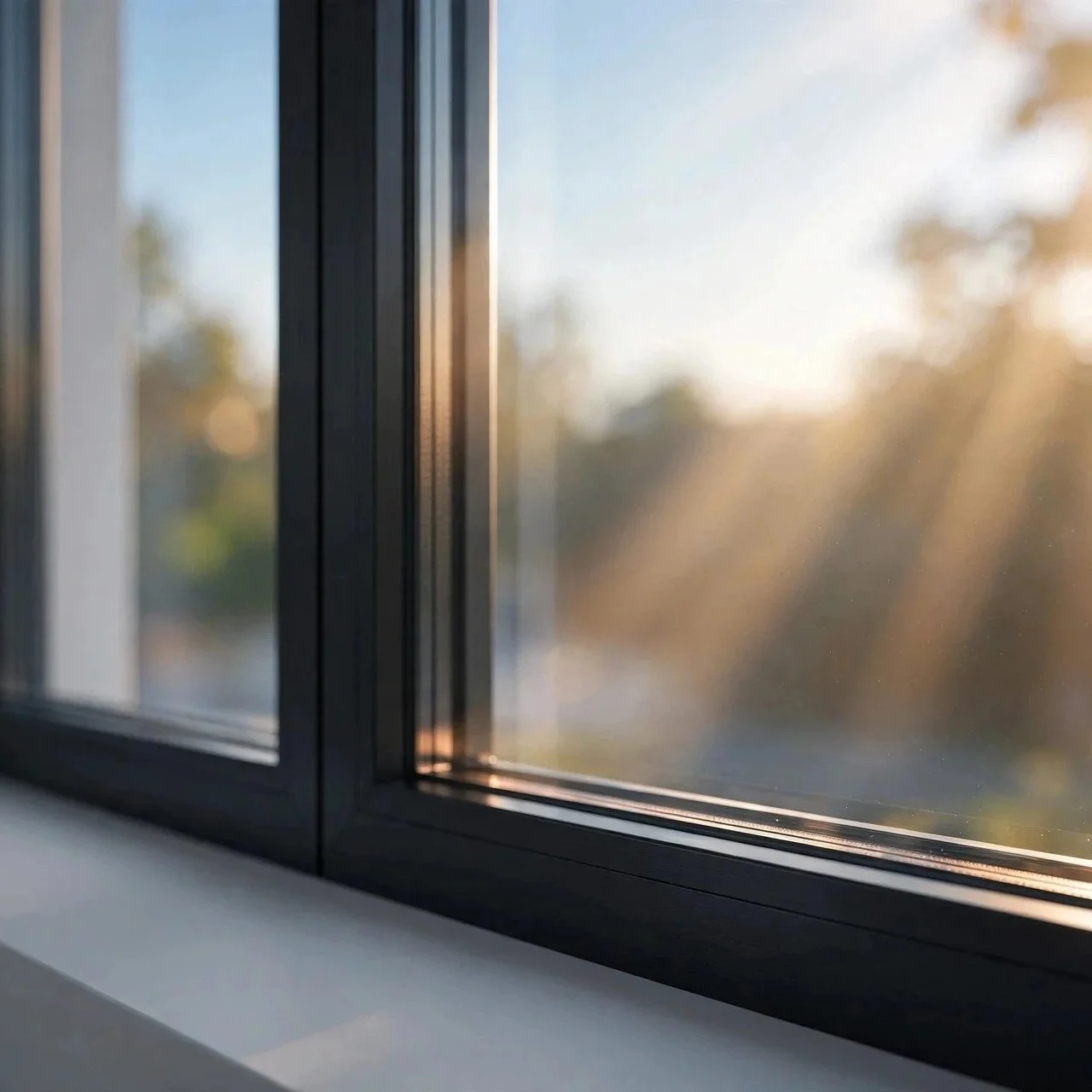
Quick Answer: Standard clear glass lets most of the sun's heat and ultraviolet energy pass straight through, so rooms warm up and finishes fade. Low-E (low-emissivity) glass has a microscopically thin metallic oxide coating that reflects radiant heat and blocks much of the UV while still passing visible light. In a hot climate, Low-E keeps interiors noticeably cooler and cuts the load on the air conditioner.
If a room feels like an oven by mid-afternoon while the thermostat shows the air conditioning is running fine, the windows are often the reason. Two panes can look nearly identical from across the room and behave completely differently once the sun hits them. One lets the heat pour in; the other turns most of it away. The difference is a coating you can barely see.
What Standard Clear Glass Actually Does to a Room
A pane of ordinary clear glass is close to a neutral doorway to let in sunlight. Visible light comes through, which is what you want, but so does the near-infrared energy that carries most of the sun's heat, along with a large share of ultraviolet. The glass itself does not filter much. What lands on the floor, the couch, and the far wall is close to the full solar payload striking the outside surface.
Two things follow from that. First, the room heats up. Every square foot of sun-facing clear glass acts like a small radiant panel during the day, dumping heat that the cooling system then has to chase. Second, the ultraviolet and visible light steadily bleach whatever they touch. Wood flooring lightens, upholstery fades, framed prints and rugs lose their color from the top down. On plain glass, none of that is being held back.
How Low-E Glass Changes the Equation
Low-E glass starts as the same clear pane, then adds a coating measured in nanometers, layers of metallic oxide too thin to see. That coating is tuned to a specific job: reflect long-wave and near-infrared energy, the radiant heat you feel, while letting visible light through so the view and the daylight stay intact.
Here is a useful way to picture it. Think of the coating like sunscreen for the window. Sunscreen lets you see and feel daylight on your skin but turns back the burning wavelengths you cannot see. Low-E works on the same principle in a room: light passes through, and the heat-carrying and fading wavelengths are mostly reflected. The glass stays clear to your eye because the part of sunlight your eye uses is exactly the part the coating is designed to keep.
Because the reflection happens at the coating rather than by darkening the glass, you are not trading away your view to get the benefit. That distinction matters, and it is where Low-E parts ways with older heat-control approaches.
The Specs That Describe the Difference
Glass performance comes down to a few ratings. You do not have to memorize them, but knowing what each one points at makes it far easier to compare options.
- SHGC (Solar Heat Gain Coefficient): the share of the sun's heat that makes it through the glass, on a scale from 0 to 1. Lower means more heat blocked. For sun-facing windows in a hot region, a low SHGC is the number that most directly keeps a room cool.
- U-factor: how well the glass resists heat flow, essentially its insulating value. Lower is better. This one governs how much heat leaks in or out through the assembly, regardless of direct sun.
- VT (Visible Transmittance): how much visible light comes through, again 0 to 1. Higher VT means a brighter, clearer room. The appeal of a good Low-E is that it holds VT high while pushing SHGC low.
One point worth knowing: Low-E is not a single product. The coatings are formulated for different climates. A high-solar-control, or "southern," Low-E is designed to reject as much heat as possible, which is the version that suits a hot, sunny exposure. A different formulation, aimed at cold northern climates, retains more solar warmth. Same category, different tuning, so the type matters as much as the label.
Low-E coatings are almost always applied inside an insulated unit, which means a double-pane construction with a sealed air gap and often an argon fill in that gap to further slow heat transfer. The coating handles radiant heat; the sealed gap and gas handle conduct heat. Together, they do more than either would alone.
Low-E vs Standard Glass at a Glance
| What matters | Standard clear glass | Low-E glass |
|---|---|---|
| Solar heat blocked | Little; most passes through | Much of the radiant heat is reflected away |
| UV blocked | Minimal | Large share blocked |
| Visible light | Full daylight | Nearly full daylight, the view stays clear |
| Look | Plain, no tint | Nearly clear to a faint tint, depending on the coating |
| Seasonal behavior | Heats rooms in summer, loses warmth in winter | Blocks summer heat, reflects indoor warmth in winter |
Cooler in Summer, and Still Working in Winter
It would be easy to file Low-E under summer-only, but the coating earns its keep year-round, which matters for glass that stays in the wall for decades. In the hot months, the story is obvious: less solar heat crosses the glass, the room stays closer to the thermostat setting, the air conditioner cycles less, and the space near the window stops feeling like a heat lamp.
The winter side is quieter but real. The same coating that reflects the sun's radiant heat outward in summer also reflects your heated indoor warmth inward when it is cold outside. Instead of that warmth radiating out through the glass and away, more of it stays in the room. So the panel that keeps summer heat out also helps keep winter heat in. In a hot climate where summer cooling dominates, the summer benefit is the headline, and any small reduction in free winter solar warmth is minor by comparison, but the two-way behavior is genuine either way.
What You Actually Feel and See
Beyond the thermostat, the day-to-day changes tend to be what people notice first.
- Comfort near the glass- Sitting by a sun-facing window on plain glass means feeling the radiant heat on your skin. Behind a heat-rejecting Low-E, that hot-spot effect drops sharply, so seating near windows becomes usable through the afternoon.
- Less glare- Cutting part of the incoming energy softens harsh midday glare on screens and surfaces without dimming the room into gloom.
- Slower fading- With much of the UV turned back at the glass, floors, fabrics, wood, and artwork hold their color far longer than they would behind clear glass.
- A steadier cooling bill- Less solar heat coming in means the air conditioning works against a smaller load during peak sun, which shows up as a cooling system that runs less hard.
The Tradeoffs, Stated Plainly
Low-E is not without compromise, and it is fair to name what it gives up.
The upfront outlay is higher than plain glass, since you are paying for the coating and usually an insulated double-pane unit around it. Some coatings carry a faint tint or a slight surface reflectivity, most visible at certain angles or against a bright sky, though many modern coatings are close to invisible from inside. And in a cold-dominated climate, you would forgo a little passive solar warmth in winter, though for a hot, sunny exposure that loss barely registers against the summer gain.
For most sun-exposed windows in a hot region, those tradeoffs land well on the side of Low-E. The heat and fading it holds back through the long cooling season tend to outweigh the modest costs.
Getting the Choice and the Install Right
Picking the right glass is only half of it; the insulated unit has to be measured, fabricated, and set correctly to seal and perform as rated. That is professional work, not a task to attempt on your own, both for the handling of large panes and for the sealed edges that keep an insulated unit from fogging later. Matching the Low-E type to each window's exposure and confirming the assembly and gas fill is where an experienced glass company earns its place.
Frequently Asked Questions
The active layer is a microscopically thin coating of silver, sometimes two or three separate silver layers, sealed inside the insulated glass unit, and that silver is what reflects infrared heat while still passing visible light. Silver happens to be highly reflective to the long-wave energy you feel as heat, yet nearly transparent to the wavelengths your eyes use. Stacking two or three silver layers rejects more heat without dimming the room much further. The layers are so thin they add no visible color of their own, which is why the pane still reads as ordinary clear glass.
A high-solar-control Low-E typically has an SHGC of 0.25 or lower, versus roughly 0.7 or higher for plain double-pane, so it lets through barely a third of the solar heat the plain unit would. That gap matters most on east- and west-facing glass, which takes low, direct sun in the early morning and late afternoon when the rays come in almost level and a high overhang gives no shade. South glass sits higher in the sky and is easier to shade, so the low-SHGC coating earns its keep first on those side exposures. Picking the glass by exposure rather than buying one spec for the whole house is where the rating pays off.
The coating sits on a protected inner surface of the sealed unit, commonly the position glaziers call surface 2, so it cannot be wiped, scratched, or cleaned off, and it stays nearly clear. Because it lives on an interior face rather than an exposed one, it also does not weather or haze the way an applied film can. Any faint cast it does carry shows up mainly at a glancing angle against a bright sky, not head-on from inside. That protected placement is why most people stop noticing it once the window is in.
A hot-climate coating is tuned for solar control, while a colder-climate home would instead specify a high-solar-gain northern Low-E that deliberately lets more winter sun in. So the coating is matched to whichever season dominates rather than being one-size-fits-all. The same unit still reflects your heated indoor warmth back inward once it is cold out, so even the solar-control version is not simply working against you in winter. The choice is really which trade you want the glass optimized for, not whether Low-E helps at all.
Low-E blocks a large share of UV, but not all of it, so it sharply slows fading without stopping it. Visible light and heat drive some fading on their own, which no clear glass fully removes. For a room full of art, textiles, or a valued rug, pairing the Low-E with a laminated pane or an added UV film blocks even more of the damaging band. That layered approach is the move when the contents matter more than they do in an average living room.
Because Low-E works through a clear coating rather than darkening the glass, it does not cut nighttime visibility or indoor brightness the way a heavy tint does. A dark tint keeps the room dim after sunset, when there is no solar heat left to block, making looking out at night harder. Low-E gives up neither, since it targets the invisible heat band and leaves the visible light largely alone. That is why it is chosen when you want to keep both the view and the heat control.
Book a free consultation to match the right Low-E glass to your sun-facing windows — cooler rooms and less fading without giving up the view. Luxe Residential and Commercial Glass serves the Las Vegas Valley. Call (702) 825-7463.
