
What Type of Glass Is Used for Wine Cellars?
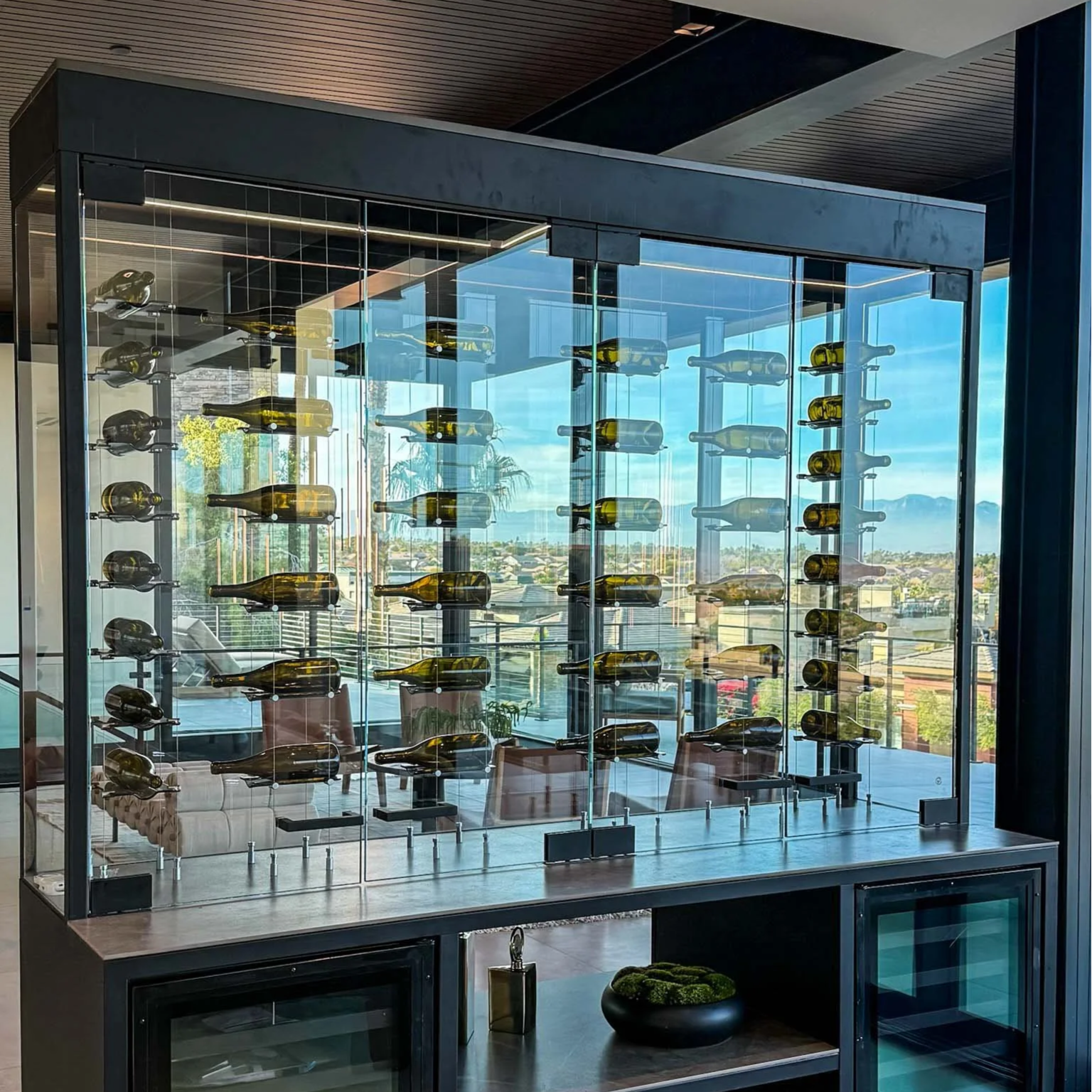
Pull the wrong bottle off a shelf that's been sitting in sunlight and you'll know something's off before you even pour it. The aroma is flat. The color has shifted. In serious cases the wine smells of wet cardboard, onion, or something faintly burnt. Winemakers call it "lightstruck" — and it's irreversible.
Light isn't kind to wine. Neither is heat. And if you're building or designing a glass wine cellar, the glass you choose is the primary thing standing between your collection and both of those threats. This isn't a decision to make based on what looks good in a showroom photo.
Why Glass Type Matters for Wine
Wine chemistry is sensitive to two things above most others: temperature and ultraviolet radiation. UV triggers photochemical reactions that degrade polyphenols — the compounds responsible for structure, tannin, and color — and destroy the volatile aromatics that give a wine its character. Exposure to UV also accelerates oxidation. The result is a bottle that ages badly, loses its color, and develops off-flavors long before it should.
Standard clear float glass blocks almost no UV. It's essentially transparent to the 300–380 nanometer range, which is precisely the wavelength band that causes these reactions. A cellar framed in standard glass looks striking and does almost nothing to protect what's inside it.
And glass technology has specific solutions for this. But they're not all the same, and the right choice depends on your cellar's actual conditions.
The Four Main Glass Types Used in Wine Cellars
Tempered glass
Tempered glass is the baseline for any wine cellar application — not because of its UV properties (standard tempered glass provides none beyond regular glass) but because of its safety profile. Tempered glass is four to five times stronger than annealed glass and shatters into small, blunt pebbles rather than sharp shards if it breaks. For walls, doors, and panels that people will walk past, lean against, or accidentally knock into, tempered is the structural starting point. It's not a wine protection solution by itself, but other treatments are built on top of it.
Low-E glass (low-emissivity glass)
Low-E glass has a microscopically thin metallic coating — typically silver or tin oxide — applied to one surface during manufacturing. This coating reflects infrared radiation back toward its source and filters a significant portion of UV. Depending on the coating type and glass thickness, Low-E glass reduces UV transmission by 40–70%. It also provides meaningful thermal insulation by reducing heat transfer through the panel. For a cellar where ambient temperature varies, Low-E cuts the load on your cooling equipment while simultaneously providing UV filtering. It's a two-for-one that makes sense for most temperature-controlled installations.
Laminated glass
Laminated glass consists of two glass layers bonded together with an interlayer — typically polyvinyl butyral (PVB) or ethylene-vinyl acetate (EVA) film. The interlayer is where the real wine protection happens: properly specified PVB interlayers block 99% or more of UV radiation. If you're building a display cellar in a space with any natural light exposure, laminated glass with a UV-blocking interlayer is the most direct solution to the UV problem. Laminated glass also has a structural safety advantage beyond tempered: if it breaks, fragments stay bonded to the interlayer rather than scattering. For floor-to-ceiling panels in a residential setting, that matters.
Insulated glazing units (IGUs)
Insulated glazing units — also called double-pane or double-glazed — consist of two glass panels separated by a sealed air or inert gas-filled gap. The gap, typically 1/2 to 3/4 inch and filled with argon or krypton, provides thermal insulation that a single panel can't match. For a temperature-controlled cellar where the interior stays at 55°F and exterior ambient hits 105°F in summer, that insulation directly determines how hard your cooling system works and how stable interior temperature stays. IGUs are frequently combined with Low-E coatings on one or both panels to stack the thermal and UV benefits in a single unit.
Matching Glass to Your Cellar's Conditions
The right specification depends on how your cellar is actually situated.
Direct sun exposure — any south- or west-facing panel that gets unfiltered sunlight — demands UV-blocking glass. Laminated glass with a UV-filtering PVB interlayer or a High Solar Heat Gain Control Low-E coating is the appropriate response. Standard tempered alone won't do it.
Actively cooled cellars maintained at a fixed temperature need insulated glazing to reduce thermal infiltration. In a climate where temperatures swing 40–65°F across the day and across seasons, a single-pane glass wall will let significant heat in during summer. Your cooling equipment compensates, but it works harder and temperature swings increase. Double-pane with Low-E is the standard specification for this application.
Interior display cellars with no direct sun but ambient indoor light can often manage with tempered Low-E glass — less UV protection than laminated, but adequate for indirect light exposure. If the space uses halogen or incandescent fixtures near the glass, those also emit UV; switching to LED removes that variable entirely.
Commercial and hospitality installations — restaurant wine rooms, hotel displays — typically specify laminated tempered IGUs as a complete package: laminated construction for safety, double-pane for insulation, and Low-E coating for UV and thermal performance. It's the premium specification, and it addresses all three concerns at once.
Glass Thickness
Standard cellar panels run 3/8-inch (10mm) for tempered and 1/2-inch (12mm) for heavier doors or large fixed panels. Laminated units are specified by each layer — a common specification is 6mm + 1.52mm PVB + 6mm, which totals roughly 13.5mm including the interlayer. IGUs add the gap: a typical double-pane unit might be 1/4-inch outer + 1/2-inch argon gap + 1/4-inch inner, or heavier variations depending on the thermal performance target.
Thicker glass provides more rigidity in large unsupported panels, but the meaningful performance difference comes from the coatings and construction type. An extra millimeter of glass doesn't change the UV or thermal story; the coating and interlayer do.
The Case for Low-Iron Glass
Standard float glass contains iron oxide as a manufacturing byproduct, giving it a slight green tint that's visible at the edges. On a single shower panel, it's barely noticeable. On a wine cellar with multiple floor-to-ceiling panels and interior lighting designed to display the collection, that green cast affects how the space reads — and how the labels and bottles actually look under warm light.
Low-iron glass (also called ultra-clear or Starphire) removes most of that iron oxide, producing a panel that's nearly colorless. When the same cellar design is compared side by side in standard and low-iron glass, and the difference under warm interior lighting is real — the bottles read truer, the labels are sharper, and the overall space feels cleaner. It costs roughly 20–30% more in the same specification. For a cellar designed to impress, it's worth putting in the budget.
Desert Conditions and UV Intensity
UV intensity at desert latitudes is roughly 30% higher than at northern latitudes during summer, and it runs hot for more months of the year. Standard Low-E coatings specified for moderate-climate markets may not provide adequate UV and heat protection for a southwest-facing cellar panel here.
Any cellar facing south, west, or receiving light through a rooftop or skylight should be specified for High Solar Heat Gain Control — not just thermal insulation. Ask specifically about the Solar Heat Gain Coefficient (SHGC) and UV transmission percentage of any unit proposed. A glazier who works in this climate regularly should bring those numbers up without prompting.
Frequently Asked Questions
Standard tempered glass provides almost no UV protection. It's the right structural foundation, but not a complete solution for wine preservation. Any cellar with natural light exposure needs Low-E coating or a UV-blocking laminated interlayer on top of the tempered base.
Laminated glass with a UV-filtering PVB interlayer blocks 99%+ of UV — the most direct solution for sun exposure. Pair it with a Low-E coating and double-pane construction if the cellar is also temperature-controlled.
Yes. A single pane of tempered glass has an R-value of roughly 0.9. A double-pane IGU with Low-E coating reaches R-3 to R-6 depending on gas fill and coating type. In a desert summer with 105°F ambient temperatures, that difference reduces cooling load and temperature fluctuation inside the cellar meaningfully.
Lightstruck wine has been damaged by UV radiation. UV triggers photochemical reactions that degrade polyphenols, destroy aromatics, and produce sulfur compounds — resulting in flat aromas and off-flavors often described as wet cardboard, onion, or rubber. It's irreversible, which is why UV protection in any display cellar matters.
Not structurally necessary, but worthwhile if display aesthetics matter. Low-iron glass eliminates the green tint of standard glass and reads as nearly colorless, which improves how the cellar looks under warm interior lighting. It's an aesthetic upgrade, not a wine protection requirement on its own.
Yes, with the right glass specification. An exterior wall in a desert climate means high UV exposure and significant thermal load in summer. IGUs with Low-E coating and UV-filtering laminated interlayers are the appropriate specification for exterior-facing cellar glass in this environment.
Getting the Specification Right
Wine cellar glass isn't one-size-fits-all. The right combination depends on sun exposure, ambient temperature swing, active cooling, and how the space is meant to function. A glazier who regularly works with wine cellar installations should be able to give you a specification matched to your actual conditions — not just whatever glass is most available.
Consult on wine cellar glass specification and installation — Luxe Residential and Commercial Glass handles custom wine cellar glass installations throughout Las Vegas, Henderson, North Las Vegas, and the surrounding metro. Call (702) 825-7463 (License #0090853) to schedule.
