What Is Low-Iron Glass and Is It Worth the Extra Cost?
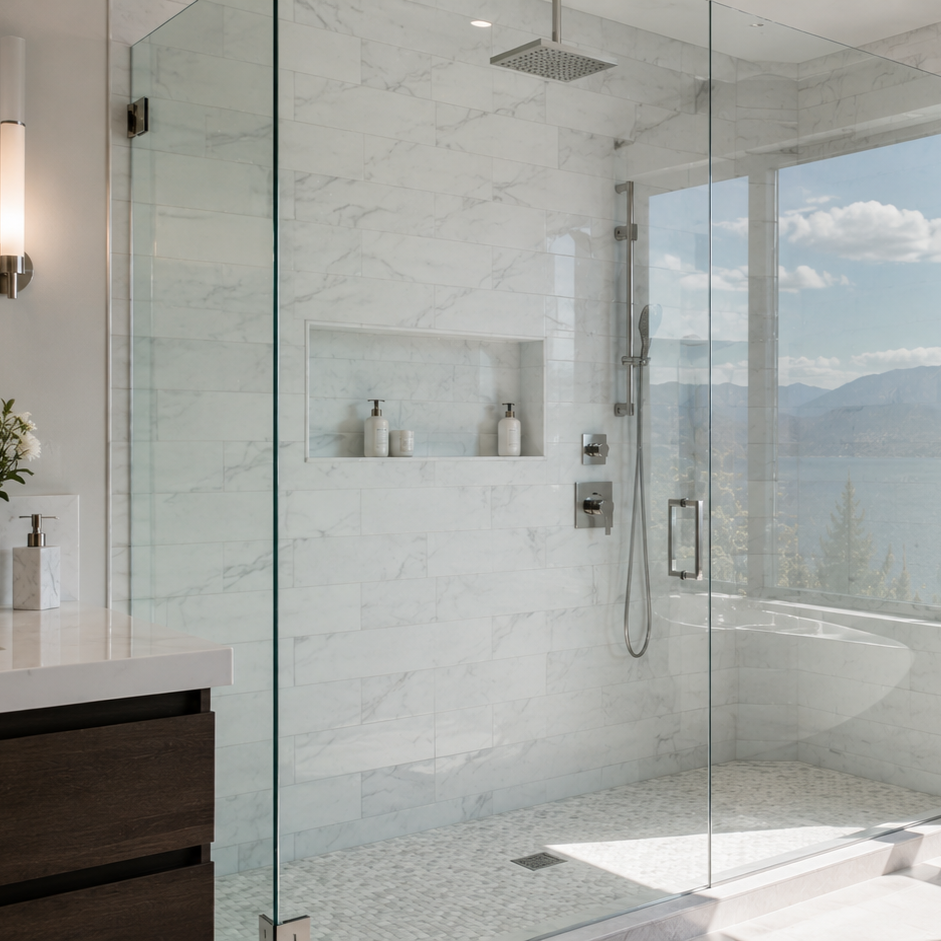
You are standing in the tile showroom, holding up a sample of bright white subway tile, and everything looks right. Then the shower doors go in. Two weeks later you're staring at a bathroom that reads faintly green. The tile is the same. The grout is the same. The glass is what changed.
That's how most people learn about low-iron glass — after they've already skipped it.
What Low-Iron Glass Actually Is
Standard float glass isn't as clear as it appears in your hand. The silica sand used to make it carries trace amounts of iron oxide — roughly 0.1% of the total composition. That sounds like almost nothing, but iron oxide absorbs certain wavelengths of light differently than others, producing a faint green cast through the glass.
You see it most clearly at the edges. Hold a standard glass panel edge-on against a white wall. The edge looks distinctly green — sometimes quite dark on thicker panels. That same iron content runs through every millimeter of the panel, but it's harder to notice when you're looking straight through a thin piece.
Low-iron glass starts with higher-purity silica sand, refined to reduce iron content to roughly 0.01% — about one-tenth of what standard glass contains. The result is a panel that transmits around 91% of visible light, compared to 83–86% for standard clear glass. The color shift that iron oxide produces drops to near zero.
It goes by a few trade names: ultra-clear glass, extra-clear glass, Starphire (PPG's branded version), and Optiwhite (Pilkington). They all refer to the same principle — lower iron content, higher transparency, no green cast.
Why the Green Tint Gets Worse With Thickness
The iron content in the glass itself doesn't change, but how much of it the light travels through does. Glass thickness means a longer light path through more iron-containing material.
A 1/4" panel shows mild tinting at the edges. A 3/8" or 1/2" panel — which is standard for frameless shower doors and glass railings — has significantly more iron in the light path. I've seen homeowners pick a 1/2" frameless shower door from a small sample card under fluorescent light. Installed full-size against white marble tile, the green is obvious — and they come back genuinely confused about why the bathroom reads "off." The tint was invisible in a 3-inch sample. It's unmistakable in a full-height panel.
But that's not the whole story.
Angle matters too. Frameless shower enclosures often include a fixed side panel or two alongside the swinging door. Looking into the shower from outside means your sight line passes through more than one panel. Each panel adds its own iron content to the light path, and the green stacks. Through three panes of standard 3/8" glass in a corner shower, you can see the color shift plainly.
The Edge Test
Here's something you can do with any piece of glass in your home right now. Hold it edge-on against a white sheet of paper.
Standard glass shows green. Low-iron glass doesn't.
More precisely: a green or teal-colored edge confirms standard clear glass. A near-colorless or very faintly silver edge is low-iron. Some low-iron panels have a slight blue tint at the edge, but it reads neutral rather than green. That's it — the test takes about 10 seconds and never lies.
What Low-Iron Glass Costs — and Why
The premium is real and consistent: low-iron glass runs 20–40% more than standard clear glass of the same thickness. Two things drive the cost.
First, raw materials. High-purity silica with iron oxide below 0.01% is less abundant and more expensive to source than standard construction-grade sand. Second, manufacturing controls. Keeping iron that low requires tighter process management, more rigorous incoming material testing, and closer monitoring of the melt.
At the project level, the cost difference is often smaller than people expect. For a standard frameless shower door, upgrading to low-iron glass might add $100–$300 to the total job depending on size and glass thickness. A larger installation — a full glass enclosure, a multi-panel wine cellar, or a back-painted backsplash — can run $400–$600 more.
Whether that premium pays for itself depends almost entirely on what sits behind the glass.
When the Upgrade Is Worth It
The pattern is straightforward: the lighter and more neutral the background, the more the upgrade matters. White subway tile, white marble, Calacatta stone, light gray concrete, cream tile — these surfaces all make the green tint visible. Dark slate, dark wood, charcoal tile — the tint mostly disappears.
| Application | Standard Glass | Low-Iron Glass | Worth the Upgrade? |
|---|---|---|---|
| Frameless shower door, white or neutral tile | Green tint visible | True clear appearance | Yes |
| Frameless shower door, dark stone | Tint mostly hidden | Marginal gain | Optional |
| Back-painted glass backsplash | Tint shifts color perception | Accurate color rendering | Strongly yes |
| Wine cellar glass | Casts tint on bottle labels | Neutral, clean view | Yes |
| Glass railings | Tint visible at edge | Cleaner, crisper look | Often yes |
| Residential windows | Barely noticeable | Minor improvement | Rarely necessary |
| Office partitions, dark background | Low visibility | Small difference | Usually no |
Back-Painted Backsplash Glass: The Case Is Closed
If you are ordering a back-painted glass backsplash, low-iron glass isn't a preference — it's the right material for the job. Standard glass acts as a subtle green filter over whatever color is applied behind it. A crisp, custom white becomes an off-white with a hint of mint. A warm gray shifts toward sage.
I've had customers arrive with a paint chip from their designer expecting a perfect color match, only to find the standard glass threw the color off enough that the proof required a redo. Low-iron glass is the only way to get predictable color accuracy in a back-painted installation. The cost of getting the color wrong — reprinting, remeasuring, reinstalling — costs more than the glass upgrade ever would have.
Glass Railings and Wine Cellars
Glass railings often span wide openings — a pool deck edge, a staircase balustrade, a second-floor overlook. Large panels in bright, open settings make the edge tint more apparent, especially from the side. In railings, you're frequently looking at the edge of the glass, not just through it. Low-iron glass gives railing installations a cleaner, sharper look and makes the hardware and metal finish the focal point rather than a greenish frame.
For wine cellar glass, the stakes are aesthetic but real. A wine cellar display is usually the most intentional design choice in the room — careful lighting, bottle arrangement, custom millwork. Standard glass puts a green filter between all that and the viewer. Low-iron glass lets the cellar read the way it was designed to.
When You Can Skip It
Standard glass works fine for most residential window replacements, utility-area glazing, and commercial applications where the backdrop is dark or visually busy. If you're replacing a cracked window in a back bedroom or glazing a commercial partition against a charcoal wall, the tint won't register.
The cases where the upgrade clearly doesn't pay off: standard window glass, most interior partitions against non-white walls, and any installation where the glass sits more than a foot from a reflective or light-toned surface.
But when the whole point of the glass is to disappear and let the surface behind it be seen clearly — that's where standard glass often works against you.
Frequently Asked Questions
It refers to the iron oxide content in the glass batch. Standard float glass contains roughly 0.1% iron oxide, which creates a green tint that gets stronger with thickness. Low-iron glass reduces that to around 0.01% — one-tenth as much — producing a near-colorless, higher-transparency panel. The iron is still there. It's just present in amounts too small to shift the color noticeably.
Hold the glass edge-on against white paper. Standard glass edges look green — the shade varies with thickness, but it's unmistakable. Low-iron glass edges look near-colorless or faintly silver. If you can't access the edge directly, a glazier can confirm it in about 30 seconds.
Typically 20–40% more per square foot than standard clear glass of the same thickness. On a full shower enclosure, that premium usually translates to $150–$400 more on the total job. For a custom glass backsplash or wine cellar, the difference is similar. Whether that premium is worth it depends on whether your installation has a light or neutral background.
No. The iron reduction affects optical clarity only, not mechanical properties. Low-iron glass is tempered to the same specifications as standard glass — roughly four times the strength of annealed glass, shattering into small blunt fragments under the same safety standards.
If your tile or surround is white, light gray, marble, or any other light-toned material — yes, and ask for it in writing. The upgrade is commonly available but has to be specified explicitly. A good glazier will show you samples of both types side by side before you commit. Look at the edges, hold them against the tile you've chosen, and trust what you see. That five-minute comparison closes the question faster than any description.
Schedule a glass consultation — Luxe Residential and Commercial Glass handles custom installations including frameless shower doors, glass backsplashes, wine cellars, glass railings, and windows throughout Las Vegas, Henderson, North Las Vegas, and the surrounding metro. Call (702) 825-7463 (License #0090853) to schedule.
