
Window or Glass Door Shattered? Your Safe First-Response Checklist
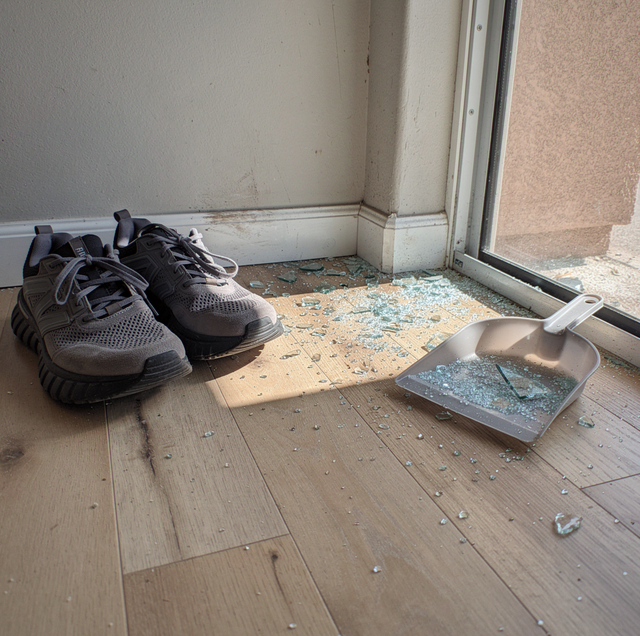
Quick Answer: If a window or glass door shatters, clear people and pets from the room, put on solid-soled shoes before you go back near the glass, and don't touch or pull at anything still standing in the frame. Once the area is contained, call a professional to finish the removal and check the frame for damage a quick look would miss.
When a window or glass door shatters, the priority isn't the hole in the frame: it's where the glass went. Fragments can travel several feet across a hard floor, land on a counter or a nearby chair, or settle somewhere no one thinks to check until later, and people or pets nearby matter more in that first moment than the broken pane itself. What you do in the first few minutes decides how safe the cleanup is and how ready the space is when a professional arrives to finish the job.
What Happens in the First Few Seconds After Glass Breaks
Broken glass doesn't behave one way. A large jagged shard can drop straight down and stay mostly in one place. A field of small fragments can skid several feet across a hard floor, especially if the pane failed near shoe height and pieces picked up momentum on the way down. A pet running through the area, or someone walking in from another room, can carry fragments further than they look like they should travel.
The immediate goal is containment, not cleanup. Keep people and pets out of the room until you have a clear view of where the glass landed, including under furniture, inside floor vents, and along baseboards, where small pieces settle and stay hidden until someone finds them the hard way.
Why Tempered and Laminated Glass Break Differently
Most residential windows, shower doors, and glass entry doors use tempered glass, laminated glass, or standard annealed glass, and each fails in its own pattern.
Tempered glass is heat-treated so that, when it breaks, it fractures into small, relatively blunt fragments rather than long shards. That's a genuine safety feature, and it's also why a shattered shower door or a tempered window pane leaves a floor covered in what looks like a spill of glass pebbles. Those pebbles still cut, and they scatter into places a single broom pass won't reach.
Laminated glass, common in some entry doors, storefronts, and select window assemblies, has a plastic interlayer bonded between two glass sheets. When struck hard enough to break, it typically cracks in a spiderweb pattern but remains held together by the interlayer rather than falling apart. A cracked laminated pane can appear stable yet be structurally compromised, which is why it requires the same distance and caution as a pane that's already come apart.
Standard annealed glass, found in some older windows and interior panels, breaks into large, sharp-edged shards, lacking tempered glass's built-in fragmentation. This is the pattern most likely to produce a serious cut from a single piece.
The Safe First Response to Broken Glass
Once people and pets are clear of the area, a short list of steps keeps the situation from getting worse before help arrives.
Clear the room first. Move people, pets, and anything you don't want damaged well back from the broken glass, and keep that distance until the area has been fully checked in daylight or good lighting.
Put on shoes with solid soles before going near the glass again, even to check on something. Bare feet and thin socks are how small fragments turn into injuries hours later, often once everyone has stopped thinking about the glass at all.
Look before you step. Small tempered fragments reflect light differently depending on the angle, so a slow visual check from a few positions catches pieces a quick glance misses.
Do not attempt to remove large shards still held in a window or door frame by hand, even wearing gloves. A cracked but still-standing pane can shift or drop without warning while you're working near it. If a frame still holds broken or cracked glass, keep people and pets clear of the area and leave full removal to a professional with the right tools and protective equipment.
If the opening faces the outside and you can tape or cover it from a safe distance, without reaching across or touching sharp edges, doing so keeps weather, pests, and curious pets out until a professional arrives. If reaching the opening means leaning over or near broken glass, skip this step and wait instead.
What Not to Do Near Broken Glass
A few instincts that feel helpful in the moment actually raise the risk of a cut or a second break.
Don't vacuum a large volume of glass with a standard household vacuum right away. Larger fragments can damage the machine and, on some models, get flung back out; a standard vacuum works fine only for the fine grit left once the bigger pieces are gone.
Don't reach into a frame to pull out a shard that's still wedged in place. It can be under more tension than it looks, and a shard that lets go suddenly is a common way people get cut during cleanup.
Don't let kids or pets help with cleanup, even to hold a dustpan or a trash bag. Small hands and paws move faster than anyone can watch, and a pebble-sized fragment is easy to miss until it isn't.
Clearing Small Fragments Without Getting Cut
For the fine debris that's actually safe to handle yourself, a broom and dustpan, followed by a slow pass with a flashlight held at a low angle, catches most of what's left. Light raked across a floor at a shallow angle makes small glass pebbles glint in a way overhead light doesn't.
A damp paper towel, pressed rather than wiped, lifts the smallest grit a broom leaves behind, especially in grout lines and along baseboards. After a visual check and a damp-towel pass, it's still worth keeping bare feet and pets out of the area for a day or two, since a missed fragment can work its way out of a rug or carpet fiber later.
When a Covered Opening Is Safe to Leave for a Professional
An exposed window or door opening left overnight invites weather and pests, so a temporary cover is a reasonable step, but only when it can be done without any contact with sharp glass. Painter's tape or plastic sheeting applied to a clean, glass-free edge of the frame, working from the outer perimeter inward, is a low-risk way to close the gap.
If cracked glass is still standing in the frame, or reaching the opening means stepping over or near loose fragments, the safer move is to block off the room and wait. A frame with jagged edges still in place needs someone with cut-resistant gloves, proper tools, and experience removing a full pane cleanly.
What Happens During a Professional Glass Repair Visit
An emergency glass repair visit generally starts with a full check of the frame, not just the visible break. A technician confirms the frame is sound, measures for a replacement pane that matches the original glass type and thickness, and removes any remaining fragments from the frame track and surrounding trim before anything new goes in.
For a shattered shower door, storefront panel, or office partition, the sequence looks similar: full removal of the damaged pane, a check for impact damage in the surrounding hardware or framing, and installation of a replacement built to match the original glass. Emergency response typically includes securing the opening to keep the space protected between the initial call and the final glass installation.
Warning Signs a Window or Door Is About to Fail
Sometimes glass doesn't shatter without warning. A pane that's already cracked but hasn't come apart, a shower door with a small chip or impact nick along an edge, or a window with a chip near the frame is a sign the glass could go from cracked to broken with very little added force.
Treat a standing crack the same way as glass that's already fallen: keep the area clear, don't lean or push against the cracked section, and get it assessed rather than waiting to see if it holds. A pane under stress can hold for weeks or fail the next time a door slams nearby, with no reliable way to tell which happens first.
Frequently Asked Questions
In a dual-pane window, two lites of glass are manufactured and sealed together as one unit with an air gap between them. If the outer lite cracks, the seal that holds that airspace is often compromised as well, even when the inner lite looks untouched, and fogging or moisture inside the unit can follow within days. Because the two lites are sealed as a single assembly, a cracked outer lite almost always means replacing the whole insulated unit rather than swapping just the damaged pane. Treat it like any other broken glass in the meantime: keep the area clear and don't press on the cracked lite to check the inner one.
Check paws and pads gently for any tiny cuts, since fragments can embed without an animal immediately favoring the foot. It's also worth shaking out and checking pet bedding, rugs, and blankets from the room, since a stray fragment can hide in fabric for days and turn up as a cut during a normal nap or play session.
Yes. A pane that breaks with no thrown object, no slam, and no visible strike can mean the frame is warped, settled, or holding the glass unevenly, putting it under constant stress until it finally gives way. It can also point to a rare defect within the glass itself, which is one reason a full-frame inspection after a spontaneous break matters, even when a single replacement pane looks like the obvious fix.
That depends mainly on how quickly a matching replacement pane can be sourced. Standard clear glass in a common size is often the quickest to replace; a custom shower door, a tinted or patterned pane, or a large storefront panel usually takes longer because the replacement must be cut and finished to match the original. A securely covered opening is meant to hold for that entire waiting period, not just overnight.
Loose broken glass can injure whoever handles the trash or recycling next, so it should never go into a bin unwrapped and never into recycling at all. For the small fragments you've swept up yourself, wrap them securely in several layers of newspaper or heavy paper, seal them in a sturdy box or a clearly labeled bag, and mark the outside so anyone handling it knows what's inside before they pick it up.
A chip is localized surface damage, a small divot where material is missing but the surrounding glass is still intact. A crack is different because it's already a break in the glass structure, and in annealed or laminated glass, once it reaches an edge, that edge can no longer carry the stress as it's designed to. A chip at the edge is sometimes cosmetic; a crack that reaches the edge in annealed or laminated glass generally means the whole pane needs to be replaced.
Call for emergency glass repair — get a broken window or glass door safely removed and replaced before it becomes a bigger risk. Luxe Residential and Commercial Glass serves the Las Vegas Valley. Call (702) 825-7463.
