
Foggy Windows? Signs Your Window Seal Has Failed in a Desert Climate
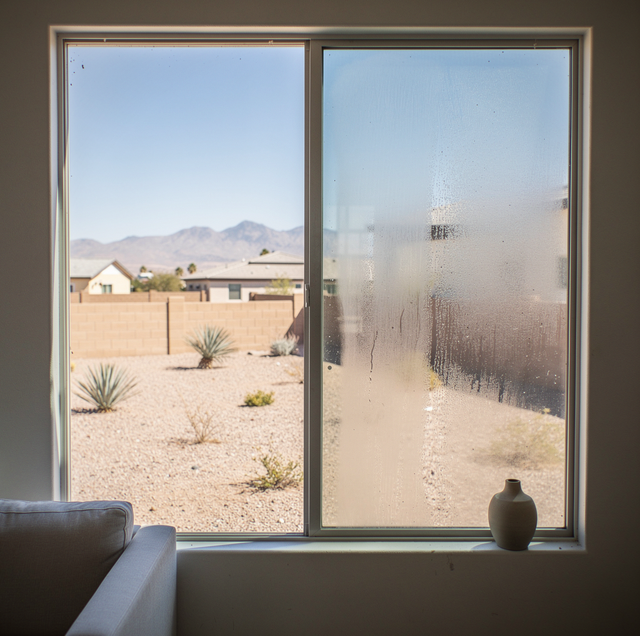
Quick Answer: A film or haze sitting between the panes, condensation that won't wipe away, and a wavy or distorted view are the main signs a dual-pane window seal has failed. Intense heat and daily thermal swings work on the perimeter seal continuously, not just in summer, and once it lets go, the affected pane is replaced as a sealed unit rather than patched.
You notice it on a window you walk past every day: a soft gray film sitting somewhere inside the glass, not on either surface you can reach with a rag. Some mornings it looks like dust trapped under a picture frame. Other times it's a puddle-shaped smudge that never quite clears, even on a bright afternoon when the rest of the pane looks spotless. That's not a cleaning problem. It's a sign that the sealed gap built into the window has stopped working.
Dual-pane windows work because two sheets of glass are sealed together with a dry, still layer of air or gas trapped between them. That seal is a manufactured part with a finite working life, and heat is one of the hardest conditions it has to withstand. Knowing what the early signs look like, and which ones mean the glass itself has to be swapped, saves you from guessing at a cleaning fix for a problem soap and water were never going to touch.
How a Window Seal Is Supposed to Work
A dual-pane, or insulated, window is built from two panes held a fixed distance apart by a spacer bar, with the gap between them sealed shut and filled with dry air or an inert gas. That gap is what gives the window its insulating value: still, sealed gas resists heat transfer across it nearly as well as a much thicker wall of solid material would.
None of that works without the seal staying intact. The bonded perimeter around the spacer is the only thing standing between that dry gap and the humid, dusty air outside. As long as the seal holds, the gap stays clear and the gas fill stays put. The moment it cracks or pulls loose, outside air starts working its way in, and the clock starts on visible fogging.
Why Heat and Thermal Swings Wear a Seal Down
Glass and the metal or composite spacer inside it expand and contract at different rates as temperatures rise and fall. On a day that swings from a cool morning into triple-digit afternoon sun and back again, that expansion and contraction happens on repeat, and the sealant bonding the pane to the spacer flexes to absorb the difference every single time.
A sealant built to flex occasionally holds up fine. One asked to flex through that kind of daily swing, day after day, year after year, is working under a much harder load than the same window would face in a milder climate. Direct sun exposure raises the surface temperature of the glass itself well above the surrounding air, so a west-facing pane can run through a wider daily range than the thermometer on the patio ever shows. Over enough cycles, the bond between sealant, spacer, and glass fatigues, and eventually a hairline gap opens somewhere along the perimeter.
This is a year-round mechanism, not a single-season one. Winter nights that dip well below the daytime high add their own stretch of contraction, and a window doesn't get a break from thermal cycling just because the calendar changes. Heat sets the pace, but the constant swing between hot and cool is what actually tires the seal out.
The Early Signs a Seal Has Failed
A haze or film that sits between the panes: This is the clearest sign of all. It looks like a light gray or milky smudge, sometimes patchy, sometimes covering a whole corner, and it does not respond to cleaning either glass surface because it isn't on either surface. It's condensation and mineral residue sitting on the inside faces of glass that no cloth can reach.
Condensation that won't clear once the day warms up: Morning dew on the outside face of an efficient window is normal and clears within an hour or two as the air warms. Moisture trapped between the panes behaves differently: it can linger for days, come and go with humidity and temperature swings, and never fully disappear the way outside condensation does.
A wavy or distorted view through the glass: As the gas fill diffuses out of a failing unit, the pressure difference between the sealed gap and the outside air can pull the panes slightly inward or let them bow, distorting straight lines you'd otherwise see through the glass, like a fence line or a doorframe on the other side. It's subtle at first and easiest to catch by looking at the glass at a low angle rather than straight on.
A rattling or looser-feeling sash: Less common, but worth noting: as sealant along the spacer degrades, the unit can shift slightly within the frame, and you may notice a faint rattle in wind or when the window is opened and closed.
A visible white or crusty residue at the corners: Sometimes the first hint isn't fog in the middle of the pane but a chalky buildup right at the edge, where the spacer and seal sit. That residue is often a mineral deposit left behind as moisture has seeped in and evaporated repeatedly at that spot.
Any one of these on its own is worth a look. Two or more together, especially fog between the panes paired with a wavy view, means the seal has already let go.
What's Fixable and What Isn't
A little confusion is normal here because not every foggy-looking window means the same thing. Dust or a light film sitting on the outer surfaces of the glass wipes away with normal cleaning. If a cloth and glass cleaner make the haze disappear, the seal is fine, and the issue was surface grime.
Condensation on the outside face on a cool morning is also not a failure. It usually means the window is doing its job well: an efficient pane keeps interior heat from radiating outward, so the outer glass stays cooler and collects dew, as a car windshield does overnight. That clears with the day and isn't a reason to worry.
What isn't fixable is the sealed gap itself once moisture has actually gotten inside it. The desiccant built into the spacer, a drying agent meant to absorb any trace moisture from manufacturing, can only absorb so much before it saturates. After that point, water vapor keeps condensing inside the gap on cool mornings and evenings no matter how the outside weather behaves. Drilling a small vent hole to "let a foggy window breathe" is sometimes floated as a shortcut, but it does the opposite of fixing anything: it opens the seal further, lets in more humidity and dust, and permanently ends whatever gas fill and insulating value the unit still had.
Because the two panes, spacer, and seal are bonded into a single component, a failed seal calls for a new sealed unit, not a patch. In most cases, the frame and sash stay exactly where they are; a professional measures the failed glass and fits a matching sealed replacement into the existing opening, so the surrounding trim and hardware aren't disturbed.
Why This Failure Shows Up Faster Under Intense Sun and Heat
Every dual-pane window everywhere eventually reaches the end of its seal life. What changes with climate is how quickly that clock runs out. Strong, near-constant solar load pushes glass surface temperatures noticeably above ambient air temperature for much of the year, which means the sealant is working through wider daily swings and spending more hours at its hottest point than it would in a location with softer sun and milder afternoons.
South- and west-facing windows tend to fog up first for exactly this reason: they receive the most direct heat throughout the day. A north-facing window in the same house, shaded by an overhang or a neighboring structure, can hold on for years longer simply because it never gets pushed through the same range of temperature. If you're comparing two windows of the same age and noticing one has already fogged while the other looks fine, exposure and shading are usually the difference, not a defect in one unit versus the other.
None of this means every window is destined to fail early. Quality of the original seal, how well the unit was installed, and whether water has a path to pool against the bottom edge all play a part too. But in a place where the sun is intense for most of the year and the swing between day and night temperatures is wide, seals are simply asked to do more work than they would in a milder place, and that added work eventually shows up as fog.
Living With a Failed Seal Longer Than You Should
A fogged unit is not an emergency the way a cracked pane is, so it's easy to let it sit for a season or two while other projects take priority. The trade-off is mostly comfort and cost of ownership rather than safety: a failed seal loses much of its insulating value once the gas fill diffuses out, so the affected room works harder to maintain a comfortable temperature, and the view through that pane remains permanently hazy, no amount of cleaning will remove.
The good news is that a fogged IGU rarely means the entire window frame or sash has to be removed. In most installations, only the glass itself needs replacing, which keeps the job smaller than the fog might suggest. Catching it early, before the haze spreads across the whole pane or a corner starts showing mineral crust, usually means an easier measurement and a cleaner fit for the new unit.
Frequently Asked Questions
No. Once moisture has actually worked its way into the sealed gap, the desiccant inside the spacer is already saturated, and the gas fill has started to diffuse out. There's no way to re-dry or re-seal that gap from outside without removing and rebuilding the unit, which is effectively the same job as replacing it. Kits or drilling methods sold as fixes only vent the unit further rather than restoring the seal.
Usually not. The seal, spacer, and two panes form a single sealed component that fits within the existing frame and sash. A professional typically removes just that failed glass unit and fits a new one into the same opening, leaving the surrounding frame, trim, and hardware in place unless a separate problem, like rot or warping, is found during the inspection.
It varies. Some windows show a faint haze in one corner for months before it spreads across more of the pane, while others go from clear to noticeably foggy within a matter of weeks, especially on panes that get heavy, direct sun for most of the day. There's no reliable timeline, so a window that shows even a small patch of persistent fog is worth having checked rather than waiting to see how far it spreads.
No, and it's worth telling the two apart. Condensation on the room-facing surface, the one you can wipe with a towel, usually points to high humidity inside the home relative to how cold the glass surface is, and it clears with better ventilation or a dehumidifier. Fog trapped between the two panes, on interior surfaces no towel can reach, is a sign of a failed seal and doesn't respond to changes in household humidity.
Not usually. Sun exposure varies widely from one side of a house to another, so windows that face the strongest, most direct sun for most of the day often show signs of a failed seal years before a shaded window of the same age and original installation. Two windows installed on the same day can be years apart in how long their seals actually hold up.
Both, though the insulating loss matters more over time. Once the gas fill escapes and moisture takes its place, the unit's ability to slow heat transfer drops back toward that of a much older, single-pane-style window even though it still looks like a modern dual-pane unit from across the room. The haze is the visible cue, but the higher cost shows up as a harder-working HVAC system and a less comfortable room near that window.
Get a foggy window seal inspected and replaced — restore a clear view and the insulation a working seal is supposed to provide. Luxe Residential and Commercial Glass serves the Las Vegas Valley. Call (702) 825-7463.
