
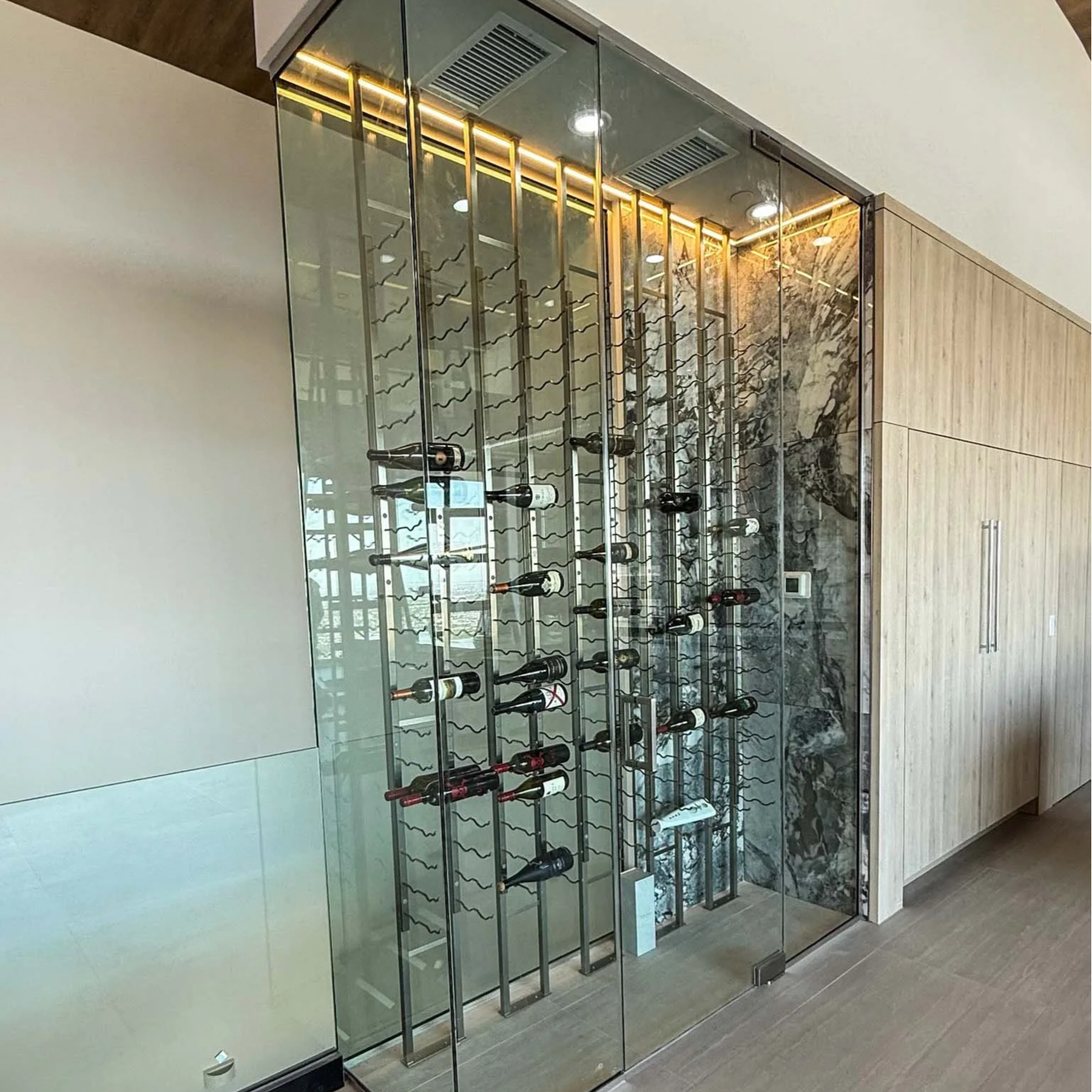
You pull a bottle of Chardonnay from the display side of your new glass cellar after six weeks. The wine smells flat and wrong — like wet cardboard with a faint sulfur edge. Nothing spilled. The temperature held steady. The wine is fine on paper, but something has already happened to it.
What happened is lightstrike. And the glass cellar you paid for is probably the reason.
Why UV Light Is Different From Heat and Vibration
Most wine storage advice focuses on temperature and humidity. Those are real concerns, but they are slow problems — the kind that develop over months if a cellar runs warm or dry. UV damage is faster. Under direct sun exposure through unprotected glass, lightstrike can develop in a matter of hours.
The mechanism is photochemical, not thermal. When UV light in the 370–400 nanometer range hits wine, it triggers a reaction between riboflavin (vitamin B2, present naturally in most wines) and sulfur-containing amino acids. The byproducts are dimethyl disulfide and related mercaptans — compounds that produce that wet cardboard, cooked cabbage, or sulfurous smell. The wine hasn't spoiled in the traditional sense. The chemistry has been permanently altered.
That wavelength range — 370–400 nm — sits in the near-UV zone, also called UVA. It's invisible to the human eye and passes through most common glass without resistance. This is why you can't see the risk. Bright afternoon sunlight looks identical coming through standard float glass as it does through UV-protected glass.
How Standard Glass Fails Here
Standard float glass transmits roughly 70–75% of UV light below 380 nm. The majority of the harmful wavelength range passes straight through. If your glass cellar sits in a room with natural light — even indirect northern exposure — and the glass isn't specifically rated for UV blocking, your wine is being exposed.
The failure is invisible. The glass doesn't look different. There's no discoloration or fogging. The UV just passes through and does its work quietly.
And the risk varies by bottle. Dark Burgundy-style bottles (the nearly opaque "dead leaf" green) absorb around 50–60% of near-UV before it reaches the wine. Green glass provides moderate protection. Clear glass provides almost none. A clear-bottled Chardonnay displayed against the glass wall of a south-facing cellar in a room with afternoon light is the highest-risk scenario you can build.
On installations where the homeowner chose standard tempered glass to save money. The whites went flat within two months. The reds held up for about a year before the owner noticed the color was shifting on the paler bottles. By then, the cellar was fully installed and the options were film or a full reglazing.
How UV-Resistant Glass Actually Works
UV-resistant wine cellar glass achieves its protection through one of three methods — or a combination.
Metallic oxide coating.
A thin metallic oxide layer is applied to one surface of the glass during manufacturing, similar to Low-E glass. This coating absorbs near-UV wavelengths before they can pass through into the storage space. Quality UV cellar glass using this method typically blocks 98–99% of UV below 380 nm while maintaining 70–80% visible light transmission. The glass looks clear. The UV protection is invisible.
UV-absorbing laminate interlayer.
Laminated glass bonds two glass lites around a polyvinyl butyral (PVB) or ethylene-vinyl butyral (EVB) interlayer. UV-absorbing compounds are incorporated directly into this interlayer. The result is a glass that blocks UV through the full thickness of the assembly, not just at one surface. This is common in higher-end wine cellar installations because the interlayer also provides safety glass properties — if the panel breaks, it holds together rather than shattering.
Modified iron oxide content.
Standard float glass gets its slight green tint from iron oxide. Specialty formulations increase the UV-absorbing iron compounds in the base glass itself. Less common in wine cellar applications, but it shows up in some architectural glass products and is worth recognizing on spec sheets.
The critical distinction: UV transmittance (UVT) and visible light transmittance (VLT) measure different things. A dark-tinted glass can still pass significant UV. A clear, nearly colorless glass can block nearly all UV if properly coated. Buying by appearance is how most specification mistakes happen.
| Glass Type | Typical UVT Below 380 nm | VLT | Wine Cellar Suitability |
|---|---|---|---|
| Standard float glass | 70–75% | 87–90% | Not suitable |
| Low-E glass (thermal spec only) | 30–50% | 70–80% | Marginal — confirm the UV spec |
| UV-rated cellar glass (coated) | 1–5% | 65–80% | Good for display and mid-term aging |
| Laminated glass with UV interlayer | <1% | 60–75% | Best for long-term aging |
| Tinted glass (no UV coating) | 15–40% | 30–60% | Inconsistent — not reliable |
VLT vs. UVT: Why You Need Both Numbers
When a glass supplier hands you a spec sheet, look for two separate figures: VLT and UVT. VLT indicates how much visible light passes through — relevant to aesthetics and interior lighting. UVT tells you how much UV passes through — relevant for wine protection. You want VLT reasonably high so you can see your bottles, and UVT as low as possible.
For serious wine aging, aim for a UVT below 5% at 380 nm. For display collections with bottles you plan to drink in the next one to five years, a UVT below 15% is generally acceptable.
But here's what most spec conversations skip: the UV spec covers the panel, not the whole enclosure. Gaps at the frame, unsealed edges, or a glass door panel using different glass than the walls can undermine the protection you paid for. UV doesn't need much of an opening. A quarter-inch gap at a corner is enough to expose the bottles stored closest to that edge — and those are usually the showpiece bottles facing outward.
Does UV-Resistant Coating Degrade?
This is a fair question, and it rarely comes up before the sale.
Metallic oxide coatings are stable under normal conditions. They don't wear down from cleaning or sunlight exposure the way a surface topcoat might. But they are vulnerable at the edges. If the glass perimeter is unprotected and moisture infiltrates the frame, delamination can start at the edge and work inward. It's a slow process — typically visible as a faint haziness or discoloration along the frame after 10–15 years in high-humidity environments.
Laminated interlayers are similarly durable. PVB interlayers are rated to last 20–30 years under normal conditions. Edge yellowing can develop if water infiltrates the lamination bond, which is why edge sealing and proper frame coverage matter as much as the glass specification itself.
The glass is not the weak link. The weak link is installation quality — frame coverage, edge sealing, and keeping moisture away from the perimeter of each panel.
How to Verify Your Cellar Glass Has UV Protection
You don't have to take anyone's word for it.
The simplest homeowner test: get a 365 nm UV flashlight (around $10–$15 at any hardware store) and hold it against the glass in a dim room. Look for fluorescence on the far side. Standard glass lets the UV beam pass through — objects on the other side will glow or fluoresce. UV-protective glass stops the beam. Nothing on the far side reacts.
A second check: look at the corner of each glass panel for a manufacturer's etched or printed spec stamp. Legitimate UV-rated glass typically carries markings that reference the UV specification — terms like "UV99," "SolarGard UV," a UVT figure, or similar. No stamp doesn't automatically mean no protection, but it's a reason to request the original spec documentation.
If you're specifying new glass, ask for the manufacturer's published UVT at 380 nm in writing before the job starts. That number should appear on the product data sheet, not just the installer's verbal assurance.
What About Bottle Placement?
This is almost never discussed when homeowners plan their cellars, but it matters.
Bottle color interacts directly with the UV protection your cellar glass provides. If your glass is rated at 5% UVT — meaning it transmits 5% of near-UV — that 5% still reaches clear-bottled wines fully. A dark Burgundy bottle sitting against the same glass wall absorbs another 50–60% of what gets through. The residual UV reaching the wine inside is dramatically different between those two bottles.
The practical implication: if your glass cellar has even moderate UV exposure — a window nearby, some indirect natural light — put clear-bottled whites and sparkling wines in the least-exposed positions. The back of the cellar, away from glass walls. Reserve the display positions closest to the glass for your darker-bottled reds if you insist on the aesthetic of visible wine.
Retrofitting Existing Glass
If your current cellar has standard glass with no UV protection, full glass replacement isn't your only option.
High-quality UV-blocking window film achieves 99% UV blocking and applies directly to the existing glass surface. It doesn't improve thermal performance, but it stops the photochemical damage. Film is rated to last 10–15 years before the adhesive begins to fail, and it's a fraction of the cost of reglazing the enclosure.
The catch is installation quality. Film needs to go edge-to-edge with no gaps at the frame. Any exposed glass edge — even a small gap at the corner — admits UV in exactly the zones where bottles tend to sit closest to the glass. A careful professional installation with proper edge coverage is worth the extra labor cost versus a fast self-install with partial coverage.
Frequently Asked Questions
No. Most glass sold for wine cellar enclosures is specified primarily for thermal performance and aesthetics. UV protection is a separate specification that needs to be called out explicitly. If your installer doesn't mention UVT on the spec sheet, ask directly — it's not safe to assume UV protection is included because the glass is marketed as "wine cellar glass."
Standard double-pane IGUs improve thermal performance significantly but don't address UV on their own. Some double-pane units with Low-E coatings reduce UV — typically blocking 40–60% — but that's not the same as purpose-rated UV glass that blocks 98–99%. For casual display storage it may be acceptable; for a collection you're aging for 10 or more years, it's not enough.
It depends on the specific Low-E coating. Most residential Low-E glass reduces UV transmittance to somewhere in the 30–55% range — meaningfully better than uncoated glass, but still passing significant amounts of the wavelengths that cause lightstrike. A few high-performance Low-E products achieve 90%+ UV blocking. The spec sheet is the only reliable answer; "Low-E" alone doesn't tell you enough.
Most residential LED fixtures emit very little UV — typically well under 1% of their output falls in the UV range. It's not zero, but it's not the primary concern. The real risk is natural light coming through the glass walls, not interior fixtures. An hour of direct sunlight through unprotected glass does more UV damage than interior LEDs running all day.
Use a 365 nm UV flashlight in a dim room. Hold it against the glass and check whether objects on the far side fluoresce. If they do, the glass is passing UV. Also check each panel's corner for a manufacturer's spec stamp with UV ratings. If neither test gives you a clear answer, a glazier can pull the glass spec in about 30 seconds from the original installation paperwork — or from the manufacturer's marking if it's still legible.
Schedule a wine cellar glass consultation — Luxe Residential and Commercial Glass installs custom wine cellar glass with UV-rated, thermally insulated panels throughout Las Vegas, Henderson, North Las Vegas, and the surrounding metro. Call (702) 825-7463 (License #0090853) to schedule.
