
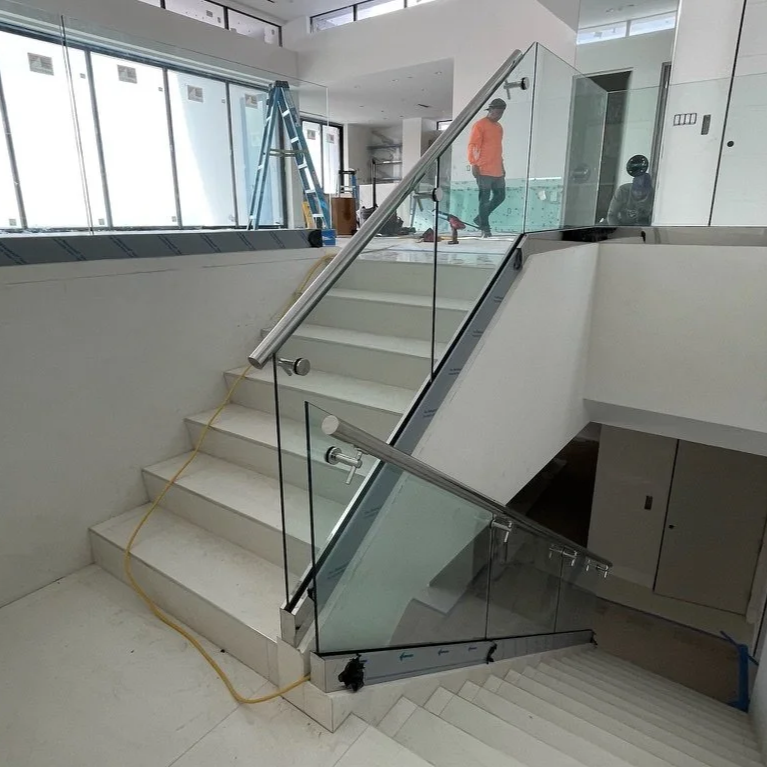
You are out on the deck, and you put your hand on the glass to steady yourself — and the panel moves. Not much, maybe a quarter inch. But it moves. You pull your hand back and look at it. The glass looks fine: no cracks, no obvious damage. But it moved.
That movement is the problem. And yes, it is a safety hazard.
What the Code Says a Railing Must Do
Glass railings are not decorative. They are guardrails, and building code treats them the same way it treats any other fall-prevention structure. The International Building Code requires guardrails to resist 200 pounds of concentrated lateral force applied at the top rail — the equivalent of a large adult falling into it with full body weight behind the impact.
Two hundred pounds. That's the minimum.
When a panel shifts under the 20 or 30 pounds of pressure from a resting hand, the math doesn't work. The panel is not close to where it needs to be to meet that load requirement. And unlike most household problems, this one doesn't stay stable while you get around to fixing it — each thermal cycle, each time someone leans against it, looseness tends to get worse, not better.
Where the Looseness Actually Comes From
A glass railing panel doesn't hold itself in place. It's secured by a system of components — clamps, gaskets, standoff pins, a base shoe channel, or post-mounted hardware, depending on the system type. Looseness almost always traces back to one of five specific failure points, and knowing which one you're dealing with changes both the urgency and the fix.
Gasket compression or hardening.
Most railing systems grip the glass with rubber gaskets sitting between the glass edges and the surrounding hardware. Those gaskets create friction and absorb vibration. Heat cycles compress them over time. In desert climates where daytime temperatures push past 110°F and then drop 40 or more degrees overnight, that compression happens quickly. I've pulled gaskets off panels that looked visually intact but had lost nearly half their original thickness. Once a gasket collapses, the glass shifts inside its mounting even when every visible bolt is tight — because the friction holding it in place is gone.
Thermal cycling loosening hardware.
Glass and aluminum expand at different rates across temperature swings. Aluminum expands roughly twice as fast as glass for a given change in temperature. After years of hot days and cool nights, that differential movement works fasteners loose incrementally — a fraction of a turn per cycle. A bolt torqued correctly at installation may be two or three turns behind after five summers of extreme heat. The panel doesn't feel loose in year one. It feels loose in year four.
Failed standoff pin anchors.
Frameless systems that use standoff pins drilled into concrete, masonry, or wood depend on the anchor bond holding the pin — not just the bolt you can see at the surface. When the anchor pulls free, the pin rotates or wobbles under load. The tell is directional: the panel tilts when pushed rather than sliding straight. The top goes one way, the bottom goes the other. That pivot signature points to an anchor failure, not a gasket issue.
Base shoe setting block migration.
Frameless panels sitting in a continuous aluminum base shoe channel are positioned on rubber setting blocks — small spacers that keep the glass at the correct height and distribute weight evenly. When those blocks migrate over time, the panel drops unevenly inside the channel and rocks. The movement pattern is distinctive: the base of the panel shifts in the direction of the push while the top tilts in the opposite direction.
Post base anchor failure.
When the entire post moves rather than just the glass panel, the failure is at the deck or concrete anchor beneath the post. This is the most serious version. A moving post means the entire railing section between posts is compromised — not one panel, but all of them. Don't apply a lateral push test to this. If you can rock the post by hand, stop using that section entirely.
If any railing post moves when you push it — at any height, on any installation — stop using that railing section immediately. Post base failure is a full-section hazard, not a single-panel issue.
The Self-Test You Can Run Right Now
Put your palm flat on the center of the glass panel at mid-height. Apply firm lateral pressure — roughly the force you'd use to push open a heavy door. Watch and feel whether the panel moves.
If it moves: stop using that railing section while you get it assessed.
If it holds: also place your fingertips along the bottom edge of the panel and apply upward pressure. A properly seated panel should have zero vertical lift at the base. Any lift means the setting blocks have migrated or the lower clamps have lost grip.
Apply roughly 30 to 40 pounds of lateral pressure at mid-panel — that's firm but not body-weight force. A structurally sound panel should show no perceptible movement at that load level.
The two tests together — lateral at mid-panel and vertical at the base — tell you whether the problem is structural or maintenance-level. A panel that rattles in wind but resists both tests is in the early gasket-wear stage. A panel that moves under either test is already in failure.
What Each Movement Pattern Tells You
| Movement Observed | Most Likely Failure Point | Urgency |
|---|---|---|
| Panel slides laterally, top and bottom move together | Gasket compression or loose hardware | High — assess within days |
| Panel tilts: top goes one way, base goes opposite | Standoff anchor failure | High — stop use immediately |
| Panel rocks, base shifts in direction of push | Setting block migration in base shoe | Moderate — schedule repair |
| Entire post section moves | Post base anchor failure | Critical — stop use immediately |
| Panel rattles in wind but resists hand pressure | Early gasket hardening | Low — schedule maintenance |
Why Cheap Fixes Don't Hold Here
The correct approach starts with identifying which failure point is active before touching anything. Tightening visible hardware is right when the cause is loose fasteners. It accomplishes nothing when the gasket has collapsed, and it makes things worse when standoff threads are stripped — over-torquing a stripped anchor just damages it further.
Clear silicone run around a loose base shoe to fill the visible gap. It looks like a fix. For three or four weeks, the panel feels stable. But general-purpose silicone has no structural adhesion to aluminum — it's designed to seal, not bond. The first meaningful load tears it loose, and the homeowner is back to the same problem with a bead of torn silicone to show for it.
But that's not the only thing that goes wrong with DIY attempts. The structural fix uses silicone rated for glass-to-metal bonding, applied after acetone prep and gasket replacement, then left to fully cure before anyone uses the railing. That cure window is 24 to 72 hours depending on ambient temperature. Repairs done in the morning that get tested by a leaner that afternoon haven't cured — and they fail within days.
When a standoff anchor has pulled free from concrete, the correct repair involves removing the panel, extracting the old anchor, cleaning the hole, and re-anchoring using an epoxy resin chemical anchor system. Chemical anchors bond directly into the concrete substrate and pull-out resistance runs significantly higher than mechanical expansion anchors. That's not a wrench-and-bolt job. It requires the right epoxy product, proper mixing, and adequate cure time before any load is applied.
When to Stop Using the Railing Immediately
Any glass railing panel above grade — deck, balcony, stair landing, elevated walkway — that moves under hand pressure is a fall hazard. Not a potential hazard. An actual one. The elevation is what makes it urgent.
A loose panel beside a glass railing on an elevated deck or stair is a specific scenario worth mentioning: people instinctively reach for railings when they slip or lose balance. That's exactly when the panel needs to hold 200 pounds of sudden lateral load. A panel that shifts under 30 pounds of slow pressure will not hold that load.
Frequently Asked Questions
You can hand-check visible fasteners and bring loose ones to hand-tight. But torque specs matter — over-tightening creates stress concentration at the glass edge, which can cause delayed cracking. More critically, tightening surface hardware won't fix a collapsed gasket or a pulled anchor. If the looseness doesn't fully resolve after basic hardware checks, the root cause hasn't been addressed. Have the system assessed before deciding the fix is done.
If you can hand-check visible fasteners and bring loose ones to hand-tight, that's a good start. But torque specs matter — over-tightening creates stress concentration at the glass edge, which can cause delayed cracking. More critically, tightening surface hardware won't fix a collapsed gasket or a pulled anchor. If the looseness doesn't fully resolve after basic hardware checks, the root cause hasn't been addressed. Have the system assessed before deciding the fix is done.
Not always. Rattling often means the gasket has hardened and lost its dampening function, but the panel may still resist lateral load correctly. Run the push test at mid-panel and the lift test at the base. If the panel holds both, structural integrity is likely intact and the rattle is a maintenance issue. If either test shows movement, the rattle and the movement are the same problem with the same cause.
A gasket replacement typically runs $150 to $400 per panel, depending on system type and hardware accessibility. Full panel replacement with new custom-cut tempered glass generally starts around $400 to $800 per panel. A standoff anchor repair — which requires extracting the old anchor and re-anchoring with epoxy — usually runs $200 to $500 per anchor point depending on substrate condition. Post base anchor repairs vary more widely if the underlying substrate needs attention before a new anchor will hold.
Replacing individual glass panels or hardware typically doesn't require a new permit in most jurisdictions. Structural modifications to the post system, anchor points, or the railing frame may require one depending on local code. A licensed glazier will confirm what applies to your specific repair and pull the required permits as part of the scope.
Run the push test at mid-panel with firm pressure — around 30 to 40 pounds. If the panel resists without any perceptible movement, you're likely dealing with early-stage gasket wear rather than anchor or base shoe failure, and scheduling within a few days is reasonable. If the panel moves at all under that pressure, don't use it until it's repaired. A glazier can confirm the structural condition on-site in about 10 minutes.
Schedule a glass railing inspection or repair — Luxe Residential and Commercial Glass handles loose panel repairs, gasket replacement, standoff anchor re-anchoring, and full railing inspections throughout Las Vegas, Henderson, North Las Vegas, and the surrounding metro. Call (702) 825-7463 (License #0090853) to schedule.
