
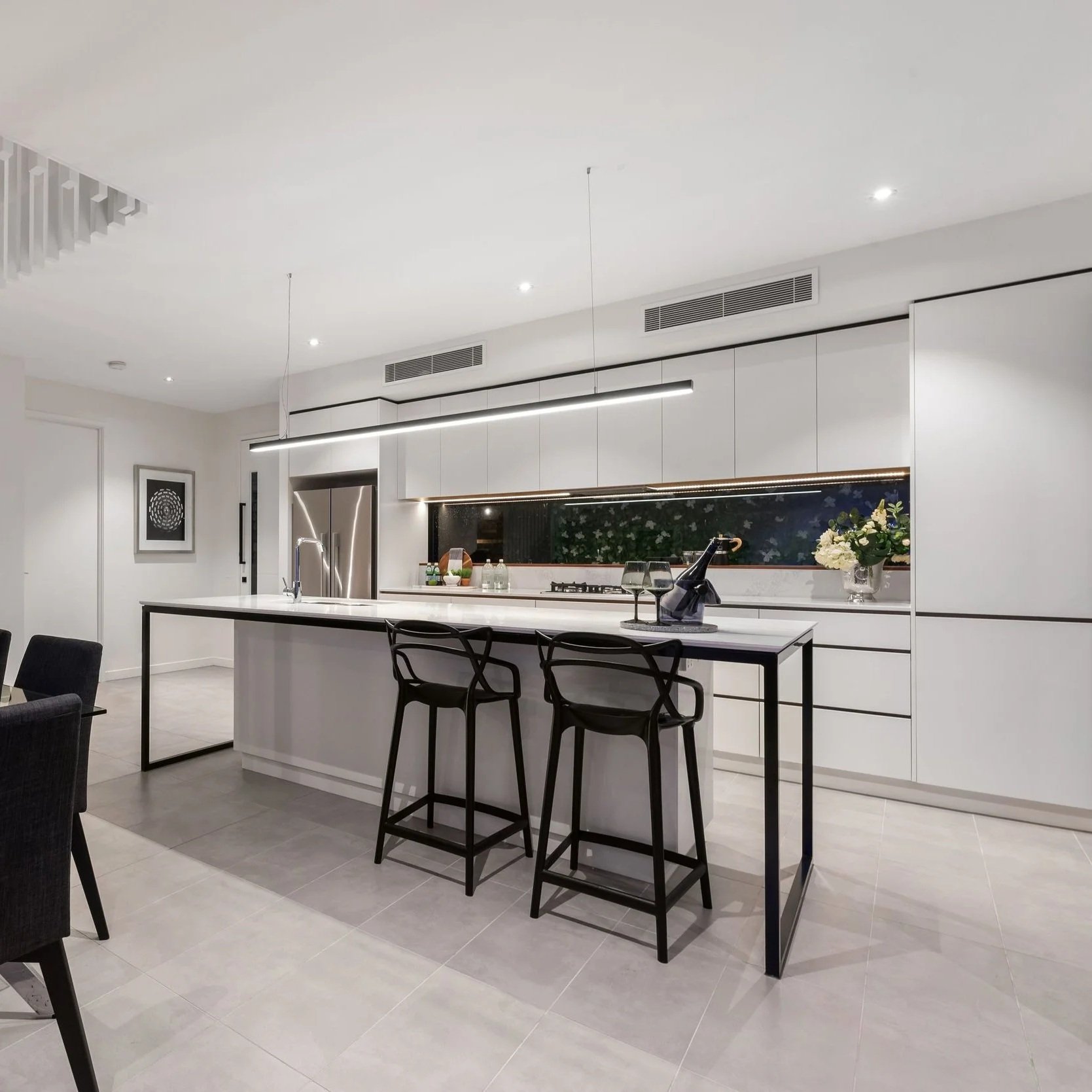
You repainted the kitchen last spring. New cabinets, new countertops, fresh hardware. But the tile backsplash behind the stove — the one you've scrubbed every weekend for four years — still looks dull, mottled, slightly gray no matter what you use on it. That's not a cleaning problem. That's a grout problem.
The comparison between glass and tile backsplashes comes down to one core question: do you want a surface that resists contamination, or one that absorbs it? Both materials work. But they work differently at the component level, and understanding that difference is what actually helps you make the right call for your kitchen.
Why Grout Is the Real Problem
Tile itself is fairly inert. The ceramic or porcelain face of a standard kitchen tile handles heat, grease, and moisture without much trouble. What fails is the grout between the tiles.
Grout is cement-based. It has a porous internal matrix — think of it like compressed sponge material with millions of microscopic channels running through it. Every time you cook, airborne oil and grease particles settle onto that surface. The grout absorbs them. Heat from the cooktop drives those particles deeper into the material. Those oxidized grease compounds build up inside the grout matrix in a way that plain soap and water cannot reverse.
This is why you can scrub tile grout and it still looks stained. The discoloration isn't sitting on the surface — it's inside the material, bonded to the cement structure. The only real solutions are resealing (which slows the absorption process going forward) or full grout replacement, which is a full weekend project that most homeowners defer indefinitely.
In most residential kitchens, visible grout discoloration sets in somewhere between 18 and 36 months after installation. By year four or five, even well-maintained grout looks noticeably older than the tile face sitting next to it. The degradation is built into the material.
Glass has no grout lines. The backsplash is a single continuous panel. There's nothing to absorb, nothing to seal, and nothing to eventually replace.
How Glass Handles Kitchen Heat
This is where most questions come in. People assume glass will crack near a hot cooktop.
A custom backsplash panel uses toughened safety glass — the same material used in shower enclosures, glass railings, and commercial storefronts. The tempering process heats the glass to roughly 1,200°F and then rapidly quenches it with high-pressure air jets, creating a compressive stress layer on the surface. That process fundamentally changes how the glass responds to both impact and heat.
Toughened glass for kitchen backsplash installation should be at least 6mm thick. For areas directly behind a gas cooktop, 8mm is the standard minimum. Anything thinner isn't spec'd for that heat zone.
The failure mode for glass near kitchen heat isn't gradual degradation — it's thermal shock. That happens when one section of the panel heats or cools dramatically faster than an adjacent section. The stress differential exceeds what the compressive layer can hold, and the panel fractures.
The practical risk of this is low when the glass is installed correctly. The critical detail: the glass should not be in direct contact with a gas flame, and there should be at least a 50mm gap between the cooktop edge and the lower edge of the panel. A glazier accounts for heat zones during measurement. This isn't guesswork — it's part of the template.
Tile backsplashes can crack from thermal cycling, usually within three to five years on west-facing kitchens that get afternoon sun. The grout joints go first, then the tiles themselves crack along stress lines once the mortar behind them has separated. By the time the homeowner sees it, several tiles are already loose.
And that grout isn't fireproof either. Unsealed grout that has absorbed years of cooking grease, near an open gas flame, is a slow-developing fire risk that almost nobody talks about.
What Cleaning Actually Looks Like
Glass: Wipe with a microfiber cloth and any non-abrasive glass cleaner. Done in about 30 seconds. The non-porous surface doesn't hold grease — it sits on top until you wipe it off.
Tile: Depends entirely on how consistently you've sealed the grout and how much you've cooked. In a kitchen that sees regular use, you're scrubbing those joints every week or two if you want them looking clean. And even that only manages surface buildup, not the embedded contamination deeper in the grout structure.
But that's not the whole story. There's also what's developing behind the grout lines that you can't see from the surface. Degraded grout in a kitchen can support mold growth, particularly along the lower backsplash seam where steam and cooking moisture collect. Most homeowners don't discover this until they're removing the tile for a renovation.
Glass, properly installed with a full perimeter seal, eliminates that category of problem. Nothing gets behind a well-bonded glass panel.
Cost Breakdown: Upfront vs. Long-Term
Glass backsplash installation costs more upfront than standard tile. But the long-term math is closer than most people expect.
| Category | Glass Backsplash | Ceramic Tile Backsplash |
|---|---|---|
| Material cost per sq ft | $18–$45 | $3–$15 |
| Installation per sq ft | $8–$20 | $10–$20 |
| Total installed per sq ft | $26–$65 | $13–$35 |
| Resealing (every 1–2 yrs) | None | $150–$400 per service |
| Grout replacement (~10 yrs) | None | $500–$1,500 |
| Estimated 10-year cost | $26–$65/sq ft | $20–$60/sq ft |
For a typical 30 sq ft backsplash, glass installed runs $780–$1,950. The equivalent tile job might run $390–$1,050 installed — but add $1,000–$2,000 in maintenance over a decade, and the actual cost difference narrows to nearly nothing.
That table also doesn't include the hours you spend cleaning grout every month.
When Tile Still Makes Sense
Glass is the practical choice in most kitchens. But tile has genuine advantages that glass cannot replicate.
Pattern and texture. Tile offers dimensional options — handmade terracotta, subway relief profiles, penny rounds, natural stone mosaic — that a flat glass panel cannot match. If the kitchen aesthetic depends on visible material variation and texture, tile delivers that in a way glass doesn't.
Traditional and transitional kitchens. A single-panel glass backsplash reads as contemporary. In a kitchen with shaker cabinets, natural wood tones, and warm hardware, a solid-color glass surface can feel visually incongruent. Tile integrates more naturally into those styles.
Tight renovation budgets. Basic ceramic tile at $3–$8 per square foot is hard to beat for upfront cost, especially in large backsplash areas. If the budget is constrained and the existing wall preparation is already done, tile is a legitimate entry point.
The honest answer: tile works. It's not a bad choice. But it requires ongoing maintenance that glass doesn't, and most homeowners underestimate how much of that they'll actually do over five to ten years.
What to Know Before You Commit to Glass
A few installation details matter that most articles don't cover.
Wall flatness first. Glass is unforgiving of substrate irregularities. If the drywall behind your backsplash isn't flat and plumb, the glass panel will either bridge gaps (creating internal stress points) or show waviness in reflections. A reliable installer checks flatness with a level and straightedge before taking measurements. Any wall repair needs to happen before the template is made — not after.
Run a straight edge along your wall before calling anyone. If you find gaps of more than 3–4mm, the substrate needs to be corrected first.
Adhesive coverage. Glass backsplash panels must be bonded with at least 70% adhesive coverage on the back surface. Less than that creates pressure points that increase thermal stress risk over time. Ask your installer what their bonding spec is. If they look at you blankly, that's informative.
Outlet and switch cutouts. Every electrical box cutout is a precision fabrication job. Once glass is toughened, it cannot be trimmed or modified on site. The panel has to be right from the shop. Measure twice. If the fabrication is off, the panel is remade from scratch.
Color and the iron-tint issue. Standard float glass has a faint green tint from iron in the silica. In most colors — deep blues, dark grays, warm neutrals — this is invisible. But in whites, pale grays, and light blues, the tint shifts the color noticeably warmer or cooler than what you selected. Low-iron glass eliminates the tint and is worth the additional cost for those lighter palettes. Your fabricator should mention this when you're selecting color. If they don't, ask.
Frequently Asked Questions
Yes. The glass needs to be toughened, at least 6mm thick, and positioned with proper clearance from the direct flame zone. Professional templating ensures the panel is correctly placed relative to the burner layout. The glass doesn't need to be far from the cooktop — it needs to be correctly positioned, which is a different thing. A qualified glazier can tell you the exact placement spec for your cooktop in about five minutes on site.
Toughened glass fractures differently than standard glass. Rather than cracking into long sharp shards, it breaks into small cubed pieces that are far less hazardous. That said, a chipped panel needs to be replaced — there's no field repair for toughened glass. The compressive stress layer is compromised at the point of impact, and the structural integrity of the entire panel is affected.
More than matte tile, yes. The surface is easy to wipe but needs wiping more often if you want it looking clean. Matte and satin glass finishes are available and significantly reduce the visibility of surface marks. Worth considering in high-traffic cooking kitchens, especially if you have kids.
Using a compatible silicone adhesive or structural bonding agent applied across the back of the panel, then pressed to a prepared wall surface. Some installations use adhesive plus mechanical standoffs at the perimeter, but adhesive-only is standard for most residential backsplashes. No fasteners through the glass, no grout — the panel is a bonded surface. Correct wall preparation and adhesive coverage are the two variables that determine whether it lasts 20 years or develops problems in five.
Depends on what the existing tile looks like. If the current backsplash is dated, cracked, or visually degraded, glass is a strong upgrade for staging. Clean lines and an unbroken surface read well in listing photos and in person. Custom fabrication takes two to three weeks from template to installation — plan accordingly if you're working toward a sale date.
Glass outlasts tile in terms of appearance. The surface doesn't discolor, doesn't require resealing, and doesn't develop the grout-line degradation that makes tile backsplashes look tired after a few years. The limiting factors are installation quality and substrate preparation — a well-installed glass panel on a sound wall will look the same in 15 years as it does on day one. With tile, the grout starts losing that battle almost immediately.
Schedule a measure and quote — Luxe Residential and Commercial Glass handles custom glass backsplash installation throughout Las Vegas, Henderson, North Las Vegas, and the surrounding metro. Call (702) 825-7463 (License #0090853) to schedule.
