
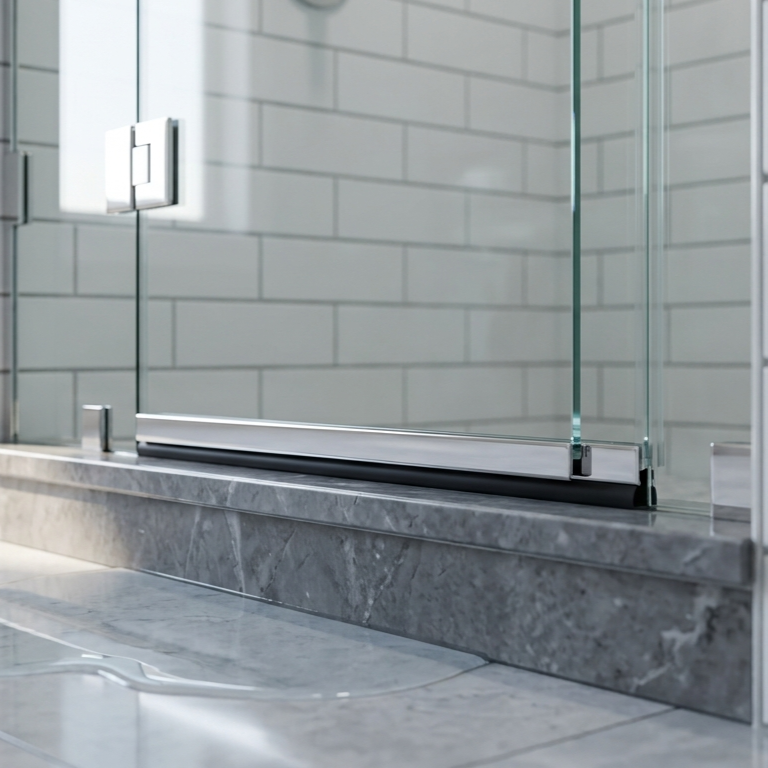
You step out of the shower and your foot lands in a puddle — not inside the enclosure, but out on the tile floor. The door looked closed. Nothing looked wrong. But there's water spreading toward the bath mat, and it's been happening for weeks.
Bottom leaks are the most common complaint we get about shower doors. The frustrating part is that they rarely show up immediately. A new door can run fine for 18 months and then start dripping almost overnight — which makes people assume something broke. Usually nothing broke. Something wore out, or a small alignment issue finally crossed the threshold where the seal can't compensate for it.
Why the Bottom of the Door Is the Weak Point
A shower door keeps water contained through hardware alignment and flexible sealing components. The glass itself is just a barrier. All the real sealing work happens at the edges — and the bottom edge takes the hardest hit.
Water hits the glass at force, runs down the full height of the panel, and arrives at the bottom with momentum. Every drop that strikes the glass ends up at the floor line. The bottom sweep — the vinyl strip that spans the gap between the glass edge and the shower curb — is absorbing all of it, every single shower. It's the hardest-working component on the door.
When that sweep fails, or when the gap it's supposed to span changes, the water has nowhere to go except the floor.
Five Causes of Bottom Leaks
Worn or Mineralized Sweep
This is cause number one. Bottom sweeps are made from soft vinyl with one or two flexible fins that compress lightly against the curb when the door closes. Fresh vinyl conforms well. But the fins stiffen as the material ages — and hard water makes it happen faster.
Minerals in tap water, primarily calcium and magnesium carbonate, deposit inside the vinyl channel and along the fin edges with each shower. As the deposits accumulate, the fins lose their ability to flex and seat against the curb. Instead of forming a continuous watertight line, the stiffened fins bridge small irregularities in the curb surface and leave open gaps.
The glass isn't the problem. The fins are.
You can check this yourself. Close the door and slide a piece of paper under it, moving slowly across the full width. If it pulls through with no resistance at any point, the sweep isn't sealing there. That test takes 30 seconds and tells you exactly where the leak is entering.
In hard water areas, sweeps typically last 12 to 18 months. Wiping the bottom edge of the glass monthly with a diluted white vinegar solution slows mineral buildup and extends sweep life considerably.
Sweep Installed Backward
It's a common scenario — and the maddening part is that the door leaks from the very first shower, so the homeowner assumes there's a bigger structural problem.
Shower door sweeps have a directional drip fin that faces the wet side of the door. When oriented correctly, water pressure pushes the fin down against the curb, tightening the seal. When it's reversed, that same pressure lifts the fin away from the curb. The seal fails under exactly the conditions it's supposed to hold.
If your door has leaked since installation and the sweep looks undamaged and new, check the orientation before doing anything else. The fin should point toward the interior of the shower. This is a two-minute fix if that's all it is.
Hinge Sag Creating a Bottom Corner Gap
Frameless doors are heavy — 3/8" or 1/2" tempered glass typically runs 60 to 90 pounds for a standard shower opening. That weight rides on two or three hinges. When the bottom hinge loosens slightly, the door sags.
But the sag doesn't drop straight down. The hinge geometry causes the bottom corner of the door — the hinge side — to swing slightly outward at the same time. This creates a widened gap at the bottom hinge corner. That corner becomes the primary leak point, not the center of the door.
The practical test: after a shower, check where the puddle forms on the floor. If it's skewed toward the hinge side rather than centered under the door, the bottom hinge is your issue. Check the hinge screws at the wall mount. If any are loose, tighten them and re-check the door alignment.
But that's not the whole story. Even after tightening, a hinge that has been cycling for years may not hold torque reliably. If the screws re-loosen within a few weeks, the hinge itself needs replacement, not just tightening.
Clogged Weep Holes (Framed and Semi-Frameless Doors)
This one doesn't apply to fully frameless doors. Framed and semi-frameless designs have a U-shaped aluminum track at the bottom that sits on the curb. That track is designed to catch any water that gets past the outer seal and drain it back into the shower through small holes in the inner wall of the channel — called weep holes.
When mineral scale and soap film clog those holes, the track fills up and overflows onto the bathroom floor. The leak appears to come from the bottom of the door, but the actual failure point is hidden inside the track.
The fix: remove the door, clean the track thoroughly with white vinegar or a commercial descaler, and clear each weep hole with a thin wire or a toothpick. If the track has deep pitting from years of hard water exposure, replacing it is more reliable than cleaning.
Shower Curb Slope
This one surprises people.
A shower curb needs a slight inward pitch — typically 1/8" per foot toward the drain — to keep water from pooling against the base of the door. When the curb is flat or tilted outward, water sits against the door gap and finds any path through. A perfectly sealed sweep can't hold against standing water indefinitely.
Test it with a level on the curb when the shower is dry. If the bubble shows the curb is flat or tilting outward, the slope is likely contributing to the leak. Correcting this requires rebuilding the curb with a properly pitched mortar bed and retiling — not a DIY fix, but a permanent one that eliminates the underlying cause.
Diagnosis at a Glance
| What You See | Most Likely Cause | First Action |
|---|---|---|
| Puddle under door from day one | Reversed sweep or wrong-size sweep | Check sweep orientation; replace if wrong profile |
| Leak appeared after 1–2 years of use | Worn or mineralized sweep | Paper test; replace sweep |
| Puddle skewed toward hinge side | Bottom hinge sag | Check/tighten hinge screws; re-align door |
| Water overflowing from bottom track | Clogged weep holes (framed doors) | Clean track and clear weep holes |
| Leak persists after new sweep installed | Curb slope issue | Level the curb; regrade with mortar if needed |
How to Actually Fix It
Replacing a sweep is a 15-minute job for most frameless doors — pull the old strip off the glass edge, clean the edge with rubbing alcohol, and press the new one on. But you have to match it correctly.
Match the sweep to your glass thickness first: most frameless doors use 3/8" (10 mm) or 1/2" (12 mm) glass. Then measure the gap between the bottom of the glass and the top of the curb with the door closed. That gap should be between 1/4" and 3/8". If it's wider than 3/8", a standard sweep won't span it — you either need a larger sweep profile or the door alignment needs correction before the new sweep will work.
Some homeowners come back after a DIY sweep replacement still dealing with the same leak — because they bought the wrong profile. There are five or six sweep profiles on the market: drip rail, wiper seal, H-channel, U-channel with single fin, U-channel with double fin. They're not interchangeable. If you're not sure which type you have, bring the old sweep to the glass shop and match it physically.
For hinge problems: tightening the mounting screws is DIY territory. But if the door isn't centering properly in the opening after the adjustment, stop there. A misaligned frameless door that's being forced to close correctly puts stress on the wall anchors with every use. It's not unusual to see tile cores crack behind the anchor points from years of a door that was pulling at a slight angle — and that repair costs far more than a hinge replacement would have.
Grout and caulk failures at the curb base are frequently confused for door leaks. Water can penetrate deteriorated grout lines inside the enclosure, travel through the tile substrate, and surface at the floor line — nowhere near where it entered. If you've replaced the sweep and the leak continues, inspect the grout inside the shower, especially at corners and along the bottom two rows of tile before assuming the door hardware is still the problem.
Frequently Asked Questions
One to three years under normal conditions. Hard water shortens that range significantly — plan on 12 to 18 months if you have high mineral content in your water. Monthly maintenance with a diluted white vinegar spray keeps deposits from hardening on the fins and extends sweep life. When in doubt, run the paper test: if the paper slides through anywhere without resistance, the sweep is ready to replace.
In most cases, just the sweep. Tempered glass doesn't wear out under normal use. If the frame hardware is corroded or the hinges are deformed, those components may need replacement — but the glass panel itself typically stays unless it's been cracked or chipped. A full door replacement is rarely the answer to a bottom leak.
Asymmetric leaks almost always point to alignment. The hinge-side bottom corner is the most common single-point leak source. Check the bottom hinge first, then measure the gap at both bottom corners of the closed door. They should be roughly equal. A gap that's noticeably wider on one side means the door has shifted, and the sweep can't compensate for it.
Frameless doors rely entirely on sweep contact and seal fit — there's no channel-and-track system to catch overflow the way framed doors have. A small amount of condensation mist finding its way outside at a bad spray angle isn't unusual. A consistent puddle after every shower is not normal. That's a component failure or a slope problem that needs to be fixed.
Possibly. Check the grout lines at the base of the shower walls for soft spots or crumbling, press on the floor tile near the curb, and look at the baseboard trim for warping or staining. Water reaching the subfloor regularly can cause rot in months. Finding it now costs a few hundred dollars. Finding it during a full bathroom remodel costs several thousand.
Schedule a shower door inspection or sweep replacement — Luxe Residential and Commercial Glass handles shower door repairs, seal replacements, and full enclosure installations throughout Las Vegas, Henderson, North Las Vegas, and the surrounding metro. Call (702) 825-7463 (License #0090853) to schedule.
