
What Causes Shower Door Glass to Become Cloudy?
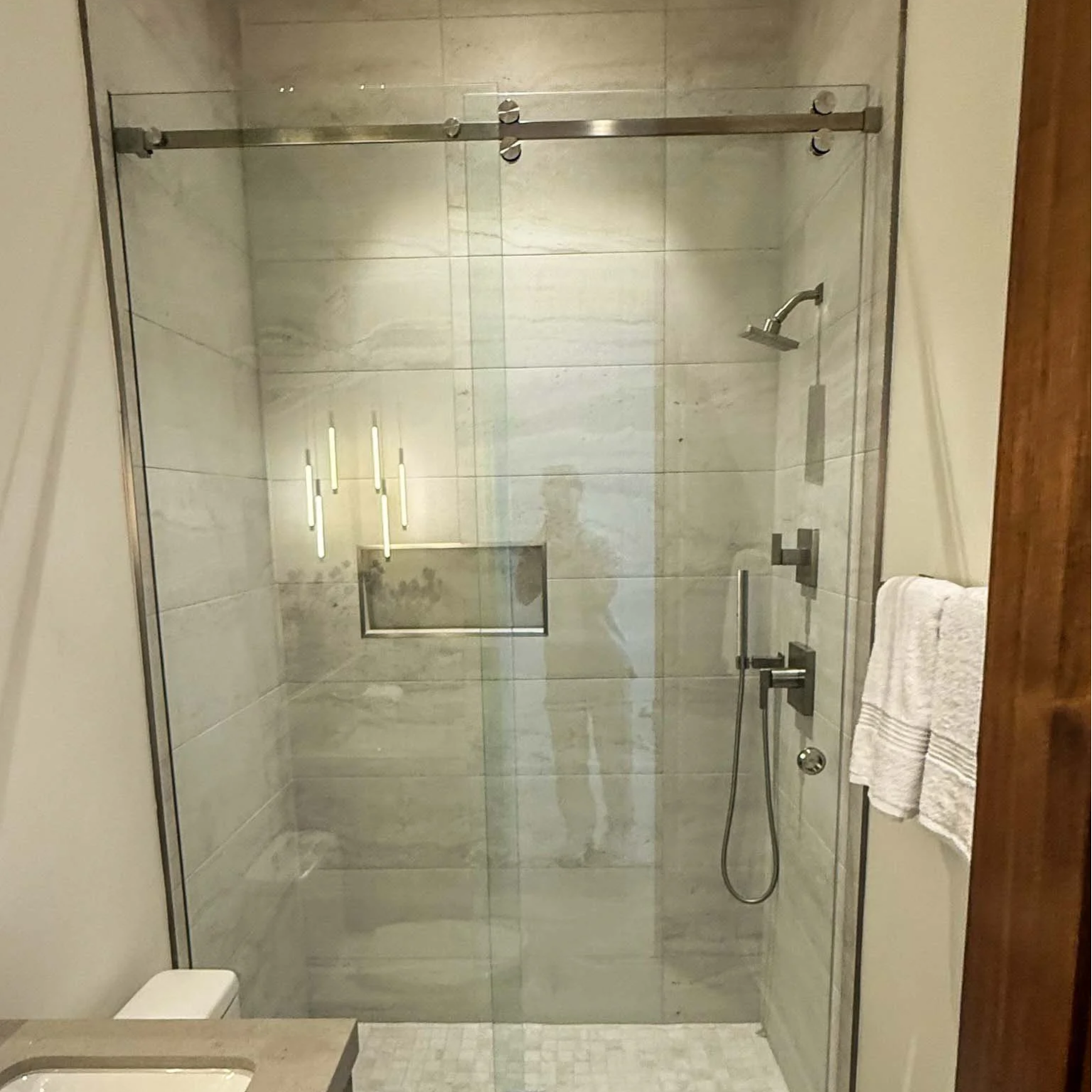
You scrub the glass with the cleaner that worked last time, rinse it off, and the haze is still there. Not a film — the glass itself looks dull, like it's been frosted from the inside.
That's the moment most people realize they're dealing with two very different problems. One is a buildup sitting on top of the glass that can be dissolved and rinsed away. The other is permanent etching of the glass surface itself, and no household cleaner touches that. Knowing which one you have changes everything about what you do next.
The Chemistry Behind the Cloudiness
Shower water carries dissolved calcium and magnesium bicarbonates in solution — picked up as water passes through rock and pipe on its way to your tap. Hot water triggers what happens next: when heated, dissolved bicarbonates break down and release carbon dioxide. As the CO2 leaves the water, calcium carbonate and magnesium carbonate precipitate out as solids. The water then evaporates off the glass, concentrating those minerals and leaving them behind as a white, chalky film.
That deposit is essentially a thin coat of limestone on your glass. It's alkaline, which is why acidic cleaners dissolve it. White vinegar and citric acid work because acetic and citric acid react with calcium carbonate and convert it back into soluble compounds that rinse away. That's the mechanism — not magic, just chemistry reversing itself.
Soap scum is a separate layer. It forms when the fatty acids in bar soap react with the calcium and magnesium ions in hard water to produce calcium and magnesium stearate — both insoluble compounds that adhere to surfaces. Soap scum is tackier than mineral deposits and traps additional grime. Acid alone doesn't lift it; you need a surfactant alongside the acid to break the bond.
Those two layers together — mineral deposits on the glass, soap scum on top — are what most people see as cloudiness.
Removable Buildup vs. Permanent Etching
But here's the part that matters most, and it's the part every cleaning guide skips.
Calcium carbonate deposits sit on top of the glass. Dissolve them and they're gone. But if those deposits stay in prolonged contact with the glass surface, a second process begins: their alkaline chemistry slowly attacks the glass itself.
Glass is primarily silicon dioxide — SiO2. At sustained high pH (above roughly 9), the silica matrix at the glass surface starts to dissolve microscopically. The result is a pitted surface — not a film on the glass, but damage to the glass. Light hitting that microscopically rough surface scatters in all directions instead of passing straight through, creating a permanent haze.
Once that happens, cleaning makes no difference. The glass isn't dirty. It's damaged.
| Removable Buildup | Permanent Etching | |
|---|---|---|
| What it is | Calcium carbonate and soap scum deposits on the glass surface | Microscopic pitting of the silica matrix of the glass itself |
| Cause | Hard water minerals left behind as water evaporates | Prolonged alkaline contact from deposits, or harsh cleaning chemicals |
| Appearance | White or chalky haze, sometimes streaky or patchy | Uniform dull haze, no distinct edges |
| Touch test | May feel slightly rough, waxy, or raised | Completely smooth — haze is in the glass, not on it |
| Vinegar test | Dissolves at least partially with acidic cleaner | No change with any cleaner |
| Fix | Dissolve with acid + surfactant; rinse clean | Resurfacing or panel replacement |
In many cases, both are present — removable buildup sitting on top of a surface that's already etched underneath. Cleaning removes the top layer, but the underlying haze stays.
How to Test Whether Your Glass Can Be Cleaned
Two tests, two minutes.
First: apply a small amount of undiluted white vinegar or lemon juice to a cloudy area with a cloth. Wait 10 minutes and wipe. If the treated spot is noticeably clearer than the surrounding glass, you have mineral deposits that can be removed. The more the vinegar helps, the more of the problem is reversible.
Second: run your fingernail lightly across a cloudy area. Removable deposits have a slight texture — a film you can feel under your nail. Etched glass feels completely smooth, because the haze is in the glass, not on it.
If the vinegar test shows no improvement, stop scrubbing. Mechanical abrasion on etched glass makes the light-scattering worse, not better. You're sanding a damaged surface, not cleaning a dirty one.
Why Hard Water Accelerates the Problem
Not all water is the same. The speed at which deposits form — and how quickly they push past "buildable" into "etchable" — depends on the mineral content of your water.
Water hardness is measured in milligrams per liter (mg/L), expressed as calcium carbonate equivalent. Below 60 mg/L is considered soft. Above 180 mg/L is very hard. In desert Southwest cities where municipal water comes from the Colorado River basin, typical readings run 250–300+ mg/L — among the highest in the country, and three to four times harder than cities with naturally soft water sources.
At that concentration, deposits form faster and thicker than in soft-water areas. Buildup that might take six months to develop elsewhere can appear in six weeks. Glass shower enclosures in homes under two years old with etching already started — not because the homeowners weren't cleaning, but because they were dealing with water that deposits minerals at a rate most cleaning routines weren't built for.
How Protective Coatings Help — and Fail
Many new shower glass panels come with factory-applied hydrophobic coatings — SiO2-based or fluoropolymer treatments that reduce the contact angle of water on the glass surface. Instead of spreading flat and evaporating in place, treated water beads up and sheets off. Far fewer minerals get the chance to deposit. The glass stays cleaner between sessions.
But coatings don't last forever. Depending on care and cleaning products, they typically hold up three to seven years before degrading. As the coating wears down, the glass becomes increasingly hydrophilic again — water spreads instead of beads — and cloudiness returns faster.
You can check your coating's condition easily: rinse a section of the glass and watch what the water does. If it beads into tight droplets that roll off quickly, the coating is working. If the water fans out flat and sits on the surface, the coating is gone.
And it can be stripped much faster than natural wear. Ammonia-based cleaners, bleach, and abrasive scrubbing products all damage hydrophobic coatings on contact. Using them regularly can reduce a five-year coating to one year or less.
What Actually Removes Existing Buildup
For mineral deposits and soap scum, the most reliable approach uses two agents in sequence: acid first to dissolve the mineral layer, then surfactant to lift the soap scum.
Undiluted white vinegar applied for 15–30 minutes handles light to moderate mineral deposits on uncoated glass. For heavier buildup, a paste of citric acid powder (about one tablespoon in a small amount of water) applied for 20–30 minutes reaches what vinegar won't shift. After either, a small amount of dish soap on a soft cloth removes the soap scum residue that the acid leaves behind.
Skip the abrasive scrubbing pads. Even mildly abrasive surfaces leave micro-scratches on uncoated glass that increase surface area and give future deposits more to grip. A non-scratch pad or a dedicated glass-safe cloth is the right tool.
After cleaning, apply a hydrophobic glass treatment to the dry surface. This reintroduces the water-beading protection that prevents rapid re-buildup.
Frequently Asked Questions
Cleaning removes the deposits but doesn't change the underlying cause — hard water minerals continuing to deposit every time water evaporates off the glass. In areas with very hard water, deposits start rebuilding within days of a thorough clean. The only things that change the rate are reducing how much water is left on the glass (squeegee after every shower — 15 seconds) and maintaining a hydrophobic coating so water sheets off instead of spreading and evaporating in place.
Sometimes. Glass resurfacing using cerium oxide polishing compounds can physically remove the damaged silica layer and reduce or eliminate light etching. It's a one-time procedure, not ongoing maintenance, and it works best on early to moderate etching. Deep etching — where the surface irregularity is significant enough that polishing would remove too much material — typically requires panel replacement. A glazier can assess whether your glass is a candidate for resurfacing or whether replacement is the better call.
It does. Bar soap contains fatty acids that react with calcium and magnesium ions in hard water to form insoluble calcium and magnesium stearates — the primary components of soap scum. Most liquid body washes and shower gels use synthetic detergent formulas that don't have the same reaction with hard water minerals. Switching to liquid body wash doesn't eliminate cloudiness on its own, but it reduces the soap scum layer substantially, which makes the mineral deposit underneath easier to remove.
Rinse a section of glass and watch how the water behaves. Tight droplets that bead up and roll off quickly — the coating is intact. Water that fans out flat and clings to the surface — the coating has worn down. Most factory-applied coatings come with a care sheet that specifies which products to avoid. If you don't have that documentation, assume the coating is uncoated and use acid-based cleaners rather than ammonia or bleach.
Yes, and it happens more often than people expect. High-concentration bleach and strong alkaline cleaners can attack the silica matrix directly. Abrasive scrubbing pads used repeatedly cause cumulative surface damage that increases light scatter — the same haze as mineral etching. Ammonia doesn't etch the glass itself, but it strips hydrophobic coatings rapidly, leaving the glass unprotected and accelerating mineral etching afterward. If your cloudiness appeared within a year or two of regular bleach cleaning, the cleaner likely contributed. The fix for chemically etched glass is the same as for mineral etching — resurfacing if it's light, replacement if it's gone too far.
Schedule a shower glass assessment or get a quote for a new frameless enclosure — Luxe Residential and Commercial Glass handles glass shower door installation, frameless enclosures, and glass repair throughout Las Vegas, Henderson, North Las Vegas, and the surrounding metro. Call (702) 825-7463 (License #0090853) to schedule.
