
Foggy Between the Panes? Why Your Double-Pane Window Failed
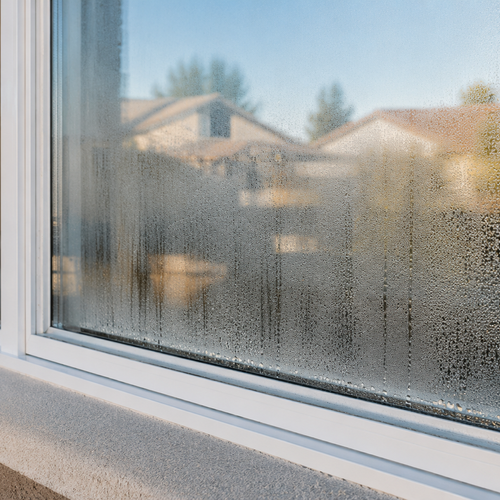
Quick Answer: Fog between the panes means the seal on that insulated glass unit has failed and let moisture into the sealed space — which is why you can't wipe it off from either side. It's driven by years of thermal expansion and contraction, and intense sun and heat speed it up. The fix is to replace the sealed glass unit, and often only the glass or sash, not the whole window. "Defogging" services are a cosmetic stopgap that don't restore the seal or the insulating gas.
You notice it on a sunny afternoon: one window looks permanently hazy, like there's a film on it, and no amount of cleaning touches it — because the haze isn't on the glass you can reach. It's trapped between the two panes, in a sealed space you can't get to. That fog is a specific, well-understood failure, and once you know what it is, both why it happened and how to fix it make sense.
What the Fog Actually Means
A double-pane window is really an insulated glass unit: two panes of glass with a sealed, dead-air space between them, often filled with argon gas to slow heat transfer. A spacer around the edge holds a desiccant that absorbs the tiny bit of moisture sealed inside at the factory, keeping the space dry.
When the seal around that unit fails, outside air and humidity work their way into the space. The desiccant absorbs the incoming moisture until it's saturated, and after that, moisture condenses on the inner glass surfaces — where no cloth can reach it. That's the haze you're seeing. It's not dirt, and it's not something you did; it's a failed seal, and the fog is the symptom.
Why Seals Fail — and Why Sun Makes It Worse
Seals don't usually fail from a single event. They fail from years of thermal pumping. Every day, the sealed air space heats up and expands, then cools and contracts, and that constant flexing stresses the seal like a bellows working back and forth. Over time, the seal fatigues and breaks down. Age, water pooling on the sill, and UV exposure all add to it.
This is where a desert climate accelerates the problem. Las Vegas windows take intense sun and huge day-to-night temperature swings, and the more a window heats and cools, the harder that daily pumping works on the seal. Inspectors note that windows on the sunny side of a house experience larger temperature swings and higher seal failure rates for exactly this reason. So a foggy window in this climate is common, and west- and south-facing glass tends to go first.
There's a hidden cost beyond looks. As the seal fails, the argon gas that made the window energy-efficient leaks out, so a foggy window is also a worse-insulating window — it lets more heat in, which your cooling system has to fight all summer.
Telling the Three Kinds of Condensation Apart
Not all window fog means a broken seal. Where the moisture sits tells you which problem you have.
| Where the fog is | What it means | What to do |
|---|---|---|
| Between the panes (can't wipe it) | Failed seal on the glass unit | Replace the sealed unit |
| On the inside (room-side) surface | High indoor humidity | Ventilate; lower humidity |
| On the outside surface | Normal temperature/humidity difference | Nothing — it clears on its own |
Only the first one is a window defect. Condensation you can wipe off the room-side glass usually means the indoor air is humid, and fog on the exterior on a cool morning is just dew that burns off — both are signs the window is doing its job, not failing.
How It's Actually Fixed
Here's the good news: a failed seal usually doesn't mean a whole new window. In most cases, the sealed glass unit itself can be replaced while the existing frame and sash stay in place — industry inspectors estimate the glass unit alone can be swapped in roughly three out of four cases, with the full window needed only rarely. If your frames are sound, you're often looking at a glass replacement, not a tear-out.
Be cautious about "defogging" services that drill the unit, dry it out, and reseal it. They can clear the haze for a while, but they don't restore the original seal or replace the lost argon gas, so you're left with a window that looks better but still insulates poorly — a cosmetic stopgap, not a real repair. And once moisture has been cycling in the unit long enough, it can etch mineral haze and faint grooves into the glass that no drying will remove; at that point, the unit has to be replaced regardless.
One thing to check first: many windows carry a seal warranty on the glass, typically 10- 20 years, depending on the manufacturer (though it usually excludes labor). If yours is still covered, the replacement unit may be far cheaper than you expect — so dig out the paperwork before you pay for anything.
Frequently Asked Questions
Because it isn't on the surfaces you can reach — it's sealed between the two panes of glass. When the window's seal fails, moisture gets into that sealed space and condenses on the inner glass surfaces, where no cloth can get to it. That's the telltale sign of a failed insulated glass unit rather than a dirty or humid window.
Usually just the glass, not the whole window. In most cases, the sealed glass unit can be replaced while the existing frame and sash stay put — inspectors estimate the glass-only fix works in roughly three out of four cases. A full window replacement is needed only when the frame or sash is also damaged, so a sound frame often means a far smaller job.
It's a cosmetic stopgap, not a real repair. Defogging dries out the unit and can clear the haze for a time, but it doesn't restore the failed seal or replace the insulating argon gas that leaked out — so the window still insulates poorly. And if moisture has etched the glass, defogging won't bring back clarity. Replacing the sealed unit is the lasting fix.
It can. The fog appears because the seal failed, and that same failure lets the argon gas that made the window energy-efficient escape. With the insulating gas gone, the window transfers more heat, so your cooling system works harder — especially under desert sun. A foggy window is both an eyesore and a small, ongoing efficiency loss.
Because sun-facing windows go through bigger daily temperature swings, and that heating and cooling is what wears out the seal. Each cycle expands and contracts the sealed air space, flexing the seal like a bellows until it fatigues. In a hot, sunny climate, west- and south-facing windows take the most of this and tend to fail first.
Often, at least the glass. Many windows carry a seal warranty on the insulated glass unit, commonly in the 10- to 20-year range, depending on the manufacturer, though it typically doesn't cover labor. Check your window's warranty before paying for a replacement — if the unit is still covered, the cost of the glass itself may be handled.
That permanent haze isn't grime, and it isn't your cleaning — it's a sealed glass unit that's worn out, hastened by sun and the daily heat-and-cool cycle. The reassuring part is that it's usually a glass-unit swap rather than a whole-window replacement, and your warranty may cover the glass. Skip the defogging shortcut, replace the failed unit, and you get the clear view and the insulation back at once.
Foggy glass you can't wipe clean? — Get the sealed unit assessed and replaced, often just the glass, with the efficiency restored. Luxe Residential and Commercial Glass serves the Las Vegas Valley. Call (702) 825-7463.
