
Can Glass Railings Handle High Winds?
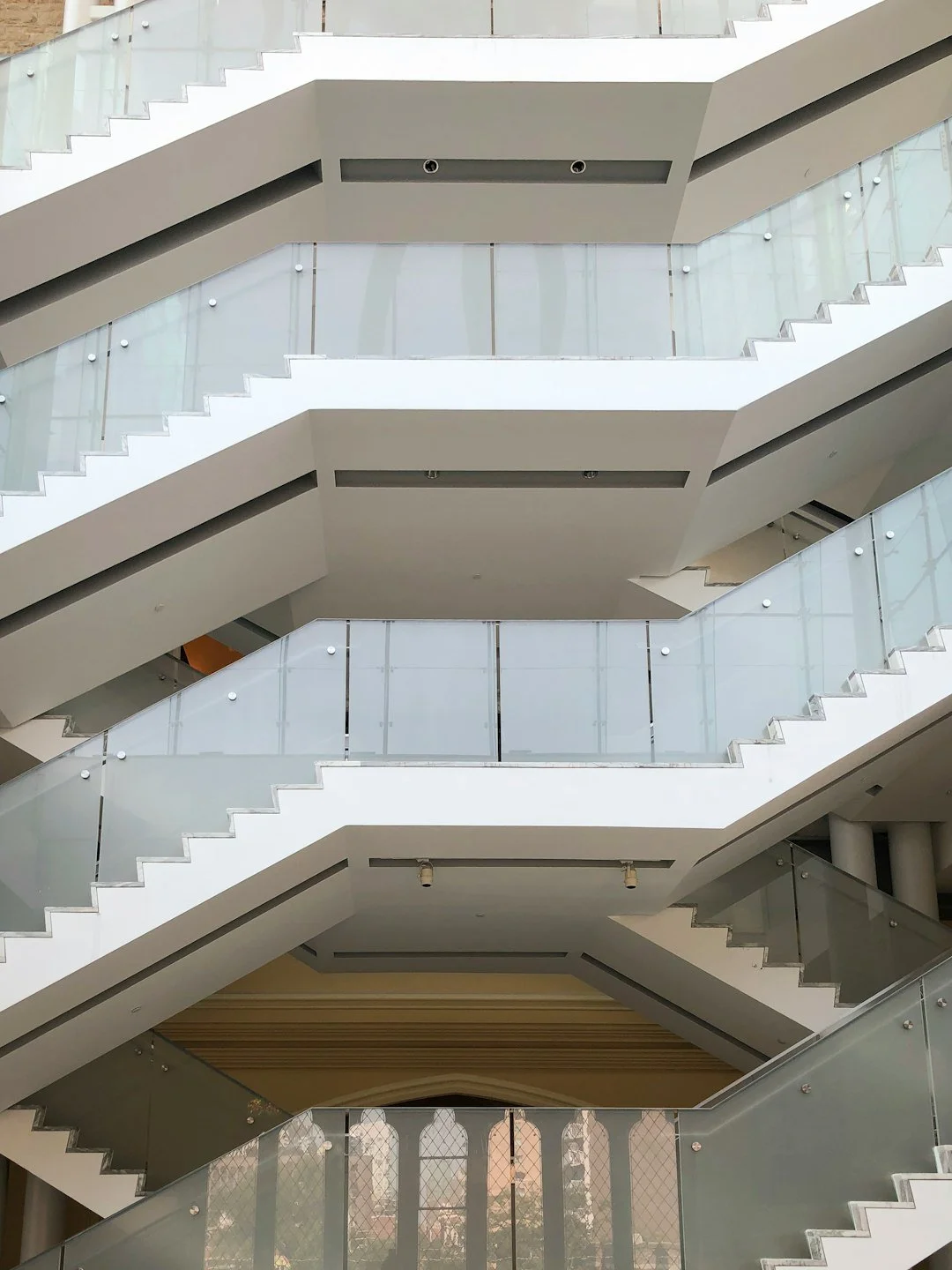
You push on the glass panel with your palm, and it moves. Just slightly — a few millimeters of give at the top — but enough that you notice it and start wondering how it survived last week's wind.
The short answer is yes: glass railings can handle high winds. But the glass itself is almost never the weak point. What fails is the mounting system — the base shoe, the post bases, and the fasteners that go into the deck framing. Usually, 3/8-inch tempered panels withstand serious wind events while the hardware connecting them to the structure quietly worked loose beneath them. The glass was fine. The installation wasn't.
What Wind Load Actually Means
Wind load is expressed in pounds per square foot (psf) — the lateral pressure that wind pushes against a flat surface. For residential deck glass railings, building codes typically require the system to handle a concentrated load of 200 pounds applied at the top rail, plus a distributed wind load that varies by location and exposure. In most residential applications, the distributed load runs 20–50 psf. In wind-exposed or elevated areas, it can reach 60 psf or more.
Certified glass railing systems are tested to specific psf ratings. A 60 psf certification per ASTM E330 — a common benchmark for quality residential products — represents roughly the lateral pressure produced by sustained 100+ mph winds on that surface area. Most homes never see conditions that intense. But the certification matters because it confirms the entire assembly — glass, hardware, and connections — was tested together, not just the glass panel alone.
That distinction is important. A panel can be rated; an installation has to be built to match the rating.
Tempered Glass vs. Laminated Tempered Glass for Wind
Both glass types handle sustained wind pressure well. The difference shows up when wind-driven debris strikes the panel.
Standard tempered glass is heat-treated to approximately four times the strength of annealed glass. It handles lateral pressure excellently — the pure physics of wind pushing on a well-mounted panel almost never breaks it. But if something does crack it — a branch, a loose piece of roofing, a rock picked up by a gust — it shatters completely. The panel disappears from the opening in an instant. That's by design; tempered glass fractures into small pieces rather than sending large shards flying. But it also means a sudden, full-height gap in your railing.
Laminated tempered glass bonds two tempered lites around a PVB (polyvinyl butyral) interlayer. When it cracks, the interlayer holds the pieces in place. The panel is destroyed but stays in the frame until it can be replaced. For elevated decks or balconies where wind-driven debris is a real possibility, that's a meaningful safety difference.
| Tempered Glass | Laminated Tempered Glass | |
|---|---|---|
| Wind pressure resistance | Excellent | Excellent |
| Wind-driven impact response | Shatters — panel lost immediately | Cracks, but stays in place |
| Typical thickness | 3/8" – 1/2" | ~7/16" – 9/16" (two lites + interlayer) |
| Best application | Protected or lower-exposure decks | Elevated, exposed, or high-traffic locations |
The Mounting System Is Where It Goes Wrong
And this is the part of the conversation most installers skip.
In a base-shoe system, the glass panel sits inside a U-channel bolted to the deck surface. Every pound of lateral wind force on the panel transfers directly into that shoe — and from the shoe into whatever it's anchored to. On a concrete slab with properly set expansion anchors, that connection is solid. On a composite deck with lag screws going into 1.5-inch framing members, you're relying on that framing to absorb cyclic loading over the years. The screws work loose. The framing checks and shrinks. The connection degrades — slowly at first, then faster.
Post-and-rail systems concentrate the load at the post bases instead of distributing it along a continuous shoe. Same substrate dependency, different geometry. A weak anchor under one post takes the full lateral load from the panels on both sides of it.
Hardware material matters at least as much as mounting method. Exterior glass railing hardware should be grade 316 stainless steel — the marine-grade alloy with molybdenum added that resists pitting and stress corrosion under outdoor exposure. Lower-grade hardware corrodes at the fastener level first, and corroded fasteners under repeated wind loading eventually give.
Some homeowners call after years of no issues, saying the railing suddenly feels different. Nine times out of ten, it's not the glass that changed — it's a base plate that's been slowly working loose in softening framing, finally reaching the point where they can feel it.
How Panel Height Changes the Math
A taller panel catches more wind. But the engineering consequence goes further than that: panel height directly determines the bending moment at the base of the panel under lateral load.
Think of it this way — wind pushes horizontally across the full height of the panel, and that distributed force acts like a lever arm against the base connection. A 42-inch guardrail panel under 40 psf wind puts significantly more stress on its base shoe than a 36-inch panel in the same conditions. Double the panel height, and you roughly quadruple the bending stress at the mounting point because both force and lever arm increase.
This is why unsupported panel span matters too. Closer post spacing reduces the bending stress on each panel. Standard specifications for point-fixed systems in wind-exposed locations commonly call for a maximum 36–42 inch spacing between support points. Wider spans need thicker glass to handle the same load without overstressing the panel edges.
If your glass panels flex visibly under moderate gusts — not just vibrate, but actually bow outward — the span may be too wide for the glass thickness installed. That's worth having assessed before a bigger wind event settles the question.
What to Check After a High-Wind Event
The glass panel is the easiest thing to see. The connections are harder to inspect and more important.
| Component | What to Check | Red Flag |
|---|---|---|
| Post bases / base shoe | Push laterally on top of panel | Any perceptible movement — even 1–2mm |
| Fastener heads | Flush with hardware surface | Standing proud = partially pulled through |
| Sealant at deck connection | Continuous seal, no voids | Cracking, separation, or gaps |
| Glass edges | Perimeter of each panel | Any new chips or cracks |
| Clamp hardware | Gaskets compressed evenly against glass | Visible gap or looseness at panel edge |
The lateral push test is the fastest first check: place both hands on the glass near the top and push toward the outside with firm pressure. A properly anchored installation has zero perceptible movement. Any play at all — any shift you can feel — means something has worked loose and needs attention before the next wind event.
What Proper Installation Looks Like
The difference between a railing that holds and one that doesn't comes down to three things: the right hardware spec for the exposure, the right anchoring for the substrate, and proper blocking inside the framing before the deck is finished.
That last point is where a lot of problems start. Deck framing typically has joist bays 16 inches on center. A base shoe bolted to the deck without solid blocking between joists at each attachment point is relying on the rim joist and decking material to carry lateral load — neither is designed for it. Solid blocking between joists at every base shoe attachment is standard practice on a properly built installation. It's hidden inside the deck once you're done, which is exactly why it gets skipped on rushed jobs.
Cheap workarounds exist. Oversized washers to compensate for soft spots. Construction adhesive at the base plate. Deck screws in place of structural lag bolts. None of them holds under repeated loading. The fix is always the same: pull the railing, add proper blocking, reinstall with the correct hardware. There is no shortcut that sticks.
Frequently Asked Questions
Under normal residential conditions, pure wind pressure rarely breaks a properly installed tempered glass panel. Tempered glass is designed to handle the lateral loads that wind produces — well above what typical sites generate. What breaks panels is impact from wind-driven debris, not pressure. If you're in an area with frequent high-wind events, laminated tempered glass is worth considering for that reason specifically: it stays in the opening even if cracked on impact.
If you received documentation at installation with a certified psf rating — often listed as ASTM E330 compliance — you have a starting point. If not, a glazier can inspect the glass thickness, hardware spec, panel spacing, and anchoring and give you a professional read on whether the assembly is appropriately built for the site. In most cases, you don't need a full structural engineering review — a professional inspection handles it.
Roughly, 60 psf corresponds to sustained wind in the 100–110 mph range acting on that panel surface. Most residential sites never approach that. The rated margin exists partly to account for gusts, turbulence off the building face, and the pressure amplification that happens at corners or open edges of structures — all of which exceed open-field wind speed.
Neither is inherently stronger. A frameless base-shoe system eliminates intermediate post connections, reducing the number of mechanical joints that can loosen under cyclic loading. But the load still has to transfer into the structure — it just happens at the shoe rather than at post bases. A well-installed framed system and a well-installed frameless system both handle residential wind loads without issue. The real variable is execution quality and hardware spec, not the style.
That sound is almost always gasketing. The rubber or neoprene gaskets inside the base shoe or panel clamps compress under cyclic loading over time. When they compress unevenly or the panel shifts slightly in its mount, you get low-frequency vibration in sustained wind. A glazier can reseat the gasketing in most cases without replacing the glass or hardware. Don't ignore it — loose gasketing is also the first sign that the panel has shifted in its channel, which is worth confirming.
Yes, on two counts. First, pool decks are often wet, and base anchors or shoe connections that aren't fully sealed will wick water into the fastener penetrations — that softens grout and framing over time, and anchors loosen faster than on a dry surface. Second, heated air rising off a pool creates upward pressure at the railing line that adds a vertical loading component on top of a standard lateral wind load. Neither issue is a barrier to glass railings near pools — they just need to be accounted for in the hardware spec and sealed properly from the start. A pool deck railing with unprotected base anchors will be loose within a few seasons. Plan for it up front.
Schedule a glass railing inspection or installation quote — Luxe Residential and Commercial Glass handles glass railing installation, inspection, and replacement throughout Las Vegas, Henderson, North Las Vegas, and the surrounding metro. Call (702) 825-7463 (License #0090853) to schedule.
