
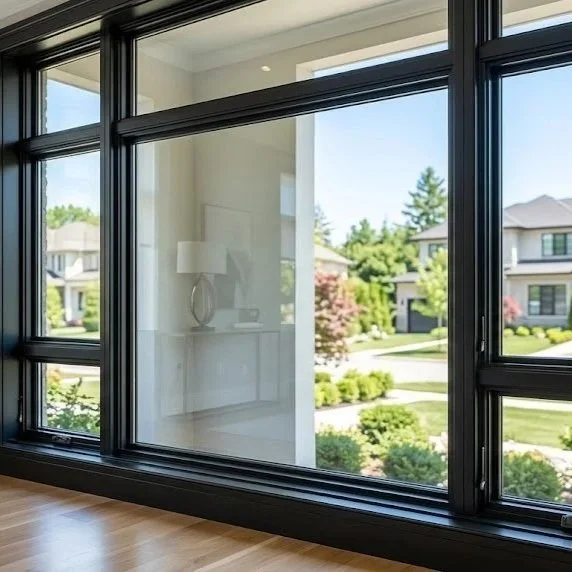
You reach for a cloth and try to wipe it away. Nothing. You move to the other side of the glass and try again. Still nothing. That haze isn't on any surface you can reach — it's sitting between the two panes, getting worse, and there every time you look out the window. It's not a cleaning problem. It's a structural one.
What's Actually Happening Between the Panes
A double-pane window — or insulated glass unit if you want the official term — works by trapping a layer of air or argon gas between two panes of glass, sealed off from the outside world. That sealed cavity is the whole point. It's what makes the window insulate. Running along the inside edge of that cavity is a metal or foam spacer, and packed inside that spacer is desiccant — tiny silica beads or molecular sieve material whose job is to absorb any moisture that sneaks in during manufacturing.
As long as the seal holds, the inside of that cavity stays dry. Clear glass, no visible problems.
When the seal fails, outside air starts getting in. Warm air carries moisture. During the day, that moisture disperses as the glass heats up. At night, when temperatures drop, it condenses against the cooler interior glass surfaces — the faces you can't reach with any cloth. Early on, the fogging comes and goes with temperature changes. Eventually, the desiccant gets fully saturated and stops absorbing. After that, the fog doesn't leave.
Why the Seal Breaks Down
Heat cycling is the main culprit. Every day the sun hits the glass, both panes expand. Every night they contract. The sealant around the perimeter — typically a butyl rubber layer on the inside and silicone or polysulfide on the outside — flexes with each of those movements. Do that ten thousand times over 15 years and it fatigues. Micro-gaps develop. Air gets in.
South- and west-facing windows take the worst of it. They absorb the most direct sun, so they're expanding and contracting harder than windows on shadier exposures. A window that sees 40°F mornings and 105°F afternoons is working considerably harder than one in a mild coastal climate — and its seals show it first.
But heat cycling isn't the only way a seal goes. Cheaper units come with thinner sealant layers and bargain-grade spacer material that wears faster. A knock from a tool during installation, or a slightly too-tight shim, can start a micro-crack before the window's even been used once. Frame movement is a factor too. A vinyl frame that's warped from years of UV exposure, or a wood frame that's swelled and dried a dozen times, puts uneven pressure on the glass unit. When that pressure runs along one edge long enough, the seal gives there first. That's why fogging often starts in a single corner before spreading across the full unit.
Diagnosing the Fog: A Quick-Reference Table
Not all window fogging is a seal failure. Before calling a glass company, make sure you're looking at a failed IGU and not something else entirely.
| What You're Seeing | Where It Appears | Likely Cause | Action |
|---|---|---|---|
| Milky haze or streaks you can't wipe off | Between the panes | Failed IGU seal | IGU replacement |
| Condensation that wipes away from inside | On the interior glass surface | High indoor humidity | Ventilation, dehumidifier |
| Condensation on outer surface on cool mornings | On the exterior glass surface | Normal thermodynamics | No action needed |
| White crusty mineral deposits | Surface (especially in hard-water areas) | Mineral buildup from sprinklers or rain splash | Professional glass cleaning |
| Fog confined to one corner, clears mid-day | Between the panes | Early-stage seal failure | Monitor; plan IGU replacement |
The dead giveaway is fog that lives between the panes and doesn't respond when you warm up the room. If you've been wiping the same window for a month and it never gets cleaner, the moisture's on the inside of the glass — where you can't touch it.
What Happens to the Window When You Leave It
A fogged window isn't just ugly. It's stopped doing its job.
The argon or air that used to sit in that sealed cavity is gone. What's there now is regular outside air cycling in and out through wherever the seal failed — and that means the thermal barrier is gone too. A failed IGU performs roughly like a single-pane window from the 1970s. You've lost the insulating performance and you're paying for it every month in heating and cooling costs.
And it gets worse from there. As moisture keeps cycling in and out of the cavity, it leaves mineral deposits on the interior glass surfaces each time it evaporates. Those deposits etch the glass. It's not unusual to see windows where the fogging had been sitting long enough that the interior glass face was permanently hazy — that etching doesn't go away even after you replace the IGU, because it's scratched into the surface itself.
The frame isn't immune either. Moisture that reaches the spacer channel eventually works its way into the surrounding frame material. Wood frames can start rotting from the inside out — you won't see it until you try to pull the old unit and find soft, crumbling material where there should be solid wood. Even vinyl frames can trap moisture at the corners and set up conditions for mold in the frame channel. It usually announces itself with a smell before you see anything.
Can You Fix It Without Replacing the Glass?
There's a service that advertises defogging by drilling small holes in the outer pane, injecting a cleaning solution, loading in fresh desiccant, and plugging the holes back up. Some homeowners come back 18 months later with the same fog, sometimes worse — the holes don't restore the seal, they just give moisture another entry point. The fogging returns within a year or two, and now you've spent money on a fix that bought you one more winter. For a window you look through every day, or one on a south-facing wall where energy performance matters, that's not a repair. It's a delay.
The real fix is IGU replacement. A glazier pulls the failed glass unit out of the existing frame, measures the opening, orders a new sealed unit to size, and drops it in. The frame stays. The hardware stays. The trim stays. You get full thermal performance back, clear glass, and a proper seal — for a fraction of what a full window replacement costs. Most quality replacement IGUs carry a 10- to 20-year seal warranty.
Most IGU replacement jobs on standard residential windows take less than an hour per opening. If you have multiple fogged units, combining them into a single visit drives down the per-window cost.
Frequently Asked Questions
Seal failures almost always start in one spot before spreading. Bottom corners are the most common location because that's where moisture tends to pool inside the cavity. Edges facing direct sun also tend to fail first. If the fogging is limited to one area and clears during the afternoon heat, the seal has given out but the desiccant still has some capacity left. That window's in early-stage failure — it'll get worse, but you've got time before it becomes urgent.
Usually not. In most cases the frame is structurally fine and the hardware still works. What's failed is the glass unit itself — a separate component from the frame. A glazier removes the failed IGU and installs a new one in the existing frame opening. No new trim, no wall repairs, no disruption to what's around it. Full window replacement makes sense when the frame itself is warped, rotted, or otherwise damaged, but that's a different problem from a failed seal.
Quality IGUs from reputable manufacturers carry 10- to 20-year warranties on the seal. Real-world lifespan depends on climate, orientation, and how carefully the window was installed. South- and west-facing windows in hot climates tend to land at the shorter end. A well-installed window on a shaded north-facing wall in a moderate climate can go well past 20 years without issue.
Argon-filled replacement units outperform air-filled ones on thermal resistance, especially in climates with wide temperature swings. The cost difference between the two is small and the performance gap is real — worth specifying argon when you're ordering a replacement, particularly on south- and west-facing glass that takes full afternoon sun.
Standard homeowner's policies treat seal failure as normal wear and tear, which puts it outside coverage. Insurance covers sudden accidental damage — a rock through a pane, storm breakage, that kind of thing. Seal failure is a maintenance issue. If your window is still within the manufacturer's warranty period, start there before paying out of pocket.
Fog between the panes is condensation sitting on the interior glass faces — you can see it through the outer pane but there's no surface you can reach to wipe it off. The glass itself hasn't cracked or weakened; the problem is thermal performance and what the trapped moisture does to the frame over months and years. Actual glass damage looks different: physical cracks, chips, or a cloudiness that looks ground into the surface itself rather than floating between the panes. A quick test — press your finger to the outside of the glass and see if the haze shifts at all. If it doesn't move, it's almost certainly a seal failure, not surface damage. A glazier can confirm it in about 30 seconds.
A Failed Seal Is a Starting Line, Not an Ending
Fogged windows aren't a disaster. But they're not something to defer indefinitely either. The longer a failed seal sits, the more the inner glass surfaces get etched and the more moisture works into the frame material. Catch it while the frame is still dry and clean, and the fix is one visit, one new glass unit, done. An IGU swap on a sound frame is one of the most cost-effective glass repairs available — you get the thermal performance of a new window without touching anything around it.
Not sure whether what you're seeing is a seal failure or something else? A glazier can tell you in about 30 seconds. The fix, in most cases, is a measurement visit and a replacement unit ordered to size.
Request a free window assessment — Luxe Residential and Commercial Glass handles IGU replacement, window glass repair, and full glass services throughout Las Vegas, Henderson, North Las Vegas, and the surrounding metro. Call (702) 825-7463 (License #0090853) to schedule.
