
What Causes Glass to Crack Without Being Hit?
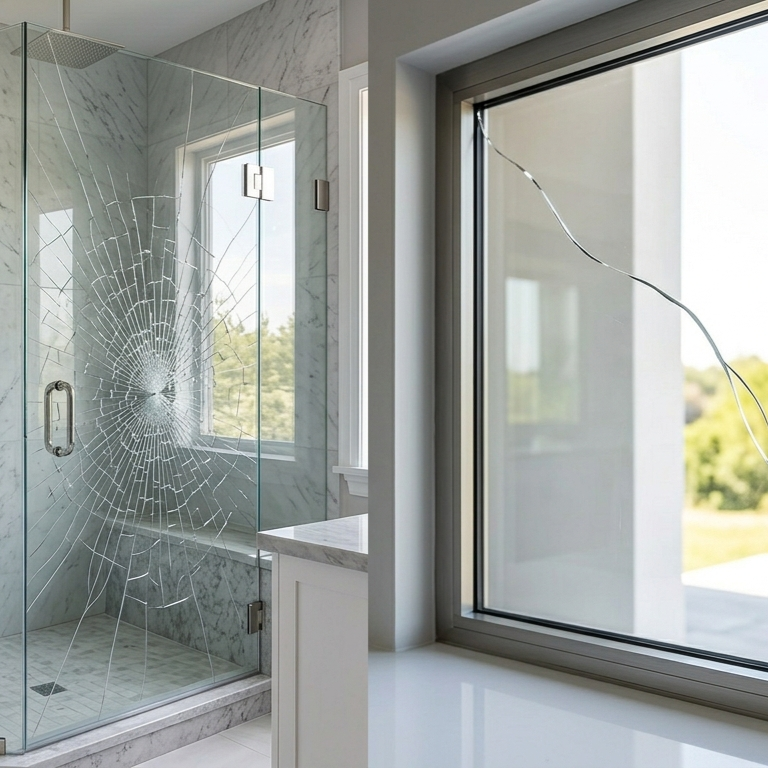
You walk into the room and there it is — a crack running diagonally from the lower corner of the window frame, maybe 18 inches long. You search for an explanation. Nobody threw anything. No unusual weather overnight. The crack just appeared.
This is more common than most people expect. And when it happens, the shape of the crack almost always tells you what caused it.
Why Glass Breaks Without Impact
Before getting into the causes, it helps to understand one thing: glass is fundamentally brittle, and it fails under tension rather than compression.
Steel can deform and bend before it snaps. Glass doesn't deform — it flexes microscopically under load, and when the stress at any surface flaw exceeds a critical threshold, a crack propagates nearly instantly. Glass compressive strength is actually impressive — under compression it can handle enormous loads. But its tensile strength is only about 10% of that compressive value. Every surface scratch, every manufacturing imperfection, every chip on an edge is a potential stress concentration site. When tensile force builds up at one of those points, the crack starts.
That's the foundation. Now here's what creates that tensile force without anyone touching the glass.
Thermal Stress: The Most Common Cause
Imagine standing outside in the morning when the sun just reaches an east-facing window. The center of the pane warms up quickly. But the edges of the glass are buried in the frame — they stay cooler, shaded by the frame material. The warm center wants to expand. The cooler edges resist that expansion. The result is tensile stress pulling outward at the edges and compressive stress building at the center.
If that stress is large enough — and it doesn't require a dramatic temperature swing — a crack initiates at a cooler edge and propagates inward. Thermal stress cracks have a distinctive signature: they typically start perpendicular to the glass edge, run straight for the first inch, then curve gently as they travel across the pane. Unlike impact cracks, they almost never branch into a spider-web pattern. One smooth line, originating at an edge, usually with a slight arc to it.
Several conditions make thermal stress worse. Partial shading is a major factor — when one half of a window is in direct sun and the other is in shadow, the temperature differential across the pane is severe. Curtains or blinds hung directly against the glass trap radiant heat at the center while the frame keeps the edges cool, creating the same thermal gradient indoors. Low-E coatings, which absorb more solar energy than clear glass, can raise the glass temperature enough to increase thermal stress risk in certain configurations.
Window size amplifies the problem. A small pane develops smaller absolute temperature differentials. A large pane — anything over three feet in either dimension — develops enough gradient to crack under moderate sun exposure if other conditions align.
Keep interior curtains and blinds at least two inches away from the glass surface. A blind pressed against a sun-facing window on a bright afternoon can raise the glass temperature enough to trigger a thermal stress crack even in mild climates.
Edge Damage: The Hidden Crack Starter
A lot of cracks that look spontaneous trace back to an edge chip that happened during manufacturing, shipping, or installation — a tiny flaw, invisible to the eye, that created a stress concentration point.
Glass edges need to be cleanly cut with no shells, vents, or jagged interruptions. A poorly cut or chipped edge can reduce glass strength by 50% or more at that specific point. The pane then carries its normal load for weeks or months, and eventually the stress at that flaw exceeds the glass's fracture resistance. The crack starts.
This is why you'll sometimes see cracks appear in a window two to six months after installation rather than immediately. The edge damage was there from day one — the glass held through mild weather, then failed during the first summer heat cycle that loaded the pane a little more aggressively.
Edge-damage cracks look similar to thermal stress cracks: they originate at or very near the glass edge and run perpendicular to it. The distinction matters for warranty purposes and for understanding whether the same problem is likely to crack the replacement pane.
Windows with flawless-looking faces can fail at 18 months because nobody caught the small shell on the edge during installation. Once you know to look for it, you start inspecting edges as a matter of habit before any glass goes in.
Nickel Sulfide Inclusions: The Tempered Glass Problem
This one only affects tempered glass, and it's rare. But when it happens, the result is dramatic: the entire pane shatters at once, with no warning, no impact, and no obvious explanation.
During glass manufacturing, microscopic particles of nickel sulfide can become trapped inside the glass. The source is typically stainless steel components in the furnace combined with sulfur-containing fuels — the inclusion forms as the glass cools. These particles range from 0.05 to 0.5 millimeters in diameter. They're completely invisible once the glass is finished.
Here's the mechanism. Nickel sulfide exists in two crystal phases. During tempering, the glass is heated to approximately 650°C and then rapidly cooled in a cold air blast. That rapid quench "freezes" the nickel sulfide inclusion in its smaller, contracted alpha phase. But the inclusion is unstable at room temperature — it wants to revert to its larger beta phase. And it does, slowly, over years.
When the inclusion is located in the tensile core of the pane — the center zone — its expansion eventually releases the residual stress built into the glass during tempering. The pane shatters completely, typically into the small, relatively blunt fragments characteristic of tempered glass. At the origin point, you'll find a small "butterfly" or "figure-eight" pattern. That's the inclusion site.
The failure rate is low: roughly 0.8% of affected panes, and affected panes represent about one in every 500 manufactured. Failures typically occur two to seven years after installation, with almost none happening beyond 30 years. But in hard-to-access locations — overhead skylights, high stair railings, hotel atriums — that small probability matters.
A process called heat soaking holds the tempered glass at approximately 290°C for a sustained period after tempering, forcing the phase change to complete before the glass leaves the factory. About 95% of problem panes fail during heat soaking and get caught before installation. Heat-soaked tempered glass is the standard specification for overhead glazing and safety-critical locations.
And here's something most homeowner-facing guides miss: heat-strengthened (HS) glass doesn't have this problem. Because HS glass quenches more slowly than fully tempered glass, the nickel sulfide inclusions complete their phase change during manufacturing rather than being frozen in the alpha state. If a project doesn't require the full safety properties of tempered glass and NiS spontaneous breakage is a concern, HS glass is the specification to ask about.
Frame Binding and Installation Stress
Frame binding is less common but worth understanding. Glass that fits too tightly in its frame — with insufficient clearance between the glass edge and the surrounding frame material — can crack under normal thermal cycling.
Standard installation practice calls for at least 3/16-inch clearance on all sides of the glass panel to allow for thermal movement. As temperatures swing, the glass expands and contracts. A properly set panel moves within that clearance space. One set too tight has nowhere to go except back against the frame. The resulting stress concentrates at the edges and, eventually, cracks the pane.
This particular failure is frustrating to diagnose because the glass looks perfectly installed from the outside. No chips, no obvious problems. Then six months into warm weather, a crack appears at the center of one edge and runs inward. The culprit isn't the glass or the weather — it's the clearance tolerance.
But frame binding also shows up when glaziers retrofit new glass into old frames without verifying that the opening is still within spec. Frames can shift and rack over years. A frame that accepted one pane without issue may squeeze a replacement pane that's technically the same dimensions.
Pressure Differential in Insulating Glass Units
Double- and triple-pane windows have a sealed air or gas gap between the lites. That gap is sealed at the atmospheric pressure of the manufacturing location. If the window is then installed at a significantly different elevation, or if a major low-pressure weather system moves through after installation, the pressure inside the sealed unit differs from the outside.
That differential stresses the individual glass lites in opposite directions — one bows inward, the other outward. In most installations and most conditions, the glass handles it. But a large pane, or one with existing edge damage, is at elevated risk.
The resulting crack pattern tends to look like an hourglass or a curved line starting near the center of the pane rather than at an edge. This makes it visually distinct from thermal stress and edge-damage cracks, which both originate at the perimeter.
Reading the Crack Pattern
If you find a crack with no obvious impact source, the pattern is your best diagnostic tool:
- Starts at the edge, runs perpendicular, then curves: Thermal stress or edge damage — the most common residential scenario.
- Starts exactly at the edge, runs straight: Edge chip was the initiating point.
- Entire tempered pane shatters at once, butterfly or figure-eight pattern at one point: Nickel sulfide spontaneous breakage.
- Crack runs parallel to an edge, near a corner or mid-span of an edge: Possible frame binding or installation stress.
- Hourglass-shaped or bowed-center crack in a double-pane unit: Pressure differential in the IGU.
That diagnosis matters because it changes what you do next. Thermal stress cracks in a partially shaded window point to adjusting window coverings or upgrading to a glass specification with better thermal properties. Edge damage points to installation or handling problems to address before replacement. Nickel sulfide failure is a manufacturing issue — the replacement pane should come with appropriate quality certification.
How to Reduce the Risk
You can't eliminate every variable, but a few practical steps address the most common causes.
Choose appropriate glass thickness for the application. Four-millimeter glass handles thermal stress better than standard 3mm for large panes. For frameless shower enclosures and railings, 3/8-inch to 1/2-inch tempered glass is the right starting point.
Keep window coverings away from the glass surface — two inches of clearance prevents the most common indoor thermal stress scenario.
Specify heat-soaked tempered glass for overhead glazing, balcony railings, stair enclosures, or any location where spontaneous breakage would be particularly hazardous. Heat soaking catches approximately 95% of problem panes before they're installed.
Don't ignore edge chips. If you notice a chip on the edge of a glass panel during installation or shortly after, have it assessed before assuming it's fine. A chip at the wrong location can crack the pane during the first significant heat cycle.
Verify proper clearance at installation. Any glazier worth hiring will confirm the installation clearance before setting the glass, and it's a reasonable thing to ask about on any project.
Frequently Asked Questions
Yes — that's the nickel sulfide failure mode. It's uncommon (roughly 0.8% of affected panes, and not all panes contain NiS inclusions), but when it occurs the entire pane breaks at once. Heat-soaked tempered glass significantly reduces this risk by eliminating most problem panes before installation.
Thermal stress doesn't require extreme heat — it requires a temperature differential across the pane. In winter, direct sun on one portion of a window while the frame shades the edges can still generate enough of a gradient to crack the glass. Indoor forced-air heating also creates large indoor-to-outdoor temperature differences that load the glass from the warm side.
Possibly. Corner cracks can indicate frame binding — the glass was set without adequate clearance and the frame is compressing it. They can also indicate edge damage during installation. Both scenarios point to an installation problem rather than a defective pane, and both suggest the replacement should be done differently.
In most cases, no. Glass cracks propagate at very high speed through the material. By the time you see a crack, it has already reached its final extent. Stop-drilling (drilling a small hole at the crack tip to relieve stress) is used in some industrial glazing applications but isn't a standard residential practice.
Yes, meaningfully. Annealed (standard float) glass doesn't have the nickel sulfide failure mode. Heat-strengthened glass is also immune to it. Only fully tempered glass is at risk for NiS-induced spontaneous breakage — but tempered glass is required in safety glazing locations (showers, railings, doors, sidelights) because its breakage behavior is far safer than annealed glass. The answer isn't to avoid tempered glass; it's to specify heat-soaked tempered glass where the stakes are highest.
Replace it promptly when the crack compromises the seal of a double-pane unit (fogging between the panes confirms this), when the glass is in a safety glazing location, or when the crack is likely to grow under normal thermal cycling. A stable crack in a low-stress location may hold temporarily, but glass doesn't repair itself, and thermal cycling will usually propagate the crack further over time.
What the Crack Pattern Is Telling You
A crack with no impact explanation is glass under stress it couldn't absorb. Sometimes that stress built up over years — a manufacturing edge chip, a marginally tight frame, a small inclusion waiting to expand. Sometimes it appeared because of a new blind, a different seasonal sun angle, or a temperature swing that was just slightly more extreme than usual.
Either way, the pattern in the glass is information. Match the pattern to the cause, and you'll know whether you're dealing with a one-time event or a condition that will crack the replacement pane, too.
Schedule a glass assessment — Luxe Residential and Commercial Glass handles residential and commercial glass repair and replacement throughout Las Vegas, Henderson, North Las Vegas, and the surrounding metro. Call (702) 825-7463 (License #0090853) to schedule.
