
Glass Thickness for a Tabletop or Shelf: Start With Span
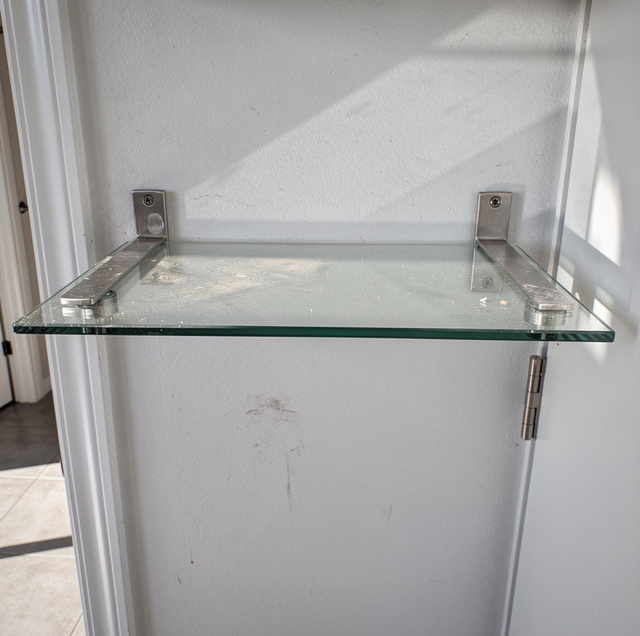
Glass does not shed a load the way a board does. Put weight on a panel, and it bends, stretching the underside while the top face is squeezed, so everything a tabletop or a shelf carries concentrates in a thin skin along the bottom. Thickness resists that bend steeply: stiffness climbs with the cube of the thickness, so one step up is never a small step.
So your answer starts somewhere other than a number. It starts with how far your panel must reach with nothing under it, and with what you plan to set on it. You can take both measurements yourself, and you will have narrowed down the thickness of your top or shelf before you ask anyone about glass.
Three Problems Hiding Inside One Question
Three objects sit behind this question, and they do not share an answer. A protective top laid over a table you own, a glass top that is itself the table, and a shelf hung with nothing under its middle are three load problems. In the first, the glass is a wear surface. In the third, it is the structure.
A protective top has something solid under every square inch. Set a heavy pot down, and the wood underneath takes the force; the glass only spreads it and survives the contact. Nothing reaches across open air, so the panel need not be stiff. It is being asked to resist scratching, heat, and dropped objects, and to carry a safe edge.
A glass top that is the table itself bridges a base, a trestle or four legs, and whatever it crosses is unsupported. Stiffness matters now, and so does the shape of what holds it up: a top on a single pedestal has its whole perimeter in open air, while four corner legs shorten every reach.
An unsupported shelf is the hardest of the three. It carries weight along its entire length, with support only at its ends, and the people loading it are not thinking about the load. A row of hardbound books is heavier than the shelf's owner pictures.
Why the Unsupported Reach Does More Work Than Overall Size
Two panels of the same thickness can behave completely differently, and what separates them is not area but the clear distance the glass crosses between supports. Bending climbs fast with that distance and drops fast with thickness, which is why a shelf that feels solid at twenty-four inches between brackets can feel alive under a hand at thirty-six. One glass professional's rule of thumb puts a number on it: for a quarter-inch tempered shelf in an open bookcase twelve inches deep with thirty-nine inches of clear width, the deflection over that distance is worth taking seriously even under a small load, and three-eighths-inch glass would be closer to a sensible minimum for that span and depth. That is a working rule offered as an opinion, not a specification, so treat it as a starting point rather than a code figure. What makes it worth repeating is the shape of the advice: a thickness tied not to shelves in general but to a specific span and depth.
Load is the second variable, and it multiplies the first. Sag tracks the weight on the panel, so doubling what sits on a shelf roughly doubles how far it bows. Glass stays elastic right up to the moment it is not. A panel quietly bowed under a load for two years looks the same as one installed yesterday, and gives no notice that it has been living near its limit.
The same point is worth keeping in mind: wood bends when you exceed its capacity, sometimes comically, while glass fails, sometimes dangerously. A wooden shelf too thin complains for months. A glass shelf too thin looks correct until it is on the floor in pieces.
What Each of the Three Applications Asks of the Glass
| Application | What carries the weight | What thickness buys | What a fabricator needs |
|---|---|---|---|
| Protective top over existing furniture | The furniture underneath | Surface toughness and a safe edge | The outline and corner radius |
| Self-supporting top on a base | The glass itself | Stiffness from the base to the rim | The overhang on each side |
| Wall shelf on brackets or pins | The glass, at two points | Stiffness across the clear span | The distance between supports, and the depth |
The reason a single number cannot serve all three shows up in the middle column. Only two rows want the glass to be stiff. The top row wants it tough at the surface, a different property, and one thickness barely improves. A thin protective top with a polished edge does that job; the same panel bridging two brackets would not.
For furnishings where the glass carries its own weight, the working range runs from three-eighths to three-quarters of an inch, the heavier end reading as more solid. A protective top is not in that conversation: it rests on something already solid, so it is routinely thinner, and naming the application keeps the two apart.
What Fogs the Glass Between a Table Top and the Wood Beneath It?
Lay a panel flat onto a finished wood surface, and you have built a sealed pocket. A spill wicks under the edge, warm air in that pocket cools against the glass overnight, and moisture condenses on the underside. The haze forms on the face you cannot reach, so cleaning the top does nothing, and over months the trapped damp can lift the finish below. A coating still curing gives the same look: a fresh finish gives off solvent for weeks, and a panel laid straight onto it blushes the surface white.
The cure is a gap. Small, clear bumpers at the corners and along the long edges hold the panel a fraction of an inch off the wood, so air can move under it and a spill can dry. They also stop the panel sliding and keep grit from grinding between hard surfaces.
Tempered, Laminated and Annealed Break in Three Different Ways
Annealed glass is ordinary float glass cooled slowly. It is the easiest to cut and order, and it breaks into long, pointed shards that retain their weight and edge. On a horizontal panel people reach across, that break is worth engineering away.
Tempering changes the glass, which changes the break. The quench puts the outer skin into compression, creating a surface compression of at least 10,000 pounds per square inch, and that process is what makes tempered glass four to five times stronger and safer than annealed or untreated glass. A national testing standard sets the specifications heat-treated and tempered glasses are made to.
Tabletops are a common use for fully tempered safety glass, alongside countertops, showcase enclosures, refrigeration and food-service equipment, and furniture, precisely because of its strength and safety characteristics. The reason sits in how it lets go: safety glazing, when broken, fractures into relatively small pieces, which greatly reduces the chance of serious cutting or piercing injuries compared with ordinary annealed glass. Where safety glazing is required in a building varies by location, and what your room needs is a question for your local building authority.
Never cut, drill or grind a tempered panel to make it fit, because the stored compression can burst it into fragments in your hands; have a glass fabricator cut, shape and finish the panel before it ever goes into the furnace.
What Fogs the Edge of a Laminated Panel?
Laminated glass is two plies bonded to a plastic interlayer, and cutting it exposes that interlayer as a thin stripe along the raw edge, the only part of the laminate the outside world can touch. Standing moisture at that stripe is the one condition a laminated panel dislikes. Where water sits against a raw edge for long periods, the bond at the perimeter can turn hazy, and the cloudiness creeps inward as a band parallel to it. No cleaner reaches it, because the haze sits inside the laminate. Ask about edge treatment for any laminated panel headed for a bath.
What laminated buys in return is behavior on failure: the interlayer holds the broken pieces in place instead of releasing them. On a shelf above a seat, a crib or a workspace, that counts for more than the stiffness the extra plies add.
The Measurement Worth Taking Before Anything Else
If you take one measurement before you speak to anyone, take the clear span. On a shelf it is the distance between the inside faces of the brackets, not the length of the shelf. On a tabletop, it is the distance from the base to the rim. On a protective top there is no span at all, and knowing that is the answer: you are buying an edge and a surface instead of a beam.
Depth comes second, and load comes third, in plain terms rather than in pounds: books, a television, a caddy that stays wet. A fabricator with those three can size the panel, choose between tempered and laminated, and specify the edge and brackets. A fabricator holding only a length is guessing, and so are you.
Frequently Asked Questions
Not its stiffness, but where a break in your panel starts changes. Cutting leaves flaws along that face, and a bending panel gives way from one of them. Polishing removes them, which is why you want a polished edge on any panel you load. A bevel thins the perimeter, so keep it off a shelf you load.
Yes, the way to get it right is a template. You make a full-size pattern of the surface in heavy paper, cut it to the outline including every curve, and mark which face is up. Your fabricator cuts to your pattern. A measurement cannot describe your corner radius, and a top a quarter inch out on a curve reads wrong to you from across the room.
Color, and nothing you could load it with. Clear float glass carries iron that gives it a green cast, invisible in a thin pane but obvious along the edge of a thick one. Look down at your three-quarter-inch panel and every edge reads green. Low-iron glass removes most of that tint, so your thick top looks colorless from every angle. It changes nothing about strength or stiffness.
Pins work, but they put your whole load into two small contact patches at the back corners, and glass dislikes point contact. Pins meant for glass carry a soft sleeve or channel that spreads the bearing over a wider footprint, and they should sit close to the ends of your shelf, not near its middle. A full-length bracket supports your entire back edge, and you want one for anything really heavy you store.
Yes, and it changes your sequence too. Any hole in tempered glass has to be drilled before the panel goes into the furnace, so you fix your position at the design stage and cannot revise it later. A hole also interrupts the panel and adds an interior edge, so fabricators keep holes away from the perimeter and away from the middle of a span, and expect a cutout panel to be specified a step thicker than the one you would order without it.
Sight along it in a raking light. Empty the shelf, then lay a straightedge or run a taut string from one support to the other and look at the gap at midspan; then load it as you normally would and look again. A visible change means the panel is working hard, and a shelf you can see bowing under its everyday load is one to lighten now. Two other tells matter as much: any chip or nick along an edge, which is the place a break will always start, and any rock or movement in your brackets. Glass gives you no gradual warning the way a wooden shelf does, so you have to inspect before anything visible goes wrong.
Take the clear span and the depth before you call anyone — a glass specialist can tell you what thickness that reach and load actually require, whether tempered or laminated glass suits the position, and which edge finish belongs on the panel. Luxe Residential and Commercial Glass serves the Las Vegas Valley. Call (702) 825-7463.
