
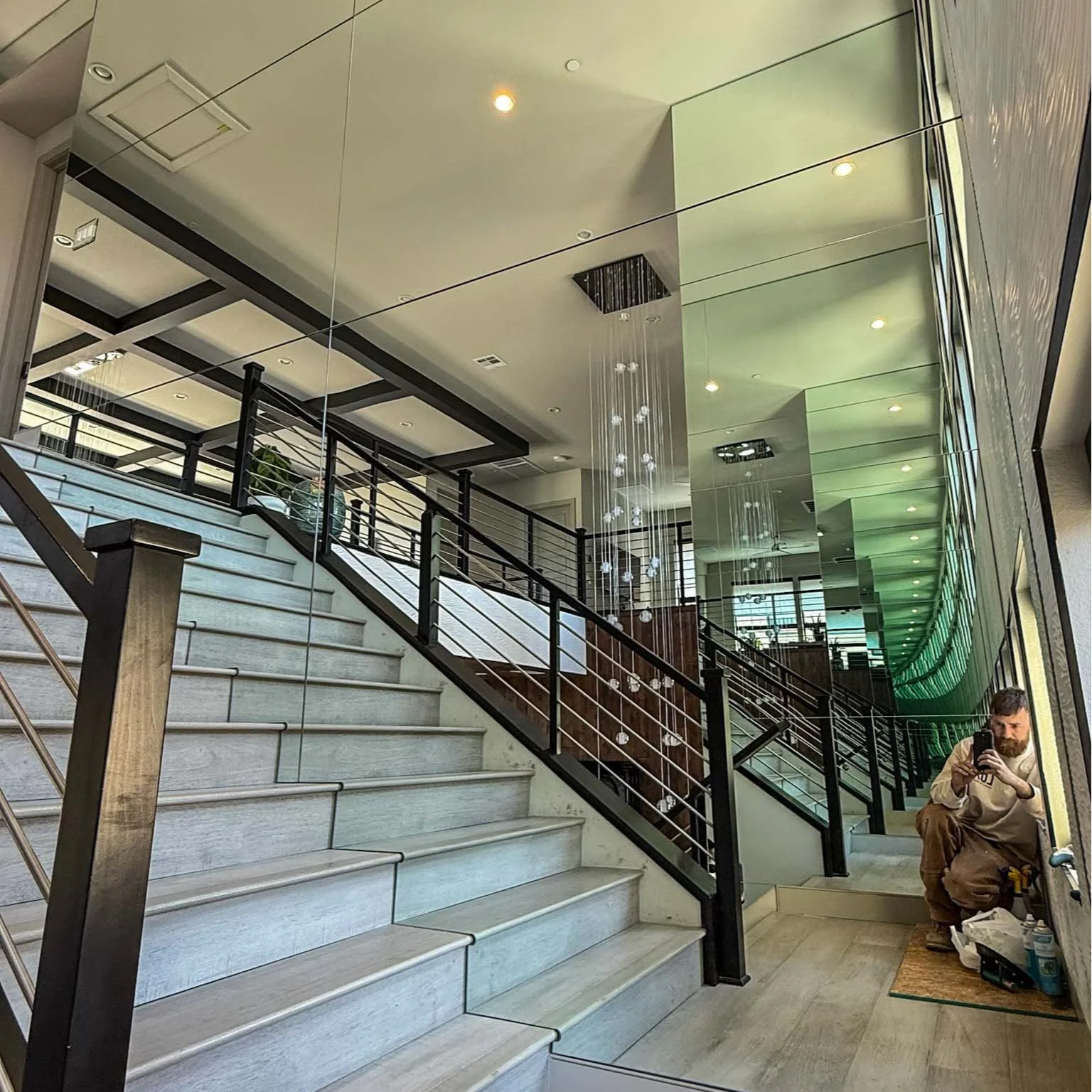
You are standing at a showroom sample board, and you push lightly on two different glass railing panels. One moves. The other doesn't. That difference isn't just glass thickness — it's the entire logic of two separate systems, and understanding it makes the rest of this decision a lot easier.
Both frameless and framed glass railings use tempered safety glass. Both meet code when installed correctly. But the way each system transfers load — from the glass to the hardware to the structure below — is completely different, and that difference drives everything else: cost, maintenance, long-term performance, and which one actually fits your space.
How Each System Works
In a framed glass railing system, the structural work is done by the frame. Aluminum or stainless steel posts and rails surround each glass panel and carry the lateral load — the force you'd apply if you leaned against it or bumped into it. Because the frame does the heavy lifting, the glass panels themselves only need to be about 1/4 inch (6mm) thick. The frame transfers load to the base posts, which anchor into the deck or floor structure.
In a frameless system, the glass IS the structure. There are no vertical posts between panels and no frame surrounding the edges. Instead, thick glass panels — typically 3/8 inch (10mm) or 1/2 inch (12mm) for longer spans — are set directly into a continuous base channel at the bottom, or clamped by individual spigot mounts anchored into the substrate. The glass panel itself carries the lateral load down to those anchors. That's why the glass has to be so much thicker: it's taking a job the frame would otherwise do.
The glass isn't decorative. It's structural. That's the whole difference.
What the Glass Thickness Actually Means
When you hear "frameless requires thicker glass," the reason matters more than the number. A 1/2-inch tempered glass panel has a significantly higher modulus of elasticity than 1/4-inch glass — meaning it resists deflection under load. IBC and IRC building codes require glass railings to withstand a concentrated load of 200 pounds applied to the top rail, plus a distributed load of 50 pounds per linear foot. For frameless systems, that load goes through the glass. For framed systems, it goes through the metal frame.
Frameless panels are typically sized to span no more than 48 inches between base channel sections or spigot mounts. Push a frameless panel to 60 or 72 inches without adjusting thickness, and deflection under load becomes a real concern — not catastrophic failure, but enough panel flex to be visually noticeable and eventually enough to work the silicone or dry-glaze fill in the channel loose.
For any frameless run over 48 inches between anchor points, specify 1/2-inch (12mm) glass minimum. At 36 inches or under, 3/8-inch (10mm) is standard.
What It Costs: An Honest Breakdown
| Cost Factor | Framed System | Frameless System |
|---|---|---|
| Installed cost (per linear foot) | $100–$300 | $200–$600 |
| Glass thickness | 1/4 inch (6mm) | 3/8–1/2 inch (10–12mm) |
| Hardware complexity | Standard posts and rails | Precision spigots or channels |
| Typical 20-foot deck run | $2,000–$6,000 | $4,000–$12,000 |
| Long-term maintenance cost | Higher (frame joints) | Lower (glass only) |
The price gap is real. Frameless costs more upfront because the hardware is more precise, the glass is heavier, and the installation takes longer — every base channel section has to be perfectly level, and every spigot anchor has to hit the right depth in the substrate. One misaligned anchor on a frameless system and you've got a panel that rocks under load.
And it shows up in a predictable pattern. Budget frameless installs that undercut the market almost always have one of two problems: anchor bolts that weren't set deep enough into the substrate, or channel sections that weren't fully grouted. Both cause the same symptom — a panel that shifts slightly when you apply pressure, then gradually loosens as the silicone fill compresses.
The View and Aesthetic Difference
This one isn't subtle. A framed railing has visible horizontal top rails and vertical posts every few feet. That's not a flaw — it's a design element, and in traditional, craftsman, or transitional homes, it often looks exactly right. Powder-coated black aluminum frames look sharp against natural wood decking.
But if the selling point of a deck, staircase, or balcony is the view behind it — a pool, a skyline, a mountain range — frameless is the only system that gets out of the way. Even a well-designed frame interrupts the line of sight at mid-panel height. Frameless glass is like no railing at all, visually.
Indoor applications tell the same story. A staircase with frameless glass railings reads as open. The same staircase with framed posts reads as divided.
Maintenance: Where Framed Systems Lose Ground
But cleaning a framed railing is about more than wiping glass. Every joint where a post meets the bottom shoe, every corner where the top rail meets a post — those are collection points for water, mineral deposits, and oxidation. In areas where hard water is common, those joints accumulate calcium buildup that standard cleaning won't touch. You end up needing oxalic acid or a phosphoric acid solution to clear the white scale from the metal-glass interface, and you're doing it two or three times a year.
Some homeowners come back to me after two or three years with framed railings that looked great at installation, but had developed a white crust along every frame-to-glass joint. Hard water is the culprit, and that narrow gap between the rubber gasket and the glass is where it concentrates. At some point, you're not just cleaning anymore — you're fighting chemistry.
Frameless systems are simpler to maintain. Glass cleaner, a squeegee, and it’s done. The only ongoing attention they need is periodic inspection of the base channel fill and spigot fasteners to ensure nothing has come loose.
What Can Actually Go Wrong
Both systems are safe when installed properly. The failure modes are different.
Framed Systems
The most common long-term issue is galvanic corrosion at aluminum-steel interfaces — particularly where aluminum frame posts are fastened to steel deck hardware. When dissimilar metals contact each other in the presence of moisture, the less noble metal corrodes. Aluminum in contact with steel without an isolation gasket will deteriorate at the fastener zone over time. This doesn't cause immediate failure, but it does cause the post to loosen at the base, which compromises the whole run.
The second common issue is frame joint loosening. Aluminum expands at approximately 0.0000131 inches per degree Fahrenheit. In a climate with significant temperature swings between winter lows and summer highs — say, 40°F to 110°F — a 10-foot aluminum frame run will expand and contract by almost 1/8 inch over that thermal cycle. Over the years, the cycling works the set screws and compression joints loose.
Frameless Systems
The failure is almost always at the base anchor. Either the anchor bolts ,pull slightly from the substrate that wasn't properly prepped, or the channel fill deteriorates, and the panel begins to rock. Neither is catastrophic — tempered glass won't shatter from slight movement — but a panel that rocks under load is a problem that needs to be addressed before it gets worse.
A frameless panel that visibly shifts or rocks when you push on it is not a glass problem. It's a hardware or substrate problem. Do not attempt to stabilize it with structural adhesive. The anchor points need professional inspection.
Which System Is Right for Which Situation
| Situation | Better Choice | Reason |
|---|---|---|
| Budget-conscious renovation | Framed | Lower installed cost |
| Deck or balcony with a view | Frameless | No visual obstruction |
| High-traffic commercial staircase | Either (framed slightly preferred) | Simpler code compliance, easier post-repair |
| Indoor residential staircase | Frameless | Openness, modern aesthetic |
| Areas with hard water | Frameless | Fewer joint crevices for mineral buildup |
| DIY-adjacent installation | Framed | More forgiving on alignment tolerance |
| Exterior in high UV environment | Frameless | No rubber gaskets to degrade |
Frequently Asked Questions
Not inherently — both meet the same structural requirements when installed correctly. The difference is how load is transferred. Frameless carries load through the glass itself; framed carries it through the metal frame. A properly installed framed system is just as structurally sound as a properly installed frameless system. Where frameless wins is longevity: fewer components to degrade, fewer joints to loosen.
Yes, and most code-compliant frameless installations include a top rail — typically a 1.5- to 2-inch round or square stainless steel or aluminum rail mounted through or above the glass panels via post extensions. The rail adds a graspable surface that building codes require for most staircase and elevated deck applications. Some designers omit it on low-height decorative railings, but verify with your local building department before assuming that's permitted.
Standard frameless panels are 3/8 inch (10mm) for spans up to about 48 inches and 1/2 inch (12mm) for longer spans or higher-load applications. All glass used in structural railing applications must be tempered or laminated tempered — never annealed. If you're not sure what you have, look for the etched or ceramic-printed safety certification in one corner of the panel.
Aluminum frames don't rust, but they can oxidize and corrode — particularly at fastener points where dissimilar metals contact each other. Powder-coated frames resist surface oxidation well. The problem areas are the connection points: the screws, anchors, and post bases, especially if the installer didn't use isolation tape or gaskets between the aluminum and any steel hardware. Using stainless steel hardware throughout eliminates most of this concern.
Framed is generally easier to repair. The frame sections act as guides, so a replacement panel just needs to be the right thickness; the frame tolerates minor size variation. In a frameless system, each panel is custom-cut to its specific opening, and the fit has to be precise because there's no frame to bridge a gap. Panel replacement in a frameless system typically requires the original shop drawings or careful field measurement. Either way, a glazier can have the right panel cut and installed in a day.
Stand at one end of the run and push each panel firmly toward the open side — not a light touch, a real push as if you bumped into it hard. The panel should have zero movement at the base. Any rocking, clicking, or shifting at the base channel or spigot means something has worked loose and needs attention before someone leans on it at full weight. You can do that test yourself in about five minutes.
Ready to install or replace glass railings? Luxe Residential and Commercial Glass handles frameless and framed glass railing installation throughout Las Vegas, Henderson, North Las Vegas, and the surrounding metro. Call (702) 825-7463 (License #0090853) to schedule a free measurement.
