
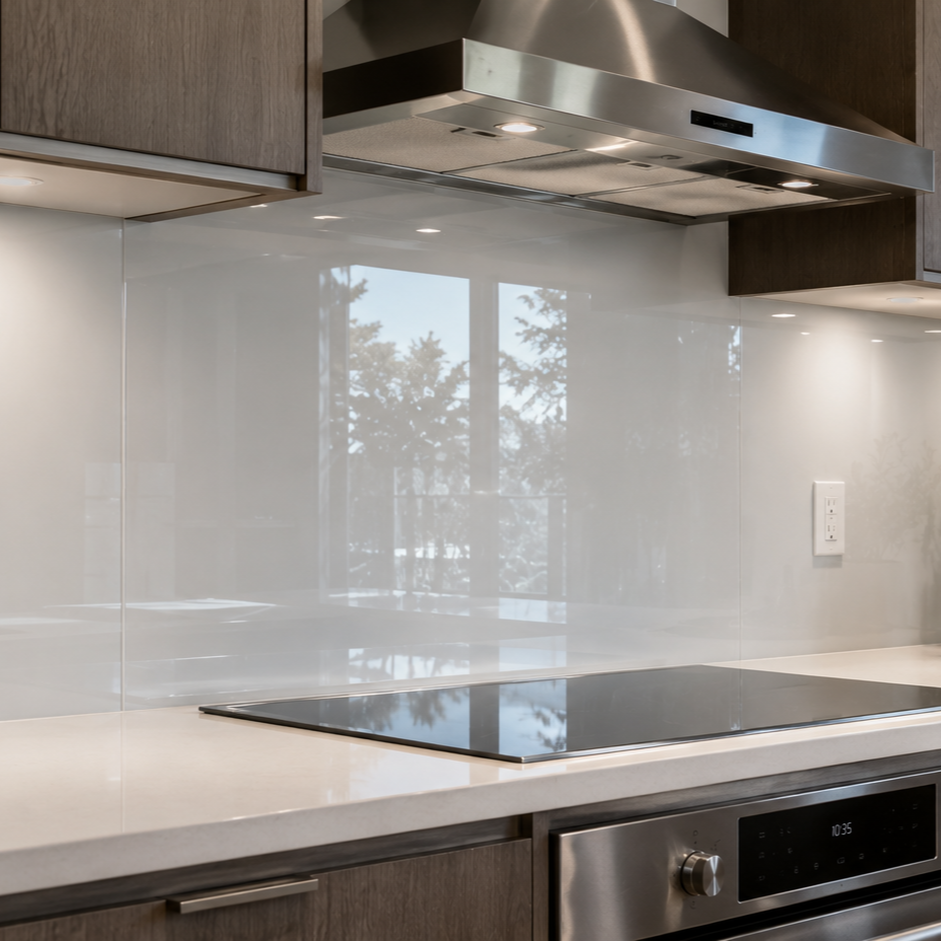
You're standing in a showroom, looking at a full slab of back-painted white glass, and the number on the quote is $2,400. Two hours later you're on a tile website seeing glass mosaic tile for $8 a square foot. Both say "glass backsplash." Only one of them is what you saw in the showroom.
That's the first thing to get straight. The phrase "glass backsplash" covers two completely different products: glass tile — small pieces in a mosaic or subway format, set in thinset with grout lines — and sheet glass — a single tempered panel custom-cut to your wall, back-painted or printed, with no joints or grout at all. They look different, install differently, and cost very different amounts. Most of the price confusion homeowners run into comes from mixing up these two categories.
Glass Tile vs. Sheet Glass: Two Different Products, Two Different Prices
Glass tile is installed the way ceramic tile is. A tile setter lays it in thinset mortar, applies grout, and seals it. The glass is the material — small pieces in a grid. Sheet glass is fabricated by a glazier. It comes in as one large panel, laser-templated to your wall, custom-cut with a water-jet for every outlet and corner, and adhered with structural silicone. No grout lines. No joints through the center of the field.
| Type | Typical Installed Cost | Key Notes |
|---|---|---|
| Glass mosaic tile (small pieces, grout lines) | $25–$45 per sq ft | Tile setter work; grout lines; edges can chip |
| Sheet glass, standard clear, stock color | $40–$65 per sq ft | Glazier work; no grout; requires flat wall |
| Sheet glass, low-iron, custom paint match | $75–$130 per sq ft | Color-matched coating; ultra-clear glass base |
| Printed glass (digital image or pattern) | $100–$200 per sq ft | Ceramic-frit or UV printing; longest lead time |
The rest of this article is about sheet glass — custom-fabricated panels — because that's the product where price surprises show up and where understanding the cost drivers actually helps you budget accurately.
What Goes Into the Price
The Glass Base
Standard clear glass has a slight green tint. You can see it most clearly on the edge, but it also affects back-painted glass: the color shifts slightly green, which changes how accurately your paint color reads. Low-iron glass removes that tint. The visual difference matters most with whites, pastels, and cool grays. It costs roughly $5–$10 more per square foot than standard clear, and on a custom color-match job, it's not optional — you'd be approving a paint sample that looks different once it's in standard glass under your kitchen lighting.
Thickness is the other driver. Most sheet glass backsplashes use either 1/4-inch (6mm) or 3/8-inch (10mm) glass. For areas near a cooktop — within about 18 inches of a burner — thicker, fully tempered glass is the standard call because it handles thermal cycling better. Going from 1/4-inch to 3/8-inch adds roughly $8–$15 per square foot to the material cost. Tempering itself requires an additional furnace cycle in fabrication, which is built into that premium.
Back-Painting
This is where a large portion of the cost lives. Stock colors — whites, blacks, and grays — are less expensive because the fabricator keeps them in inventory or can source them quickly. A custom color match, where they mix paint to hit a specific manufacturer code to match your cabinets or countertops, requires ordering in small batches. Expect a premium of $10–$30 per square foot over stock color pricing for a true custom-matched finish.
And it shows up in a predictable pattern. The jobs that end up over budget are almost always the ones with a specific client-supplied color code where the fabricator has to source a small batch run. If your design works with white, gray, or black, you can save meaningfully — and still get a seamless, high-end result.
The Cut List
Water-jet cutting is precise. It's also not free. Every outlet box, light switch, or receptacle opening in your backsplash area requires a custom cut. Each opening typically adds $50–$150 to the fabrication cost. Three outlet openings on a standard counter strip isn't a big deal. A full-height backsplash with a vent hood niche, a two-gang switch plate, four outlet boxes, and an inside corner adds several hundred dollars to the cut list before you've changed anything else about the glass.
Inside corners and L-shaped runs require either two panels with a silicone joint or precision mitered edge work. The joint is the more common solution. The miter adds cost.
Wall Condition: The Part Nobody Mentions in the Quote
Here's the one that catches homeowners off guard.
Sheet glass doesn't flex or conform to the wall. It's rigid. The substrate behind it has to be flat within about 1/8 of an inch across the entire run, or you'll have voids where the silicone can't bond and gaps at the perimeter where water can eventually get in.
Most installers don't include it in their initial quote — not because they're hiding it, but because they genuinely can't see it until they're standing in your kitchen with the right lighting.
Some homeowners come back frustrated that their final bill was $400 more than quoted, and when we walked through it together, it was always the skim-coat. The wall was uneven, nobody caught it at the estimate stage, and it only came up on installation day. Run the level test yourself before you finalize your budget.
Labor: When It Stays Low and When It Climbs
Labor on a sheet glass backsplash typically runs $15–$30 per square foot for a standard install — a straight counter-to-cabinet strip with a few outlet openings. On more complex work, labor can reach or exceed the glass cost itself.
| Scenario | Typical Labor Add | Why |
|---|---|---|
| Straight run, 2–3 outlet cuts | Included in base rate | Standard layout, single technician |
| Full-height backsplash (to upper cabinets) | +$300–$600 | Larger panel handling; two technicians required |
| Vent hood niche or inside corner | +$150–$350 | Additional template work and fit adjustments |
| Skim-coat wall prep | +$200–$500 | Not included in most initial quotes |
| Existing tile removal | +$150–$400 | Depends on adhesion type and layer count |
A two-person installation crew should be expected for any full-height job or any panel wider than about 4 feet. Oversized panels need two sets of hands to set safely. Some fabricators build the two-technician requirement into their quote automatically for panels of that size — ask when you're reviewing the estimate.
What the Finished Invoice Usually Looks Like
The backsplash area above a standard kitchen counter typically runs 20–35 square feet — the 18-inch-tall strip from countertop to upper cabinets. A full-height kitchen backsplash covering all wall sections can reach 60–100 square feet.
| Project Type | Typical Total Range | What's Included |
|---|---|---|
| Counter-strip, stock color, 20–25 sq ft | $1,200–$2,000 | Glass, standard cuts, installation |
| Counter-strip, custom color, 25–35 sq ft | $2,000–$4,500 | Glass, color match, cuts, installation |
| Full-height, stock color, 50–70 sq ft | $3,500–$6,500 | Larger panels, two-tech installation |
| Full-height, custom color, 60–90 sq ft | $6,000–$12,000 | Custom coating, full prep, installation |
These are total installed ranges. Wall prep, existing tile removal, and permitting — which is rarely required for backsplash work but worth confirming — are typically separate line items.
The Shortcuts That Don't Hold
The temptation to use standard float glass instead of tempered, or to skip the low-iron upgrade when the color spec really requires it, usually surfaces when a budget is already stretched. These are false savings.
Standard float glass near a cooktop will accumulate thermal stress from repeated heating and cooling cycles. A crack along the center of the panel — not from impact, just from that cycling — typically shows up two to five years in. By that point, the silicone is bonded, and the wall prep is done. Replacing the panel costs nearly as much as the original installation because all that work has to be repeated.
But the low-iron skip is subtler and more frustrating. You approve the painted glass sample in the fabricator's shop under fluorescent light, and it looks close. When it's installed in your kitchen under warm LED lighting, the green cast in standard glass shifts the color just enough that it doesn't match the cabinets anymore. The only fix is a new panel with the right glass base. Specifying the correct product the first time is always cheaper than replacing it later.
Frequently Asked Questions
Sheet glass panels typically cost two to four times more per square foot than standard ceramic or porcelain tile. Glass mosaic tile (small-piece format) is closer in price to mid-range ceramic. The premium for sheet glass comes from the fabrication side: laser templating, precision water-jet cutting, and custom painting add costs that standard tile installation doesn't carry. For a grout-free surface that wipes clean in seconds, most people who've had both say the sheet glass is worth the difference.
A properly installed sheet glass backsplash can last 20-plus years with minimal maintenance. There's no grout to stain, no sealant to reapply, and the back-painted surface won't fade under normal kitchen conditions. The silicone perimeter caulk is the most likely maintenance item — inspect it every five to seven years and replace it if it starts to shrink or pull away from the wall.
Yes, in almost every case. Sheet glass needs to be adhered to a solid, flat substrate — typically drywall or cement board. Setting glass over existing tile adds thickness to the wall, creates an uneven surface, and risks adhesion failure over time. Tile removal typically adds $150–$400 to the project, depending on how the original tile was set and how well it's bonded to the wall.
Yes — but it must be fully tempered. The concern isn't the open flame; the backsplash sits behind the range, not directly above the burners. The concern is thermal cycling: the wall surface heats and cools repeatedly during cooking, and annealed glass accumulates stress from those cycles. Any glass within 18 inches of a cooking surface should be specified as fully tempered, and your fabricator should confirm this in writing on the quote.
Ask each to specify the same four items: glass thickness, glass type (standard clear or low-iron), paint system (stock or custom-match), and what the quote explicitly excludes. A $1,800 quote that excludes wall prep and existing tile removal can end up costing more than a $2,400 quote that covers everything. Get the exclusions in writing before comparing numbers.
Hold a four-foot level flat against the wall where the glass will go and look for daylight underneath it. Any gap larger than 1/8 inch means skim-coating is needed first. A glazier can confirm it in about 10 minutes on-site — and if skim-coating is required, you're better off knowing that before you've signed a quote.
Get a quote for custom backsplash glass — Luxe Residential and Commercial Glass handles custom back-painted panels, precision fabrication, and full installation throughout Las Vegas, Henderson, North Las Vegas, and the surrounding metro. Call (702) 825-7463 (License #0090853) to schedule.
