
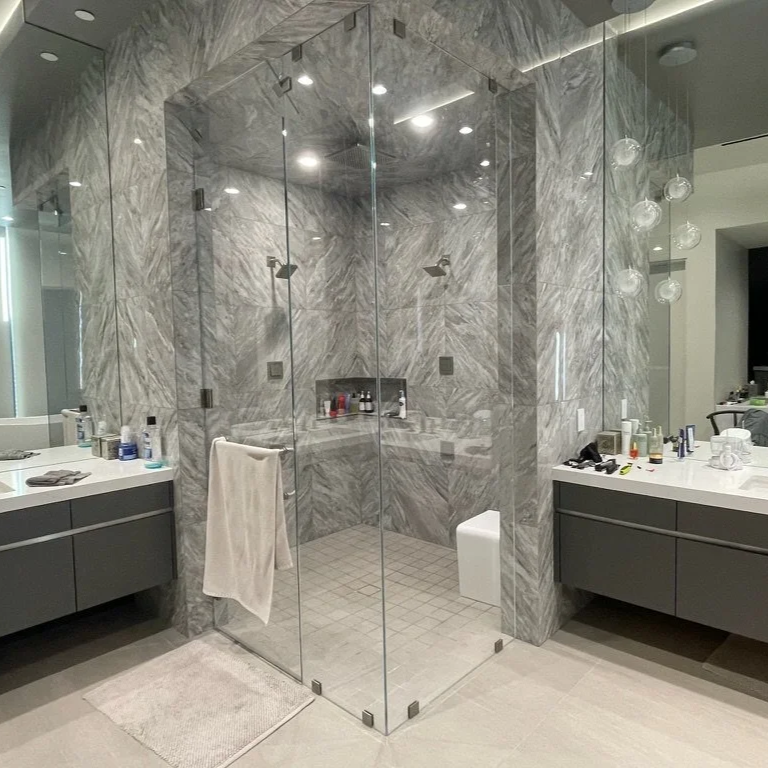
The quote comes back, and you stare at it for a second. Four figures for a shower door. That seems steep — until you’ve carried a half-inch tempered glass panel up a staircase and tried to set it plumb against a wall that isn’t.
Frameless shower doors typically run between $1,000 and $3,500 installed, with most residential projects landing in the $1,400–$2,200 range. Custom shapes, premium hardware, or larger enclosures push that number higher. A basic single-door configuration on a smaller shower comes in at the lower end.
That’s the honest range. Here’s what actually determines where your project falls.
What’s Included in That Price
A properly quoted frameless shower door covers three things: the glass, the hardware, and the labor.
The glass is custom-cut to your opening — not pulled from stock. A glazier measures the space, accounts for walls that are out of plumb, and orders panels fabricated to those exact dimensions. There are no off-the-shelf panels in a frameless installation.
The hardware includes hinges, a door handle, and typically a bottom sweep. Depending on the configuration, you may also have wall clips, a U-channel, or fixed panel clamps. These components are load-bearing — they hold several dozen pounds of glass every single day.
Labor covers the measurement visit, fabrication coordination, and the installation itself. A standard frameless door takes two to four hours to install once the glass arrives on-site. Complex enclosures or difficult wall conditions take longer.
What Drives the Price Up or Down
| Factor | Lower Cost | Higher Cost |
|---|---|---|
| Glass thickness | 3/8” (standard) | 1/2” (heavier, more rigid) |
| Door configuration | Single swing door | Double doors or multi-panel enclosure |
| Glass treatment | Clear standard | Low-iron, frosted, or coated |
| Hardware finish | Brushed nickel, chrome | Matte black, oil-rubbed bronze |
| Opening size | Standard 36”–42” | Oversized or custom dimensions |
| Wall condition | Square and plumb | Out-of-plumb or non-standard surfaces |
| Header | Included | Headerless (cleaner look, higher cost) |
A header — the metal bar running across the top of the enclosure — reduces cost by stabilizing the installation without requiring the glass to bear all lateral load. Removing it produces a cleaner, more open look, but adds a few hundred dollars to the project.
Glass Thickness: More Than a Feel Upgrade
The two standard thicknesses for frameless shower doors are 3/8” and 1/2”. Most residential installations use 3/8”. It’s strong, code-compliant, and handles daily use without issue.
But the weight difference matters more than people realize. A typical 24” × 72” shower door panel in 3/8” glass weighs about 59 lbs. The same panel in 1/2” glass weighs closer to 78 lbs. That’s nearly 20 additional pounds cycling through the hinges and wall anchors every time the door swings.
Use 1/2” glass for openings wider than 36”. The added rigidity reduces flex and vibration on a larger panel. On a standard 24”–30” door, 3/8” performs well and costs less.
The glass type also affects price. Standard clear glass has a faint green tint from its iron content — most people don’t notice it unless there’s a low-iron panel nearby for comparison. Low-iron glass eliminates that tint, producing a colorless, optical-quality look. It’s the right choice for high-end bathrooms where the glass is a design focal point. Expect to add $200–$500 for low-iron on a typical door.
Coated glass — with a permanent surface treatment that resists water spots and mineral buildup — adds a similar cost but pays back in reduced cleaning time. In hard-water areas, that tradeoff is often worth it.
Why Hardware Matters More Than You’d Think
Hardware is where quotes start to separate.
The hinges on a frameless shower door bear a constant load. Every swing cycle stresses the wall anchors. If those hinges land on tile without solid framing behind it, they’re relying on the adhesive anchor and the tile bond alone. With repeated thermal cycling, tile can flex slightly, and that anchor starts working loose. The hinge rotates under load, and eventually the door stops hanging right.
I’ve seen this happen on doors that were otherwise installed correctly. The hardware was fine. The anchor point was the problem. A good glazier checks for framing and hits it when possible, or uses anchors rated for the specific load when framing isn’t accessible.
And then there is finish durability. Chrome looks sharp in a showroom. But I’ve had customers call back 18 months later with hardware that’s pitting. It’s not the hardware’s fault — it’s what happens when acidic cleaners get used week after week to fight calcium deposits. Those cleaners etch through the chrome plating over enough cycles. Brushed nickel and matte black tend to hold up better under that kind of chemical exposure. Oil-rubbed bronze requires specific maintenance to preserve its finish.
The metal underneath matters too. Solid brass hardware costs more than zinc alloy. Both can look identical on day one.
What You’re Actually Paying a Glazier For
Labor is not the place to trim on a frameless door. There’s no frame to hide small errors or absorb gaps. If a panel is cut 1/8” too narrow, it shows. If the hinges are placed off, the door won’t close right. If the sweep doesn’t contact the threshold evenly, water gets out.
But that means you’re paying for precision — and it should show. A proper installation includes a plumb check on the walls before anything is ordered, hardware positioned to hit solid backing where possible, the door sweep adjusted for even threshold contact, and the door tested through its full swing before the installer leaves.
That last step is your quality check. Before the glazier walks out, open and close the door several times. It should swing freely, close completely, and sit plumb. Check the sweep against the threshold — it should contact evenly across its full length, with a consistent gap of 1/4” or less. Look at the silicone line along the fixed panel: it should be clean and continuous. If anything feels loose or off, flag it on-site. That’s the moment to fix it.
Common Cost Mistakes
The most expensive frameless shower door is the one you replace in three years.
Saving $300 on thin hardware or a cut-rate installation often costs more than that when a hinge pulls out of the wall or the door doesn’t seal properly. Getting multiple quotes makes sense. Choosing the lowest bid without understanding why it’s low is how you end up scheduling a callback.
A few things worth asking any glazier: Do the hinges land on stud or solid backing? What’s the hardware grade — solid brass, stainless steel, or zinc alloy? What does the warranty cover, and for how long?
And one note on measuring: showers with out-of-plumb walls take longer to measure correctly and cost slightly more to fabricate. That’s not a surprise charge — it’s the job. An out-of-plumb wall that’s ignored shows up as a gap along the panel edge that caulk won’t fully hide.
Frequently Asked Questions
A single swing door on a 36”–48” opening in 3/8” clear glass with brushed nickel hardware is the most straightforward configuration. With a standard, plumb wall condition and a rectangular opening, this typically starts around $1,000–$1,400 installed. Going much below that range usually means pre-fabricated glass, which may not fit your opening precisely.
For most showers, 3/8” performs well. The 1/2” option makes sense for wider openings — particularly those above 36” — where the added thickness reduces flex and gives the door a more solid feel when swinging. It costs more, but not dramatically. The choice comes down to opening size and personal preference for weight and rigidity.
The finish moves the price some, but the bigger variable is the metal quality underneath. Expect to pay 15–25% more for high-quality hardware versus builder-grade, regardless of finish. Brushed nickel and chrome are typically priced similarly. Matte black runs slightly higher. Oil-rubbed bronze is often at the top of the range and requires specific care in wet environments.
Yes. The geometry is different — typically a wider opening with a tub deck rather than a shower threshold — so the door usually bypasses rather than swings. Pricing is similar to a standard frameless door, in the $1,200–$2,000 range depending on configuration. The installation is slightly more involved because the tub deck surface requires careful sealing.
The process from quote to installation typically takes 1–2 weeks, depending on glass fabrication time and scheduling. The glazier will measure on-site, order the custom glass, and install once it arrives.
Open and close the door several times — it should swing freely with no binding or lifting. Check the sweep contact across the full threshold width: it should be even, with a gap no wider than 1/4”. Look at the silicone line along any fixed panel — clean, continuous, no gaps. Look at the hinge plates; they should sit flush against the wall. If anything is off, say so then. A glazier can confirm a solid installation in about 30 seconds of testing.
Schedule a measurement — Luxe Residential and Commercial Glass handles frameless shower doors, shower enclosures, and custom glass installations throughout Las Vegas, Henderson, North Las Vegas, and the surrounding metro. Call (702) 825-7463 (License #0090853) to schedule.
