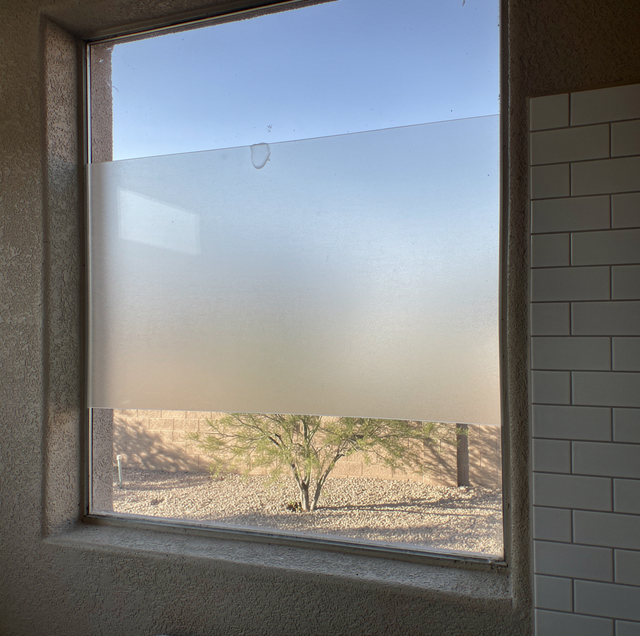
Quick Answer: Frosted or acid-etched glass, patterned privacy film, textured glass, and switchable smart glass all block a clear sightline while still transmitting most of the available daylight. Full coverage isn't required either: a frosted band at eye level, a patterned strip on a partition, or film applied to only part of a pane can screen the exact sightline that matters and leave the rest of the glass clear.
A bathroom window that faces a neighbor's siding. A home office door that opens onto a hallway everyone else in the house uses all day. A living room window at the front of the house, visible to anyone walking by. The usual answer is a blind, a curtain, or a coat of paint on the glass, and each one solves the privacy problem by cutting the light along with it. A room that used to feel bright ends up dim for most of the day just so no one can see in during the few minutes it actually matters.
Privacy and daylight compete only when the fix is a solid barrier. Several glass treatments block the ability to resolve a clear image through the pane without stopping the light itself, and each one works through a slightly different mechanism.
Why Privacy and Light Are Not Actually a Trade-Off
A window does two separate jobs at once: it lets photons through, and it lets a viewer's eye focus those photons into a recognizable shape on the other side. Blocking the first job blocks both, which is what a blackout shade or a solid panel does. Blocking only the second job is the trick behind most privacy glass: scatter the light in enough directions before it exits the pane, and a viewer's eye can no longer resolve edges, colors, or motion into a shape, even though nearly the same total amount of light still passes through.
That scattering is called diffusion, and it is the mechanism behind frosted glass, most privacy films, and textured glass. A different mechanism, used in switchable smart glass, works by changing how ordered the material inside the glass is, which is covered further down. Either way, the daylight keeps coming into the room; what changes is whether it arrives as a sharp image or as soft, undirected light.
Frosted and Acid-Etched Glass
Frosted glass gets its texture one of two ways: sandblasting, which fires fine abrasive media at the surface to roughen it, or acid etching, which uses a chemical bath to dissolve the surface into a fine, even texture. Both processes leave the glass covered in microscopic irregularities rather than a single smooth plane. Light hitting that surface scatters in many directions rather than passing straight through, so a shape on the other side turns into a soft blur of color and motion instead of a recognizable outline. Total light transmission drops only modestly, often by less than clear curtains would cost a room.
Acid etching can also be applied selectively rather than across an entire pane. Full-coverage etching works well on a shower enclosure or a bathroom window that never needs to be clear. Partial etching, including bands, borders, or an etched pattern or logo, leaves the rest of the pane transparent and is common on entry sidelights, glass partitions, and cabinet doors where some visibility is still useful.
One tradeoff worth knowing: frosted and etched glass is permanent. Once the surface has been textured, it stays that way, so it suits fixed-privacy spots like a shower or a bathroom window rather than a pane someone might want fully clear again later.
Privacy Films: Frosted, Patterned, and One-Way
Film applied to existing glass gets a similar diffusing effect without altering the glass itself. A frosted film mimics the look of sandblasted glass on a smooth adhesive layer, so an existing clear window or glass door panel can pick up the same soft, blurred sightline without being replaced. Patterned films go a step further, adding a decorative texture such as a linen weave, raindrop pattern, or geometric grid on top of the diffusing effect, so the privacy layer doubles as a design choice rather than a plain haze.
One-way film, sometimes called reflective or mirror film, works on a different principle: brightness difference rather than pure diffusion. Coated with a thin reflective layer, the film turns the brighter side of the glass into something close to a mirror while the dimmer side sees through it almost normally. During the day, with more light outside than in, a street-facing window with one-way film reflects the view back at anyone standing outside while the room inside stays visible to its own occupants. That relationship flips after dark: once a room's interior lights are brighter than what's outside, the film's reflective advantage shifts, and anyone outside can see in more easily than during daylight. Pairing it with a light curtain for evening hours covers the gap.
Films also offer a practical advantage for rented spaces or leased commercial units: none require replacing the glass, and most can be removed later without damaging the pane underneath. That makes film a lower-commitment option than etching or a full pane swap, which matters in a market where high solar load already pushes many owners toward tinted and UV-blocking glass on south- and west-facing exposures; a privacy film that also cuts glare and heat gain solves two problems on the same pane.
Textured and Patterned Glass
Beyond film, textured glass is manufactured with the diffusing pattern built into the material during production rather than applied afterward. Reeded and fluted glass, with fine vertical ribs pressed into the surface, has become a common choice for shower enclosures and glass partitions because the ribs scatter a sightline passing across them while a view straight through a single rib stays fairly clear. Rain glass and seeded glass use a more random surface pattern, closer to true frosted glass in how thoroughly they scatter light in every direction.
The depth and density of the texture set how much privacy a given pane delivers. A shallow, widely spaced pattern lets more shape and color through, which suits a partition where some sense of movement on the other side is still welcome. A deeper, tighter pattern approaches the near-total diffusion of sandblasted glass, better suited to a shower door or a window with a close, direct sightline to a neighboring structure.
Switchable Smart Glass
Smart glass, most often built around a layer of liquid crystal film sandwiched between two panes, works on an entirely different mechanism than frosting or texture. With no electrical current applied, the crystals inside sit in a random, disordered arrangement, scattering light the same way a frosted surface does and leaving the glass looking opaque and milky. Apply a low-voltage current, and the crystals align into an ordered pattern that lets light pass straight through with almost no scattering, turning the same pane clear within a second or two.
That instant switch is the entire appeal: one pane serves as both a clear window and a private one, changed with a switch or a remote rather than a physical treatment. A home office door can stay clear during normal hours and switch to opaque only during a call, without needing a separate blind or curtain. A conference room partition can do the same for meetings that call for privacy one hour and an open, visible layout the next. The tradeoff is that the effect depends on power; a switchable panel left without current defaults to its frosted state, not its clear one.
Partial-Coverage Designs: Frosted Bands and Privacy Strips
Full-pane treatments are not always the right call, since most privacy needs sit at one specific height, not across an entire window. A frosted band applied at roughly eye level, leaving clear glass above and below it, blocks a standing adult's direct sightline while a full sky view stays visible above the band and floor-level light keeps coming in below it. That partial approach shows up often on street-facing windows, where the goal is blocking a passerby's glance rather than dimming the whole room.
The same idea applies to doors and partitions in a narrower form. A horizontal privacy strip across a glass office door, sized to match average eye height, screens anyone walking past without frosting the whole panel. Vertical strips work the same way on French doors and sidelights, alternating clear and frosted sections so a hallway view stays partly open while a direct line of sight through the center panel gets broken up. A frosted border around an otherwise clear pane is another variant, common on storefront glass, where full transparency in the center supports product display while the frosted edge screens angled views from the side.
Matching the Option to the Room
A bathroom window facing a close neighboring structure usually calls for a permanent solution: full acid-etched or frosted glass, or a textured shower enclosure, since the privacy need never changes. A home office door benefits more from a partial band or a switchable panel, since the space still needs to read as open and connected to the rest of a house or workspace most of the time.
Street-facing living room or dining windows tend to do best with either a frosted or patterned lower band, which keeps sky and tree-line views intact above head height, or a one-way film for a daytime-only sightline concern. Commercial storefronts and office partitions lean toward textured or reeded glass and frosted strips, which let a storefront keep its product visible while a back-office partition screens desks from a sales floor. Strong demand for frameless showers, glass partitions, and mirrored surfaces in modern remodels has made several of these treatments, especially reeded glass and partial frosted bands, as much a design decision as a privacy one, chosen for how a space looks and photographs as often as for what it blocks.
Frequently Asked Questions
Only slightly. Frosting scatters light in many directions instead of letting it pass straight through in a single beam, which softens shadows and blurs any image on the other side, but the total volume of light reaching the room stays close to what clear glass lets in. A frosted window still reads as noticeably brighter than one covered with a blind or curtain.
Most adhesive privacy films are designed to be removed cleanly from glass, especially when applied by someone experienced with the material and removed with the right technique rather than pulled off quickly. Film that has been in place for years in a hot, sun-exposed spot can be more brittle to remove than a fresh install, so age and exposure matter more than the film type itself.
Tint is a fixed, permanent coating that reduces glare and heat but does not change appearance once applied. Switchable smart glass changes state on demand: an electrical current reorders the liquid crystal layer inside the pane, shifting it between a clear state and an opaque, frosted-looking state within a second or two, so the same window can serve as either depending on the moment.
No. One-way film relies on a brightness difference between the two sides of the glass. During daylight hours, with more light outside than in, the film reflects the outside view back and keeps the interior screened. After dark, once interior lighting is brighter than what's outside, that advantage reverses, so an evening sightline through the same window works more like ordinary glass unless a curtain or shade covers the gap.
Textured and reeded glass patterns are built into the glass during manufacturing, so adding that specific look usually means replacing the pane rather than treating the existing one. A frosted or patterned film applied to the existing glass provides a similar diffusing effect without a full pane swap, which is often the faster route when the goal is privacy rather than a specific texture.
Less than most people expect. A band roughly at eye level, sized to block a standing adult's direct line of sight, handles the sightline that actually causes discomfort in most rooms, while glass above and below the band continues to transmit daylight. Full-pane coverage matters more in spots like a shower enclosure, where the sightline concern extends across every height rather than to a single band.
Talk through privacy glass options for your home or workspace — get expert guidance on frosted, film, textured, or switchable glass that fits your space and light needs. Luxe Residential and Commercial Glass serves the Las Vegas Valley. Call (702) 825-7463.
