
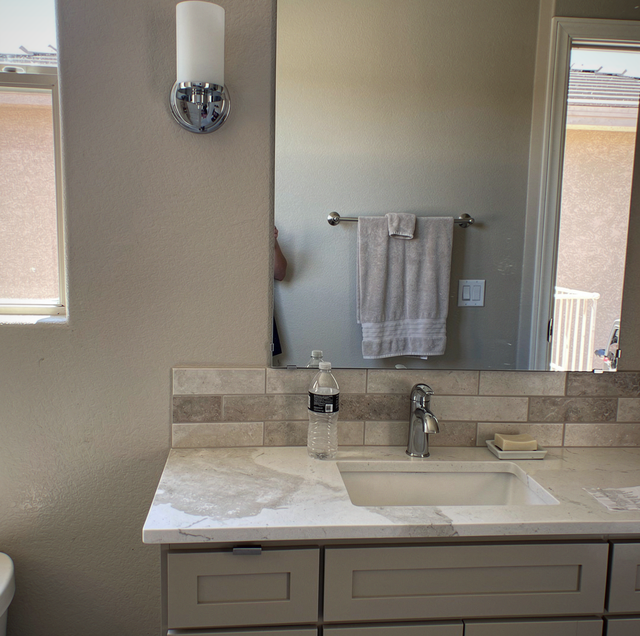
A mirror that's too small looks like an afterthought propped above a sink. One that's too large can crowd sconces, clip a window trim, or make a single vanity feel like it's wearing someone else's coat. Getting the size right is less about a single magic number and more about how the mirror relates to the vanity below it, the wall around it, and the light fixtures near it. Once those relationships are worked out, picking dimensions becomes much easier.
Standard Mirror Sizing Guidelines for a Bathroom Vanity
The most reliable starting point is width, measured against the vanity or the sink cabinet below it rather than the wall as a whole. A mirror that runs a few inches narrower than the vanity on each side, leaving a modest margin of exposed wall or backsplash, reads as intentional rather than undersized. A mirror that spans wider than the cabinet below it can work too, but it needs enough clearance from side walls, towel bars, or adjacent fixtures to avoid looking wedged into the space.
A useful rule of thumb: keep the mirror width somewhere between about seventy and ninety percent of the vanity width for a single-sink setup. Go much narrower than that, and the mirror starts to look like it belongs to a smaller sink; go wider, and it can overpower the counter and crowd out wall space needed for light fixtures or storage.
Height follows a similar logic but responds more to the wall above the vanity than to the cabinet itself. A mirror generally starts a short distance above the backsplash or counter edge and extends up toward, but not into, the ceiling line, the crown detail, or any soffit. Leaving consistent breathing room on both the top and bottom edges, rather than crowding one side, keeps the proportions calm even in a bathroom with an unusual counter height.
Frame depth matters too. A thick decorative frame reduces the reflective glass area compared to a slim or frameless edge with the same outer dimensions, so two mirrors marked with the same overall measurement can feel very different in scale once mounted.
How Ceiling Height and Lighting Placement Change Your Mirror Height
Standard sizing guidelines assume a fairly typical ceiling height and a fairly typical light location, and both of those assumptions often break down, so it's worth checking them before ordering glass.
A taller ceiling gives more room above the vanity, which usually means a taller mirror reads as proportional rather than short and stubby against all that extra wall. In that setup, stopping the mirror at a height calculated for an eight-foot ceiling can leave an awkward band of bare wall above the glass that a taller mirror would have filled naturally.
Lighting placement matters just as much as ceiling height, and arguably more, because it affects how well the mirror actually functions. A single fixture mounted directly above the mirror casts light downward and can create shadows under the brow, nose, and chin exactly where a person is trying to see clearly for shaving or applying makeup. Sconces mounted on either side of the mirror at roughly eye level solve that shadow problem, but they also set a hard boundary on how wide the mirror can be without running into the fixtures themselves.
Before finalizing height, measure from the finished floor to the bottom and top of any existing light fixture, then work backward to a mirror height that clears both without leaving a large, mismatched gap above the glass. If new fixtures are going in as part of the same project, plan mirror height and fixture height together rather than sizing one around the other afterward.
Single Large Mirror vs Two Mirrors for a Double Vanity
A double vanity presents a genuine choice, not just a bigger version of the single-sink question. One large mirror spanning both sinks reads as a single unified feature and simplifies the layout: one set of dimensions, one hanging point to plan around, and no visible gap in the middle. It also tends to make a double vanity area feel more open, since there's no frame or seam interrupting the reflection between the two sinks.
Two separate mirrors, each centered over its own sink, create a more symmetrical, deliberately paired look and allow each half of the vanity to receive its own lighting treatment without a single fixture serving two people standing at different points along the counter. This layout also handles an off-center double vanity more gracefully, since each mirror only has to align with the sink directly beneath it rather than with the full width of the counter.
The practical deciding factor is often the vanity's sink spacing and the wall's available fixture points. Two mirrors need enough distance between them to leave a visible gap without either mirror feeling squeezed against the other; too little spacing, and the paired look starts to resemble one mirror that broke in half. A single large mirror needs a wall clear enough, and a lighting plan flexible enough, to serve two people using opposite ends of the same glass at once.
Framed vs Frameless and Edge Considerations for Sizing
Frame choice changes more than the look of a mirror; it changes the math behind its sizing. A framed mirror's outer dimensions always include the frame width on all sides, so a piece labeled at a given size delivers noticeably less usable reflective glass than a frameless or polished-edge mirror cut to the exact same outer dimensions.
Frameless and polished-edge mirrors use the full ordered dimension as reflective surface, which tends to make them feel larger and more open even when the outer size matches a framed alternative closely. That's part of why a frameless mirror can look proportionally right at a size that would feel oversized in a heavy frame, and why a frame with real presence can carry a slightly smaller overall footprint without feeling undersized.
Edge finish also affects how forgiving the fit needs to be at the wall. A framed mirror's frame can visually absorb a small gap or an uneven margin along the wall, since the eye reads the frame itself as part of the design. A frameless mirror with a beveled or polished edge shows every irregularity in the surrounding wall or backsplash line, so the cut needs to be as exact as possible and the wall it's mounted against needs to be reasonably flat and true.
Custom-Cut Glass vs Off-the-Shelf Mirrors
Off-the-shelf mirrors come in a limited set of standard widths and heights, which works fine when a vanity, the surrounding tile, and the fixture layout fall within those common dimensions. Plenty of ordinary single-sink setups fit that description without any trouble.
A custom-cut mirror earns its keep whenever the space doesn't cooperate with standard sizing. An oddly proportioned vanity, a double sink with unusual spacing, a wall interrupted by a window, medicine cabinet, or an angled ceiling line, or a double vanity meant to carry one continuous mirror across both sinks are all situations where a stock size either leaves an awkward gap or simply doesn't exist in the dimension needed. Cutting glass to the exact measurement of the wall or vanity removes the guesswork of rounding up or down to whatever size is sitting on a shelf.
Custom sizing also opens up choices that off-the-shelf inventory rarely covers: a polished edge instead of a stock frame, a shape other than a plain rectangle, or a mirror sized to align precisely with the backsplash, tile grout lines, or an existing light fixture rather than approximately. For a renovation built around specific fixtures and finishes, that precision is often the difference between a vanity wall that looks planned and one that looks assembled from parts that were never quite meant to go together.
Common Mirror Sizing Mistakes to Avoid
A few sizing missteps show up often enough to be worth calling out directly.
Matching the mirror to the wall instead of the vanity: A mirror sized to fill an entire wall, rather than relating to the vanity and sink below it, can end up too wide, too tall, or both, especially in a bathroom where the vanity doesn't sit centered on that wall.
Ignoring existing light fixtures until after the mirror arrives: A mirror ordered without measuring the height and spacing of sconces or an overhead fixture can end up too tall, too short, or offset in a way that leaves the lighting working against the mirror instead of with it.
Underestimating how much a frame reduces usable glass: Choosing a framed mirror based only on its outer dimension, without accounting for how much of that outer size is frame rather than reflective surface, is a common way to end up with less usable mirror than expected.
Centering a double-vanity mirror plan on the wall instead of the sinks: When a double vanity isn't centered on its wall, a single large mirror or a pair of mirrors sized and hung at the wall's midpoint, rather than each sink's centerline, can leave one side looking off-balance.
Skipping a paper mockup before committing to a size: Taping the planned outline directly onto the wall, or cutting a paper template to the intended dimensions and holding it in place, catches proportion problems that a tape measure and a set of numbers on paper can miss.
Assuming a stock size will simply "look fine" in an unusual space: A vanity with an odd width, a double-sink layout with tight spacing, or a wall broken up by a window or cabinet is exactly the situation where forcing a standard size on hand can leave a visible mismatch that a properly measured custom cut would have avoided.
Frequently Asked Questions
A mirror that sits a few inches in from each edge of the vanity, rather than matching it exactly or running wider, tends to look the most balanced. As a general guide, keeping the mirror between roughly seventy and ninety percent of the vanity's width works for most single-sink setups, though an unusually narrow or wide vanity may call for adjusting that range.
Neither option is universally better; it depends on sink spacing and the lighting plan. A single large mirror suits a double vanity with sinks set close enough together and a wall clear enough for one continuous piece of glass. Two mirrors work well when each sink needs its own dedicated lighting or when there's enough distance between the sinks to let a paired look read as deliberate rather than crowded.
Not exactly, but the two should be closely related. A mirror noticeably narrower than an overhead fixture, or one that runs past the outer edge of side sconces, can look mismatched even if each piece looks fine on its own. Measuring fixture width and placement before finalizing mirror dimensions avoids that kind of visual disconnect.
An unusual vanity width, a double sink with nonstandard spacing, a wall interrupted by a window or cabinet, or a plan to run one continuous mirror across a double vanity are all signs that a stock size probably won't fit cleanly. Measuring the actual available wall space and comparing it to common stock dimensions is the quickest way to tell.
Centering on the sink, or on each sink in a double-vanity setup, generally looks more intentional than centering on the wall as a whole, especially when the vanity isn't centered on that wall. A mirror aligned with the wall's midpoint rather than the sink's centerline can look subtly off, even when the measurements are technically correct.
A mirror noticeably narrower than the vanity below it tends to look like an afterthought rather than a planned feature, particularly once the surrounding wall space and any side fixtures are factored in. It's usually worth remeasuring against the vanity width and the fixture layout before finalizing an order, rather than sizing based on the wall alone or a size that happened to be available.
Get a custom mirror measured and cut for your vanity — a precise fit for any size, shape, or double-vanity layout. Luxe Residential and Commercial Glass serves the Las Vegas Valley. Call (702) 825-7463.
