
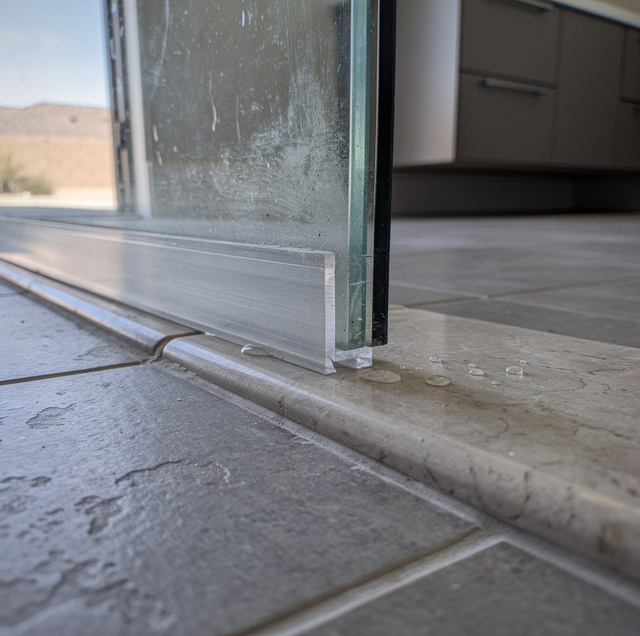
The instinct is to blame the panel. Glass does not let water through; the parts around it do: the sweep along the bottom, the seal on the latch edge, the strip on the hinge side, and the hinges that set how the door sits on the curb. Some of those wear out, and some were set wrong from the start, and telling the two apart is the whole diagnosis.
The Bottom Sweep Carries the Load
The strip fixed to the bottom edge of the door sits right where the water first crosses. Its fin brushes the top of the curb as the door closes, deflecting water running down the glass back toward the pan. That repeated mechanical contact, every single time the door moves, is also what wears it out. The strip loses its flex, develops a permanent curl away from the curb, or splits along its length, and once it stops meeting the curb evenly across its whole run, water rides straight underneath instead of getting pushed back. A worn sweep that has lost its shape can look fully seated at a glance and still leave a gap along part of its run. Sweeps come in more than one profile. A plain fin brushes the curb. A sweep with a drip rail adds a small ledge on the inside face of the glass that catches water running down the door and turns it back into the shower before it reaches the bottom edge, so a door that leaks with a plain fin can be refitted with a drip-rail profile of the same glass thickness. Because the sweep sits where the water first reaches the door's edge, checking it is a reasonable place to start.
The Side Seal Closes the Vertical Line
On the latch edge, where the door closes against a fixed panel or the wall, a second seal closes the vertical gap. That seal is deliberately not rigid: the two glass edges can't touch directly because, under pressure, tempered glass chips at contact points, and a chipped edge is its own separate problem. So the seal is a soft strip or a thin magnetic bead that closes the distance without letting glass touch glass. Unlike the sweep, it isn't dragged across a surface with every swing, but it still degrades on its own schedule: pulling away from the glass edge it clips onto, or hardening so it no longer closes against the opposite edge. A seal that has lifted at one point leaks there. A seal that has simply slid a few millimeters out of its channel can look intact from a glance and still be doing nothing where it matters. The hinges determine whether that seal ever works. Self-closing frameless hinges pull the door the last few degrees shut on their own. When that return has worn, or the hinge was set a little off center, the door comes to rest a fraction open at the latch edge, and the latch seal never meets the glass it is supposed to close against. A door that has to be pushed the last inch every time is telling you where the leak is.
The Design Leaves Gaps on Purpose
None of this is an oversight. A hinge needs clearance to swing without binding, and two panels that touch under any pressure risk chipping rather than sealing. Leaving that clearance at the hinge line, the latch line, and the bottom edge is what lets the door swing and close without one glass edge touching another. Instead of one continuous gasket doing the sealing, four small parts each cover their own narrow stretch, and the whole system holds only as long as each is still doing its job. A door that has never leaked simply has all of those small parts still doing that job at once.
Run the shower with the door closed, then look outside without opening it. Water along the curb is the sweep or curb; water at the latch or hinge jamb is that seal. Drips after opening are glass runoff.
How the Door Sits Against the Curb
A sweep is built to meet a level, consistent line, and the door has to hang at the height the fabricator set it for. A curb top should pitch slightly back toward the pan; one that has settled flat or tips outward walks water over the sweep instead of back under it, and in that case the sweep itself can be in fine condition while the leak still happens. The same logic applies to the fixed panel the door closes against: if that panel has shifted even slightly out of plumb since it was installed, the side seal is now trying to close a gap it was never shaped for. A fixed panel has its own bottom joint, set in a U-channel or on clips, with a bead of silicone along the curb. Water that shows up outside the fixed panel's base, away from the door, is that joint, and a new sweep or door seal will not touch it, since the two are separate joints doing separate jobs.
The Angle of the Spray Matters
A handheld or an angled head aimed at the door puts direct spray on the seams, the sweep, and the latch seal cover, which sheeting water down the glass never does. A leak that started after a second head or a handheld was added points to spray rather than wear.
A Leak That's the Same Every Time Versus One That Comes and Goes
How consistently the leak shows up is its own clue, separate from where the water lands. A leak every shower points to something fixed in place, a failed strip or a curb or hang problem. A leak only with long showers or one spray setting points to a seal that holds light water and not direct spray.
When It's a Seal and When It's Something Bigger
A worn sweep or a lifted side seal is a wear part, and wear parts get swapped, not repaired. If a new sweep and a new seal don't stop the leak, the cause has moved past the parts themselves and into how the door is hung or how the enclosure was built: a hinge that has loosened enough to let the panel sag slightly, a fixed panel whose mounting clip has shifted, or a curb that was never level to start with. Any of those needs a hand on the actual hardware, and it's the kind of thing a glass technician can rule in or out by watching the door swing and checking where the gap opens up. Replacing parts a second time without addressing why they failed just buys the same problem a little more time.
Frequently Asked Questions
A frameless door leaves a gap on its hinge side too, and that gap gets its own clear polycarbonate strip or H-jamb seal, separate from the seal on the latch edge. Water that shows up at the hinge jamb is that strip, not the sweep.
Yes. Replacement sweeps are sold as slide-on or clip-on strips that fit over the bottom glass edge and are trimmed to length with scissors or a utility knife. They go on and come off without touching the hinges. The door stays hung the whole time, which is why this is a short fix rather than a full teardown.
It closes the gap through a different mechanism rather than simply being better. A magnetic seal is a pair of clear strips, one clipped to each glass edge, each carrying a magnet so the two strips pull closed at a fixed gap. A plain vinyl strip bridges the same gap without that pull.
Not on the moving parts. Caulk can close a small gap where a fixed panel meets the wall or the floor, but it doesn't belong on the sweep or the door's own seals, since sealing a joint that's meant to flex or swing stops it from doing its job and can trap water behind it instead of letting it drain back into the pan.
The glass panel is not the part that moves. Frameless hinges are made with slotted mounting holes or an adjustment plate, so a technician can shim or reposition the hinge and take up a small amount of drop or lean without removing the glass. A fixed panel's mounting clips get adjusted the same way at the wall.
Water on the bathroom floor at the door line while the shower runs is the door. Water that appears in a ceiling or wall below, or on the floor away from the door line, even only during showers, is a drain, pan, or supply question for a plumber.
Get the sweep, the seals, and the way the door is hung looked at — pin down exactly what's letting water through and get it corrected. Luxe Residential and Commercial Glass serves the Las Vegas Valley. Call (702) 825-7463.