
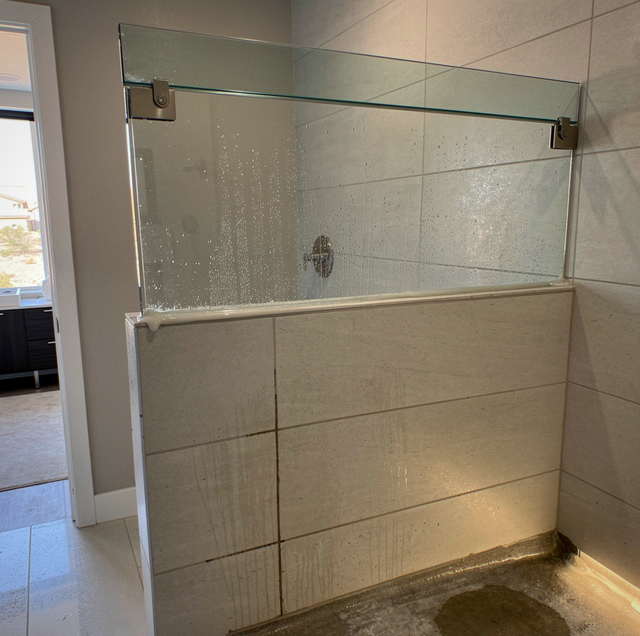
An ordinary shower enclosure is built to turn falling spray back toward the pan, and its open top lets warm, moist air drift out into the bathroom. A steam enclosure must contain the vapor within a closed volume of air. Vapor rises, and it keeps rising until it meets a surface or an opening. Over an ordinary shower, the space above the glass is open air. In a steam enclosure, the vapor goes first into the space above the door, which is part of how the enclosure holds steam at all.
A short comparison matches each arrangement at the top of the enclosure to how it handles that rising vapor and what it asks of the ceiling and the door beneath it:
| Arrangement at the Top | How It Handles Rising Vapor | What It Asks of the Ceiling and Door |
|---|---|---|
| Glass to the ceiling, fixed transom over the door | Vapor rises to the transom and stays inside the closed volume, with the door's head seal closing the joint beneath it | The ceiling glass line has to reach a finished ceiling surface it can seal against; the door needs a head seal added along its top edge |
| Operable transom | Contains vapor the same way while closed, but can be opened on purpose to air the space between uses | Needs its own separate seal and closing hardware at the head, independent of the door's own hinges and handle |
| Full-height door, no separate transom | The door itself runs to the ceiling, so the head-seal duty falls on the door's own top edge | Door height and hinge line have to reach the ceiling, with backing at the top mounting points as well as the side points |
| Glass that stops short of the ceiling | Leaves an open band above the glass line, so vapor keeps rising past it into the room | Suits an ordinary shower; nothing above the glass line is sealed at all |
How Steam Behaves in a Closed Enclosure
Steam is water vapor suspended in warm air, and once the enclosure is closed, that air has nowhere to go but up. Warm air is lighter than the cooler air around it, so vapor rises to the top of the enclosure and keeps circulating there until it meets a surface cooler than itself. Glass and exposed metal have the cooler room air on their far side, so vapor gives up its moisture on them as condensation: droplets on the glass, the ceiling line or a metal header, joining into rivulets that run back down toward the pan. That cycle, rising vapor meeting a cool surface and running back down as liquid water, repeats for as long as the enclosure stays closed and the steam generator keeps running.
Why an Open Top Defeats a Steam Shower
An enclosure with an open top gives rising vapor a way out before it can condense and run back into the pan. Warm vapor at the top of the glass crosses the open edge and spreads into the bathroom, where it cools against walls, mirrors, and fixtures outside the wet area. A steam generator sized for a sealed enclosure keeps pushing vapor out through the same gap, so the air inside cannot reach the saturated state that a steam session depends on. That is why a steam enclosure has glass that runs to the ceiling in some form, a fixed transom, an operable transom, or a full-height door, closing the top of the enclosure.
The Fixed Transom and How the Door Hangs Beneath It
A fixed transom is its own glass panel, set above the door and separate from it, closing the gap between the top of the door opening and the ceiling. That panel needs support along its top edge, whether that support is a header built into the framing above the tile line, a metal rail spanning the opening, or a set of clamps fixing the transom to the wall and to the fixed side panel. Where the transom meets the wall and the fixed side panel, a bead of clear silicone closes each joint, so the fixed glass forms one continuous surface around the top of the door opening. The door then hangs from hinges set into the wall or the fixed panel below the transom line, so the transom's job is limited to closing the gap and giving the door's head seal something solid to close against. Where the transom meets the door's top edge is where that head seal lives, which is the part of the enclosure a steam shower asks for that an ordinary shower never needs.
Shower glass is tempered and takes no new cut or hole once made. A chipped edge, a crack, or a dropped door can let the panel shatter, and the door stays out of use until a glass technician replaces or rehangs it.
An Operable Transom for Airing the Enclosure Between Uses
An operable transom does everything a fixed one does while the enclosure is closed, and adds a way to open that same panel on purpose. It is hinged or pivoted at its own point along the top of the frame, separate from the door's hinges, with its own handle or latch. Left closed during a session, it seals the same way a fixed transom does. Opened afterward, it gives the enclosure a path to vent the humid air it just held, which shortens how long condensation sits on the glass and the ceiling line before it dries. The tradeoff is one more moving joint with its own seal to maintain, set higher and less convenient to reach than the door's own hardware, against the fixed transom's simpler, unmoving seal, which leaves the door as the one panel that opens to air the space.
A Head Seal Along the Top Edge of the Door
An ordinary shower door only has to seal its bottom sweep and its side seals against splashing water; a steam door adds a strip along its top edge too, closing against the transom or header the same way the other seals close against the jamb, because vapor rising inside the enclosure will find that edge if nothing closes it.
The Ceiling and Walls the Glass Meets
Where the transom or the full-height door meets the ceiling depends on what kind of ceiling is up there. A flat ceiling provides a single-level line for the glass to seal against, while a sloped or vaulted ceiling over the enclosure means the transom or the top of the door has to be cut and fit to that angle, which changes how the header or rail above it is built and shaped. The slope has a use within a steam enclosure: condensation that forms on it can run down the slope to a wall and along the tile, where a flat ceiling lets droplets gather overhead and fall onto the seat or floor below. Either way, the ceiling surface itself has to be finished to resist moisture, as a shower wall is, since a painted surface can blister and peel from repeated condensation. Tile behind and around the enclosure and the steam generator that supplies it are their own trades, set, wired, and connected before the glass ever goes in; that work stays with whoever installed it, and the generator stays closed to anyone working around the glass, so the glass simply meets whatever ceiling and wall finish those trades left in place.
The ceiling finish over a steam enclosure is completed before the glass is measured, since tempered panels are fabricated to the finished surface and cannot be trimmed afterward to take up a change in tile or ceiling thickness.
Frequently Asked Questions
The bathroom's ceiling fan sits outside the glass and moves room air; with the transom and door closed, it has no path into the sealed volume, so the enclosure clears through an operable transom or the open door after a session.
It can, and the skylight then sits inside the steam: its frame and the shaft around it are finished to take moisture, as the ceiling is, and condensation that forms on its cold glass drips back down into the enclosure.
No. The metal header or glass rail above a fixed transom carries only that transom panel's own weight, not any part of the ceiling or roof structure above it. The ceiling framing continues to do its own job, independent of the glass hanging below it.
It can be. A transom set above an easy reach can take a pull cord or a hooked pole at its latch, and it still works on its own hinges, apart from the door's.
Only by replacing it. A fixed transom's edges sit inside a header or clamps that have no built-in hinge point, so adding one after installation means replacing the transom panel and its framing. The hinge points and any operable panel openings are cut into a new panel before it is tempered.
No. The door and the transom are separate panels, each carried by its own hardware, so one can be replaced without touching the other. The head seal between them needs to be checked and reset as a pair afterward so it closes evenly along the entire edge again.
Retain steam shower door and enclosure installation — a steam door, a fixed or operable transom, and head, side, and bottom seals fitted to your ceiling line. Luxe Residential and Commercial Glass serves the Las Vegas Valley. Call (702) 825-7463.