
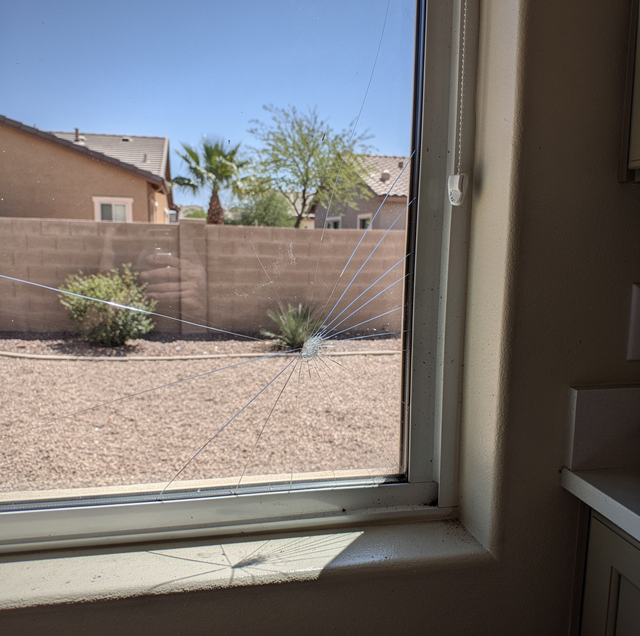
The line runs in from the edge of the glass and stops out in the middle of the pane. You have run a hand over the outside face and found nothing to catch on: no chip, no strike mark. Nobody was near the window.
Heat did it, and the reading on an outdoor thermometer barely enters into how. What broke your pane was a temperature difference between one part of the glass and another a few inches away, within the same sheet. Make that gap wide enough and ordinary window glass parts on a still day, untouched.
Where the Load Comes From
Sunlight entering a window does not all pass through: some is absorbed by the glass, and the area receiving direct sunlight warms. The perimeter cannot follow: it is captured in the frame, shaded by it, and in contact with frame material that pulls heat away.
Warm glass wants to grow. Soda-lime float glass expands about nine millionths of its length for every degree Celsius it gains, and the warm middle of your pane is trying to. The cool rim will not let it, so the rim ends up stretched, and glass carries compression far better than tension.
You can size the load yourself. Soda-lime glass has an elastic modulus of about 72 GPa (10.4 million psi). Multiply that by the expansion coefficient and by a 20-degree Celsius split, roughly 36 degrees Fahrenheit, between sunlit field and shaded rim, and the tension at the rim lands near 13 MPa, about 1,900 psi. Nothing exotic, and it arrives on a clear cold morning as readily as a hot afternoon: the arithmetic asks only for the gap.
The Edge Is Where Tension Meets Damage
The line you are looking at starts at the perimeter because tension is highest at the edge, where the glass is weakest.
Glass does not break at its theoretical strength. It breaks from a flaw in a stretched surface, and the deepest flaw is the one that counts. A pane's faces are fire-finished and nearly unblemished. The edge is a cut, carrying damage from the moment it exists: a shell chip, a shallow crescent lifted out of the edge face; a flare, a lip of glass standing proud of the cut line; a vent, a short crack running inward from the score. A corner set down on concrete adds more, exactly where the tension will be.
A flaw is a stress raiser. Tension that would spread along the whole edge crowds into the tip of that flaw, and the local figure runs several times the average. It is why two identical windows in your wall behave differently under the same sun: one has a clean edge under the stop, the other a nick nobody has seen since it was cut.
A Shadow Lying Across One Pane
The mechanism needs a temperature split, and shade supplies one. Some of it is built into the frame itself: a deep reveal, a projecting stop, each shading a band around the perimeter while the middle takes full sun. Annealed glass lives with that.
A shadow falling on the face of the glass loads a pane harder than the frame's own shading does. Half the glass receives the direct beam, the other only diffuse light from the sky, and the two halves pass through one sheet. The divide can sit anywhere on your window: a column, an overhang, a wall corner.
Sun angle moves through the day and the year, so this is never fixed. A shadow that clears your glass at midsummer can lie across it at midwinter, and a window fine for years starts carrying a split because something outside it grew.
Look at your window from outside twice in one day, mid-morning and mid-afternoon, and note where a shadow edge lies on the glass each time. Those two positions give a glazier the hours that the pane runs split.
What You Have Against the Inside Face
The room is how your pane sheds the heat it takes on, so what you have pressed up against the inside face changes what the glass has to survive. Blinds or a heavy curtain hung close to the window trap a layer of still air, and still air conducts heat poorly, so the sunlit glass behind that pocket runs hotter than it would with room air moving over it. Anything solid against the window traps that air and shades the glass at the same time: a mattress leaned there while you paint a room covers part of your pane, blocks air from it, and leaves the rest in open sun.
Applied film moves the same variable. A film that rejects solar heat by absorbing it makes your glass and its coating the absorber, and the pane runs hotter in the same opening than it did bare. Body tint does the same, with colorant through the thickness absorbing. Putting either one on annealed glass in a split exposure adds to a load your pane is already carrying.
Annealed Glass Is the One That Does This
Ordinary window glass is annealed: cooled under control after forming so it leaves the line with almost no locked-in stress. That is what makes it cuttable, and what leaves it nothing in reserve.
Heat-treated glass starts somewhere else, and the difference is a figure you can look up. A national testing standard for heat-treated flat glass specifies 3,500 to 7,500 psi of surface compression for heat-strengthened glass and 10,000 psi or more for fully tempered glass. Thermal tension has to cancel that permanent compression before the surface sees any net stretch, which is why a tempered pane sits under the same shadow line and does nothing.
So what is in your opening is worth establishing, and a missing mark will not establish it. A tempered lite carries a permanent stamp etched into one corner, naming the fabricator and the standard it was made to, but on an installed pane that corner can sit under the sash or the glazing stop with nothing showing. Heat-strengthened glass is not safety glazing, and it carries no such stamp anywhere. What you can see without pulling a stop is the break itself. Fully tempered glass dices into small pieces the moment its compression layer is breached, so a pane sitting in the opening holding one long line is not fully tempered. Which of the other two you have is on the fabrication order for that opening.
Whether that line travels any further is a separate question from why it opened, and it turns on the crack rather than on the exposure. The useful work has moved to the replacement order. A glazier measuring for the new lite looks past the glass at the opening: what shades that pane and at what hour, and what sits against the inside face. That exposure is what the edge finish and the glass type get specified against, and it is why a heavier lite is not the safe default it sounds like. Step a pane from 1/8 inch to 1/4, and the extra depth absorbs more of the beam as it passes through, so the thicker lite runs warmer and carries a wider split back into the same shadow than the one it replaced.
Frequently Asked Questions
Yes. Air temperature is one input and a small one. Glass takes on solar energy through its own thickness, so a sunlit pane sits well above the air moving past it while the shaded frame line stays near that air. For the real figure on your window, an infrared thermometer gives you surface temperature: take one figure mid-pane in the sun and one at the frame line within the same minute.
The widest split and the highest temperature are two different events. Your frame, sash, and wall carry real mass and hold their overnight temperature into the first hours of light, so the first direct sun on a cold assembly opens the gap at its widest. By mid-afternoon the assembly has warmed, and the gap has narrowed, even though the air is hotter.
Not on its own, though how your pane was glazed changes what its edge has to survive. Glass sits inside its frame with room to move: setting blocks carry the weight at the quarter points of the sill, keeping the load off the corners, and clearance is left all round in the glazing pocket so the frame never bears on the edge. A pane resting hard on metal already has a loaded edge before the sun reaches it.
It can add to the risk, which is why film products come with a glass compatibility chart. Ask your installer for the one covering the exact film being quoted. It lists glass thickness, tint, and whether the pane is annealed or heat-treated, and states which combinations the film's own warranty covers. The chart will not tell you what your own window faces, so bring the shading and the exposure to that conversation too.
Because the two lites in your unit do not sit at the same temperature. The sealed gas space between them is a thermal break, which is the point of the unit, and it lets each lite settle at its own figure. The outboard pane takes the beam first and runs hottest on a sunny day, while the inboard one stays nearer the room. Which of the two cracked narrows a glazier's search to the side the heat was on.
A clean-cut edge leaves the cutting table, carrying everything the wheel and the breakout left behind. A seamed, or arrised, edge has its two sharp corners knocked down with a stone or a belt, taking off only the shallowest damage. Ground and polished edges work the whole edge face, driving the remaining flaws shallower. Tempered glass is edged before the furnace, so the finished edge on a tempered lite in your opening comes back to you in compression.
A pane that cracked with nobody near it is a glass question and an exposure question at once — a free consultation covers measuring the opening, specifying the edge finish and glass type for what that window actually faces, and workmanship backed in writing. Luxe Residential and Commercial Glass serves the Las Vegas Valley. Call (702) 825-7463.
