
Black Edges on a Mirror, and What Is Under the Backing
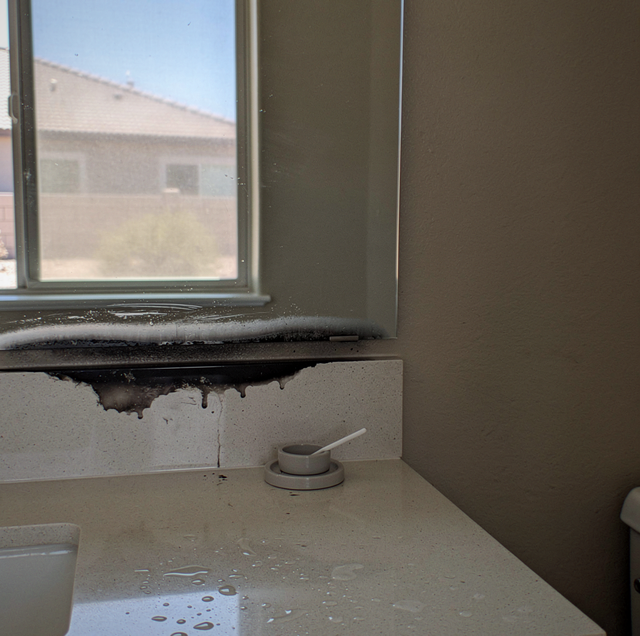
A mirror rarely fails all at once. The first sign is a thin gray rim creeping in from one corner, or spreading out from the screw holes where the frame meets the wall, and within a season it swallows enough of the reflective coating that your face is missing a slice near the edge every time you lean toward the glass to check it. Run a finger over the spot and the surface feels perfectly smooth against your skin; nothing is cracked, pitted, or rough to the touch. What is missing sits behind the glass, and once that loss starts, it does not stop, heal, or reverse itself the way you might expect a smear of grime to wipe away with a cloth.
A Mirror's Silver Backing Is Not Sealed Like a Window's Coating
Hard water spots are a different failure on the face of the glass anyone cleans, and a separate subject: mineral residue that wipes off while it is fresh, etches the surface permanently once it has been left to build; desilvering is a loss of material behind your glass, where no cloth reaches.
A mirror's reflective layer is a short stack of thin coats bonded to the back of a single sheet of glass: silver deposited first for reflectivity, then, in a traditional mirror, a copper layer over it to protect the silver from oxidizing, and a coat of paint sealing the assembly. Copper-free mirrors drop that middle layer and lean on the sealing coats instead. A window's low-E coating is sandwiched between two panes inside a sealed insulated unit, with no exposed edge for anything to reach. A mirror's backing has no second pane, so the paint coat alone stands between the metal and whatever touches your glass at its edge.
Every screw or clip holding a mirror to a wall presses against or punches through that paint layer. Manufacturers add a corrosion-resistant top coat at those points, though how much protection that buys is a claim each maker prints for its own product. An unsealed cut edge gives moisture more paths in than a fully sealed one.
The Black Edge Begins at the Perimeter and the Fixing Points
The black rim is a chemical failure. It has nothing to do with the glass expanding or contracting with temperature, and everything to do with what is reaching the metal at the edge over time.
The paint coating that seals a mirror's backing runs thinnest at every cut edge and every drilled hole, because those are the exact spots a fabricator cuts or drills after the coating has already cured. Moisture and airborne chemicals find those thin, interrupted points first and work inward along the cut edge, never through an intact panel face. Once a trace of moisture reaches the metal beneath the paint- on a traditional mirror, the copper layer, and on a copper-free one, the silver directly- it starts a slow oxidation that eats inward from that entry point, turning the metal dark and non-reflective, following the path of the weakest seal regardless of where the mirror catches the most light.
You will usually spot it first at a corner or along one edge of your mirror, rarely in the dead center, because the center is the one part of the panel the coating was never cut or drilled, and no clip or mounting hole ever interrupted it there.
An Ammonia-Based Cleaner Speeds Up the Silver's Failure Rate
Look along the back edge of a mirror for cut glass with no black paint over it: an unsealed spot like that lets cleaner in fast.
Ammonia-based glass cleaners cut through grease fast, and on your mirror with a fully sealed edge and intact backing, that is exactly what they do, without consequence. The chemistry only turns into a real problem at a mirror that already has a raw, chipped, or unsealed edge, or where the top coat has worn through at a screw.
Sprayed cleaner runs down the glass face and pools at the bottom edge, or wicks sideways into any gap between the glass and its frame. Once an edge is not fully sealed, ammonia travels along the same thin channel moisture already uses to reach the metal underneath. Ammonia reacts directly with silver and copper, accelerating the same oxidation plain humidity causes on its own, so a mirror dosed with cleaner at an unsealed edge, week after week, can lose its backing years faster than one wiped down with a milder product.
Reaching for an ammonia-free cleaner in place of your standard glass spray removes one of the few controllable inputs to the failure at any edge that is not fully sealed.
A Bathroom Mirror Loses Its Backing Years Sooner than a Hallway Mirror
A bathroom mirror lives in the one room of your house that runs humid twice a day, most days, for years. A hot shower sends the air past its dew point within minutes, and that moisture condenses on every cool surface in the room, the mirror included, then clears again as the room airs out. A hallway mirror never goes through that cycle.
That twice-daily swing matters more than average humidity in the room, because your mirror's backing does not fail from slow, steady exposure the way steel rusts in a damp basement. It fails from repeated wetting and drying at the same few thin points, the way a paperclip snaps faster from being bent back and forth than from being bent once and held under steady load. Two showers a day, roughly seven hundred cycles a year, stress the same edge far harder than one steady humidity level ever would, no matter how high that level runs, because it is the cycling itself, more than the moisture alone, that does the damage.
A bathroom mirror above your vanity sink takes an added hit a hallway mirror never sees: splashed water and dripping hands land on its bottom edge directly, keeping that edge wetter, more often, than the rest of the frame. That is why the black rim on a bathroom mirror so often starts along the bottom third of the glass, nearest the sink, while a hallway mirror that eventually desilvers tends to show its first damage at a corner instead, farther from any splash.
A New Glass Panel Restores the Reflection; the Backing Cannot Be Saved
Your mirror with early edge staining, confined to one small patch at a single corner, can sometimes be treated in place: a fabricator strips the loose backing right at the edge, cleans the area, and applies a fresh sealant to stop the reaction from spreading into the still-intact coating. That approach keeps the original glass at its exact size, which matters most on an oddly cut or beveled piece.
A mirror with damage extending more than an inch or two into the glass is past the point where a local repair will hold. The metal loss there is not surface residue; it is a structural gap in the reflective layer itself, and no sealant or cleaner brings back metal that has already oxidized away. At that stage, the only fix that restores a true, even reflection is a new mirror panel cut to the same dimensions.
Either way, the fix lives on the back of the glass rather than in the frame or the wall behind it: a fabricator lifts the mirror off its mounts, checks the backing under bright light, and hands it back showing how much of the original silver, copper, and paint is still doing its job behind the glass you look into every morning.
Frequently Asked Questions
Two different mechanisms. Moisture and cleaner reaching a raw edge give the black rim at the perimeter. A construction adhesive never formulated for mirrors attacks the backing paint where the bead touches it, so if your mirror was glued up with one, the damage shows as broad blotches well inside your reflection.
Humidity is only half of it. The other half is how your mirror is held: a bottom J-channel or a row of bottom clips forms a shallow trough that holds a film of water against the cut edge long after your bathroom has dried out. A mirror hung clear of its bottom edge drains and dries between showers.
Sometimes, though what a replacement would involve is the harder question. Mirror glass comes in standard thicknesses, commonly one-eighth, three-sixteenths, and one-quarter of an inch, and a new panel has to match yours, or your existing clips and channel will not hold it. Measure the thickness at an exposed corner before you place the order.
Yes at an open edge, and ammonia is not the only culprit. A vinegar or any other acidic homemade spray attacks an exposed silver edge just as readily, so an ammonia-free label is no guarantee. The one variable you control is whether any liquid reaches your mirror's edge at all: spray the cloth first, then wipe your glass.
There is a published method for it. Mirror backings are run through a copper-accelerated acetic acid salt spray, the CASS test described in a national testing standard, and a separate testing standard covers the specification a silvered flat glass mirror is written to. A mirror manufacturer's data sheet will state the hours its sample survived, which gives you something comparable to ask your supplier for.
No. A fogged window means the seal between its two panes failed, trapping humid air you cannot wipe from either side. Your mirror's black edge stays the same whether the bathroom runs humid or dry, no matter how you air it out, because it is chemical damage on the backing.
Book a mirror inspection before a small black edge spreads toward the center — a look at the backing shows whether the mirror can still be sealed in place or needs full replacement. Luxe Residential and Commercial Glass serves the Las Vegas Valley. Call (702) 825-7463.
