
Hard Water Spots on Shower Glass? Causes and How to Prevent Them
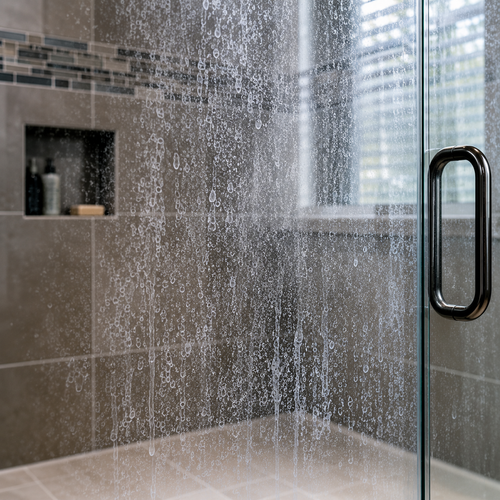
Quick Answer: Hard water spots are mineral deposits — mostly calcium and magnesium — left behind when water dries on the glass. Caught early they wipe off. Left to build, they bond with soap scum and eventually etch the glass surface itself, which no cleaner can reverse. Prevention comes down to keeping water off the glass: a daily squeegee, good airflow, and ideally softer water or a protective coating.
You squeegee, you scrub, you try the vinegar trick everyone swears by, and the shower glass still looks like it's wearing a permanent fog. In the Las Vegas Valley, this is almost a rite of homeownership, because the water here is some of the hardest in the country. Those cloudy patches aren't dirt, and they aren't your cleaning technique failing you — they're minerals, and understanding how they get there is the difference between glass that stays clear and glass you end up replacing.
What the Spots Actually Are
Every time you shower, a thin film of water clings to the glass. When it evaporates, it doesn't leave cleanly — it leaves behind whatever was dissolved in it. The U.S. Geological Survey defines water hardness as the amount of dissolved calcium and magnesium it carries, and when hard water dries, those minerals stay as solid deposits. The water vanishes; the calcium and magnesium remain, drying into the chalky white spots you see.
Local water makes this worse than most places deal with. The USGS classifies anything above 180 milligrams per liter as "very hard." Las Vegas water, drawn largely from the Colorado River by way of Lake Mead, runs around 280 milligrams per liter — about 16 grains per gallon, and in some yearly reports, higher still. That's well past the "very hard" line, so a shower door here clouds over in weeks when the same door in a soft-water city might stay clear for months.
Why They Get Worse Instead of Just Sitting There
Hard water spots aren't static. Left alone, they pull double duty as an anchor for soap scum. Soap reacts with the same calcium and magnesium to form a sticky, insoluble film, and that film grips the rough mineral deposits already on the glass. Layer after layer, the two build on each other into a cloudy crust that gets more stubborn with every shower.
Then comes the part most people don't realize until it's too late. Glass is slightly soluble in water, and given enough time, those minerals stop merely sitting on the surface and begin to etch into it — dissolving away microscopic bits of the glass. Think of it like windshield pitting from years of sand and grit: at first, it's a film you can clean off, but eventually the damage is in the surface, not on it. Once glass is etched, no cleaner can bring it back because there's nothing left to wipe away — the cloudiness is the glass itself.
Telling Removable Spots From Permanent Etching
Before you spend a Saturday scrubbing, it helps to know which problem you have. The test is simple and saves a lot of wasted effort.
| What you see / feel | What it is | Can it be cleaned? |
|---|---|---|
| White spots that lighten when wet | Surface mineral deposits | Yes — they wipe and dissolve off |
| Rough, gritty film you can feel | Mineral scale plus bonded soap scum | Usually, with the right cleaner and effort |
| Cloudiness that stays even when wet | Etching in the glass surface | No — the glass is damaged |
| Rainbow sheen or permanent haze | Advanced etching | No — replacement is the only fix |
The wet test is the quick one: splash water on the glass. If the cloudiness disappears while it's wet and returns as it dries, you're dealing with deposits you can still remove. If it stays cloudy, even soaking wet, the surface is etched, and cleaning won't change it.
How to Remove Spots That Haven't Etched Yet
For genuine deposits, acid is your friend. White vinegar is mildly acidic, and the USGS notes that acidity helps dissolve mineral particles, which is why a vinegar solution left to sit, then scrubbed with a non-scratch pad, clears real spots and the soap scum bonded to them. A paste of baking soda can add a gentle mechanical lift for stubborn patches.
One caution that matters: skip abrasive pads, steel wool, and harsh scouring powders. They can scratch the glass and create the very micro-damage that mimics etching and gives minerals more texture to cling to. If a deposit won't budge with a mild acid and a soft pad, that's usually a sign it has already crossed into etching, not that you need a rougher tool.
How to Keep the Glass Clear
The whole game is keeping water from sitting and drying on the glass. Every prevention method is a version of that one idea.
The single most effective habit is a squeegee after every shower. Thirty seconds pulling the water down the door removes the film before it can dry and deposit minerals — far and away the highest-return thing you can do, and it costs almost nothing. Pair it with ventilation: run the exhaust fan during and after showering so the glass dries faster and minerals have less time to settle.
Beyond habit, you can change the water or change the glass. A water softener uses ion exchange to pull the calcium and magnesium out before the water ever reaches the shower, which protects not just the glass but every fixture and the water heater along with it. And a hydrophobic glass coating — a clear sealant applied to the surface — fills the microscopic pores in the glass so water beads up and rolls off instead of clinging. Coating makers report cleaning becomes dramatically easier, and a treatment lasts around three years before it needs reapplying; on a new frameless enclosure, especially, it's worth it.
A daily squeegee is the highest-value step by a wide margin — about 30 seconds after each shower keeps minerals from ever drying onto the glass. No spray cleaner matches simply not letting the water sit there.
When the Glass Is Already Etched
If the cloudiness fails the wet test, you're past cleaning, and it's worth being honest about that rather than buying another bottle of miracle spray. Light etching can sometimes be improved by a professional glass polishing process using a cerium-oxide compound, but it's labor-intensive and doesn't always fully restore clarity. For glass that's heavily etched or pitted, replacement is usually the cleaner answer — and the right moment to start fresh with a hydrophobic coating and a softening setup so the new glass doesn't follow the old one down the same road. The same minerals attack mirrors and shower hardware too, so it's worth looking at the whole bathroom while you're at it.
Frequently Asked Questions
Often, yes, if the spots are still surface deposits. The acidity in white vinegar dissolves mineral residue, so a vinegar solution left to sit, then scrubbed with a soft pad, can clear genuine spots and soap scum. What it can't do is fix etching — if the glass stays cloudy when wet, the surface is damaged, and vinegar won't touch it.
Wet the glass and look. Mineral deposits become nearly invisible when wet and reappear as the surface dries; etching stays cloudy even when the glass is soaking wet. If you can feel a rough film, that's usually still removable scale, but a haze that won't clear under water is etching in the glass itself.
It dramatically reduces them. By pulling the calcium and magnesium out before the water reaches the shower, a softener means far less mineral is left behind when the water dries. You may still want to squeegee, but spots form much more slowly, and the softener protects your fixtures and water heater.
In a hard-water area, usually yes. A hydrophobic coating fills the tiny pores in the glass so that water beads and rolls off rather than clinging and drying, which makes spots easier to wipe and slows etching. Coatings wear over time and need reapplying every few years, but they meaningfully cut the maintenance, especially on new glass.
Because the local water is exceptionally hard — around 280 milligrams per liter, well past the "very hard" threshold. Each time water dries on the glass, it leaves more mineral residue than it would in a soft-water city, so doors here cloud in weeks rather than months without regular care.
Light etching can sometimes be improved with professional polishing, but results vary, and it won't always restore full clarity.
Heavily etched or pitted glass generally can't be repaired and is better replaced. Working with a glass professional is the best way to tell whether yours can be restored or has reached the point where replacement is the lasting fix.
Hard water spots start as a cosmetic nuisance, but left on the glass, the minerals can etch the surface permanently. The defense is simple habit plus the right barrier: squeegee after every shower, keep the glass clean, and consider a protective coating, especially in the Las Vegas Valley's very hard water. Catch the spots while they wipe away, and you avoid the permanent etching that means replacing the glass.
Shower glass clouded by hard water spots or etching? — Get it assessed, restored, or replaced and protected against future buildup. Luxe Residential and Commercial Glass serves the Las Vegas Valley. Call (702) 825-7463.
