
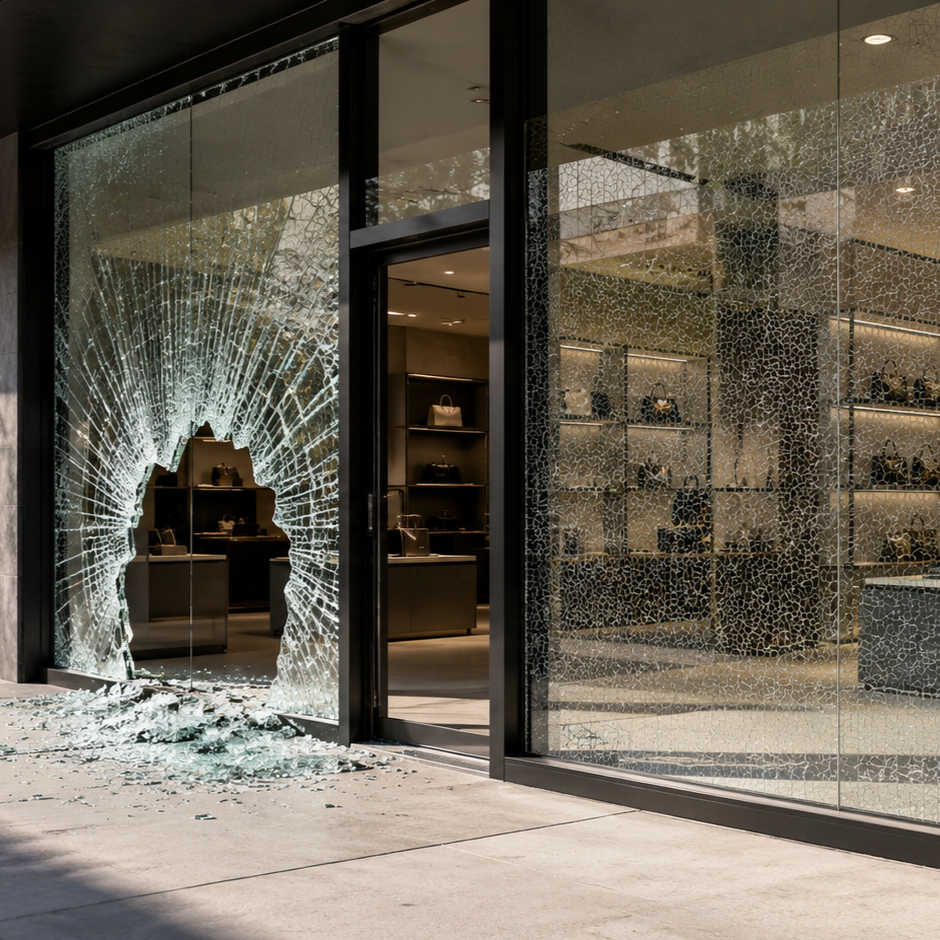
You walk past a retail shop on a Monday morning and find the familiar starburst pattern — glass cubes across the sidewalk, the frame standing wide open, register gone. Or the glass held: spider-web cracks from edge to edge, the window still in place, a crowbar lying on the ground outside. The difference between those two mornings came down to one specification decision made at installation.
Both tempered and laminated glass qualify as safety glass. Both meet commercial building codes. But they fail in completely different ways — and for a storefront, how glass fails matters as much as how strong it is before the first blow.
How Each Type Is Built
The manufacturing process explains the behavior.
Tempered glass starts as ordinary float glass that gets heated to roughly 1,200°F and then blasted with cold air in a process called quenching. That rapid cooling compresses the outer surfaces while the interior stays in tension. The stored mechanical stress is what makes tempered glass four to five times stronger than standard glass — and what causes it to shatter into small, roughly uniform cubes when it does break. The entire pane releases that stored energy at once. It doesn't crack. It disintegrates.
Laminated glass is built differently. Two or more glass layers are bonded together with a polyvinyl butyral (PVB) interlayer — typically 0.030 inches thick in standard commercial applications — under heat and pressure. The PVB acts as a flexible membrane. When the glass layers crack, the interlayer holds the fragments in place. The panel crazes. It looks wrecked from the outside. But it stays in the opening.
These two different structures produce two fundamentally different failure modes. Which one protects your business better is the whole decision.
What Happens at the Moment of Impact
Most coverage stops at "tempered breaks into small pieces, laminated stays together." But the timeline matters more than the summary.
When tempered glass breaks, the entire pane reacts at once. A single hard strike — a thrown object, a kick, a sharp blow to a corner — triggers a chain reaction through the whole panel. The glass drops out of the frame in under two seconds. There are no dangerous shards, which is exactly why it qualifies as safety glass. But the barrier is gone.
When laminated glass breaks, the glass layers crack, but the PVB holds them. The panel becomes a spider web of fractures from edge to edge. Getting through it requires sustained effort — repeated heavy blows, typically 60 to 90 seconds of work with standard tools before an opening forms. Most smash-and-grab attempts depend on speed and low visibility. Sixty seconds is a long time when the alarm is already triggered.
That delay is why security-conscious storefronts specify laminated. It doesn't stop a determined attacker indefinitely. It slows them down enough to matter.
Head-to-Head: Where Each Type Wins
| Factor | Tempered Glass | Laminated Glass |
|---|---|---|
| Initial strength | 4–5× standard glass | ~3× standard glass |
| Failure mode | Full disintegration into cubes | Crazes, holds in frame |
| Forced-entry resistance | Low — fails in 1–3 blows | High — 60–90+ seconds |
| Injury risk at breakage | Very low (no sharp edges) | Low (fragments contained) |
| Sound dampening | Minimal | Noticeable reduction via PVB |
| UV blocking | None inherent | ~99% with standard PVB |
| Code compliance | Meets IBC 2406 | Meets IBC 2406 |
| Relative cost | Baseline | 20–40% more per panel |
Both types meet International Building Code Section 2406 requirements for safety glazing in hazardous locations — which covers most commercial storefront openings. The code doesn't mandate one over the other. That's a business decision, not a permit decision.
The Security Gap Is Not Close
Safe glass and secure glass are different things.
There are storefronts where the owner went with tempered to save $300 and then spent $8,000 after a smash-and-grab — inventory loss, emergency board-up, same-day replacement, plus the insurance deductible. The tempered glass did exactly what it was designed to do. It broke safely, into small, harmless pieces, and opened the building in about two seconds flat.
Laminated glass is the correct call for any storefront with high-value merchandise. Any location with property crime exposure. Any operator who can't absorb the liability of an open frame at 2 a.m. The cost math changes the moment you factor in even one incident.
But tempered still has a legitimate place in commercial glazing.
When Tempered Is the Right Choice
Not every panel on a commercial facade is a security exposure. Tempered glass is appropriate for high panels above the reach line — typically anything above 7 feet — where forced entry through the glass isn't practical. It also makes sense for interior glass partitions and office walls, display case interiors, and door lites where occupant safety is the primary concern — not break-in risk.
For businesses where the product mix doesn't make a compelling theft target — a bookkeeper's office, a tax prep shop, a dry cleaner — the security premium on laminated may not pencil out. The risk profile of what's inside drives the calculation.
Apply the reach-through test: if someone could grab merchandise or trip a door latch through the opening left by a broken panel, that lite is a security exposure and warrants laminated glass.
PVB Thickness and Security Grades
Standard laminated glass uses a 0.030-inch PVB interlayer. That's what you get when you order laminated glass without calling out a security specification. It meets code, holds the pane together after impact, and dramatically extends forced-entry resistance compared to tempered.
For higher-risk applications, thicker interlayers are available. Security-grade laminates use 0.060-inch or 0.090-inch PVB, or stiffer ionoplast (SGP) interlayers that resist tearing more aggressively after the glass layers crack. Standard laminated holds for 60–90 seconds against typical forced-entry tools. Security-grade laminated can hold for several minutes under the same sustained assault.
For most retail storefronts, standard 0.030-inch PVB laminated is sufficient. For a jewelry store, pharmacy, or any location with a documented history of commercial burglary nearby, the conversation about security-grade interlayers is worth having.
And the Code Reality
And it matters that building code compliance doesn't answer the security question at all.
IBC 2406 requires safety glazing — tempered or laminated — in specific hazardous locations around storefronts. The code allows either type. A contractor who builds a compliant storefront in tempered glass has done nothing wrong from a permit standpoint. If they tell you the glass "passes code" and stop there, they've answered a different question than the one you should actually be asking.
The upgrade to laminated is a business decision. Make it that way — based on what's behind the glass and who's likely to walk past at 3 a.m., not on what the inspector is looking for at final walkthrough.
How to Tell Which Glass You Already Have
If you're not certain what your current storefront is glazed with, check the edge of a panel at a corner where the frame seal is thinnest. Laminated glass shows a visible interlayer — a thin, slightly greenish or neutral band running through the middle of the glass thickness. Tempered glass has no interlayer; the edge looks like a single uniform piece all the way through.
Existing damage patterns also tell the story. Tempered fracture produces a fine grid of roughly uniform, small squares across the whole pane. Laminated fracture produces larger, irregular cracks radiating from the impact point — it crazes, it doesn't cube.
A glazier can confirm which type you have in about 30 seconds by looking at the edge and measuring thickness.
Frequently Asked Questions
Most building codes require safety glazing in storefront openings — either tempered or laminated. The code doesn't typically mandate one over the other. Laminated glass is a security and performance upgrade, not a permit requirement in most jurisdictions. If you need a code-specific answer for your location, check with your local building department or a licensed commercial glazier.
Some. Tempered glass is significantly stronger than standard glass under steady load. But it's engineered to release its stored stress in a single catastrophic event when it does fail — one well-placed impact can drop the entire pane in under two seconds. For any storefront facing real forced-entry risk, that failure mode isn't acceptable regardless of how strong the glass is before impact.
It's a hybrid: glass that has been both tempered and then laminated into a multi-layer assembly. You get the high initial impact strength of tempered glass combined with the hold-together behavior of the PVB interlayer. It's the highest-performance option for storefronts where both occupant safety and forced-entry resistance matter. It typically requires a custom order and costs more than either type alone — but it's the right spec for the right application.
Expect laminated to run 20–40% more per panel compared to tempered of the same dimensions. On a typical commercial storefront with three to five vision panels, the total difference is often $300–$800. Security-grade laminated with thicker PVB or ionoplast interlayers costs more — sometimes double the price of standard tempered. Run that number against the cost of a single emergency board-up call plus after-hours replacement, and the math usually resolves itself.
Often, yes. Existing aluminum storefront frames that are compatible with the thickness of laminated glass — typically 1/4 inch (6mm) or 9/32 inch — can accept a direct swap without replacing the frame. A glazier needs to verify the rabbet depth and frame tolerance before confirming the fit. In most cases, the frame stays and only the glass changes.
Two questions drive it: what is the value of what's behind the glass, and what does property crime look like at this location? High-value product or any documented break-in history nearby tilts clearly toward laminated. Low-risk location with low-value merchandise may be fine with tempered. A commercial glazier can walk you through it in 15 minutes. The answer is almost always obvious once you put a dollar figure on what's behind the glass.
Schedule a storefront glass consultation — Luxe Residential and Commercial Glass handles storefront glass installation, specification, and security-grade glazing upgrades throughout Las Vegas, Henderson, North Las Vegas, and the surrounding metro. Call (702) 825-7463 (License #0090853) to schedule.