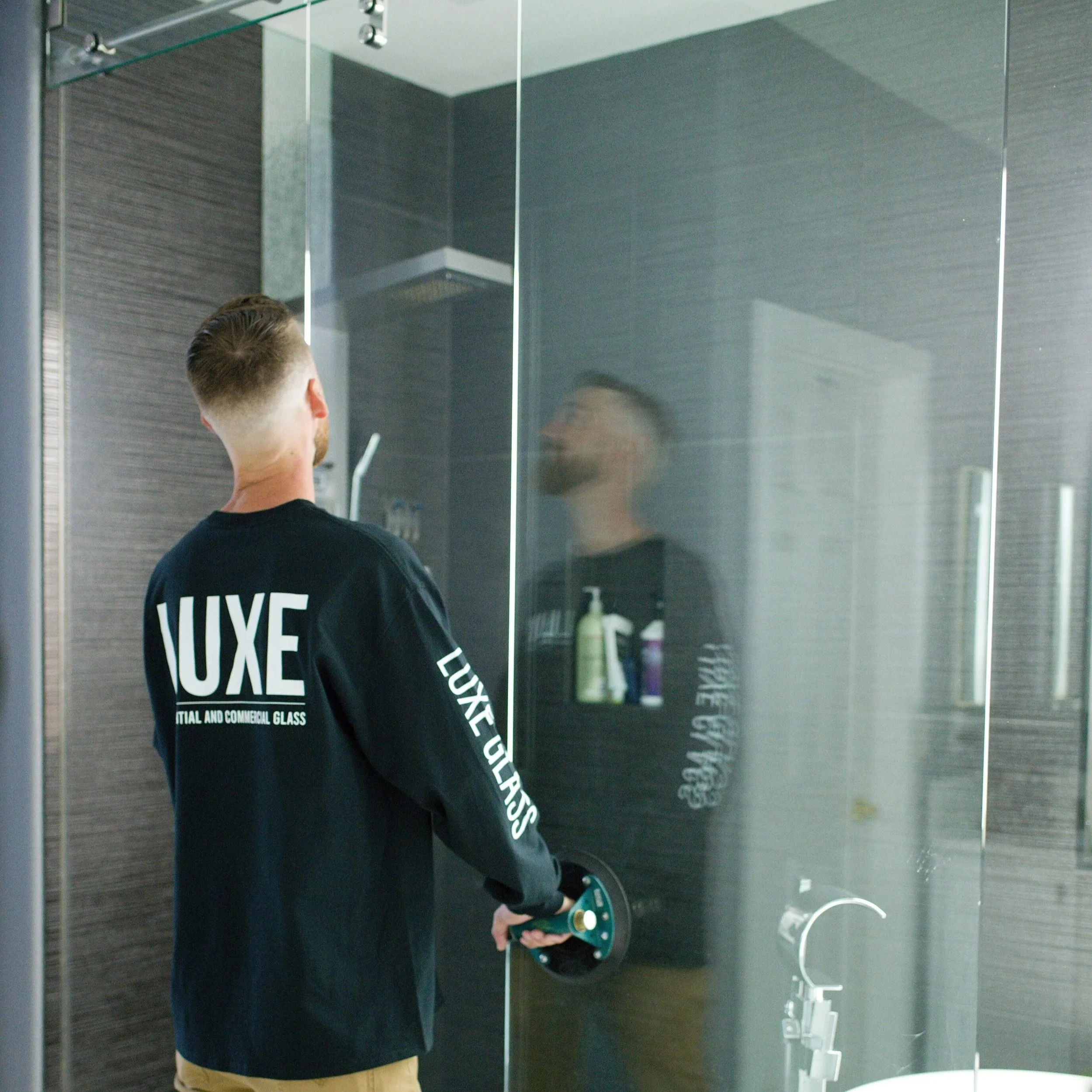
You're standing in a showroom, two frameless doors side by side. One is crystal clear. The other looks nearly identical — but the white tile behind it reads a little brighter, a little truer. The salesperson says one is "low-iron" and the other is "standard clear," and you nod like the distinction is obvious.
And it does matter. The finish you choose affects more than how your bathroom looks the first week — it changes how much time you spend cleaning in year three, how visible the shower is from the doorway, and whether hard-water deposits are fighting you every month or every quarter.
Here's what each finish actually does, how it works at the material level, and when one makes more sense than another.
Standard Clear Glass: The Baseline
Most shower door installations use standard float glass that's been tempered for safety. The glass is transparent — but not truly colorless. Float glass contains iron as a natural impurity in the silica sand used to produce it. That iron introduces a faint green tint, visible along the cut edge and faintly present when you look through a large panel at an angle.
For most bathrooms, the green cast is a non-issue. But if your shower has white or light-gray tile that you want to read as true white through the glass, standard clear pulls the color slightly toward green or cool.
On tempering: Every shower door — regardless of finish — must be made from tempered safety glass. The process heats the panel to around 1,200°F and rapidly cools it, creating internal compression stress. That makes the panel roughly four times stronger than the same thickness of untempered glass. When it does break, it fractures into small, blunt pebbles rather than long shards.
The finish doesn't change the safety rating. Clear, frosted, tinted, patterned — it all starts as tempered.
Low-Iron Glass: When Clear Isn't Clear Enough
Low-iron glass is standard float glass with the iron content reduced to less than 0.01% by weight — about one-tenth the iron of standard clear. The result is a panel that transmits around 91% of visible light, compared to 83–85% for standard float glass.
In practice: tile colors read truer, whites stay white, and the glass panel itself nearly disappears rather than adding a subtle tint.
It's not unusual for homeowners to walk into a finished bathroom with low-iron glass and genuinely ask if the door was installed yet.
That's what the finish does when it's done right — the glass disappears.
Low-iron costs more at the glass level, typically $3–$6 more per square foot before fabrication and hardware. For a standard shower enclosure, that adds $50–$150 to the total. If the tile work is the focal point of the bathroom, that difference is usually worth it.
Frosted Glass: How the Surface Actually Works
Frosted glass is clear glass made translucent by disrupting the surface so light scatters instead of passing through in straight lines. Two processes produce frosted glass, and they're not the same.
Acid etching exposes the glass to hydrofluoric acid, which reacts with the silica and creates a smooth, uniform micro-texture across the surface. Acid-etched frosted glass has relatively shallow surface pits — typically under 5 microns deep — and a consistent silky appearance.
Sandblasting forces abrasive particles (usually aluminum oxide at 80–150 grit) against the glass surface under pressure. The result is a rougher, more irregular texture with pits that can run 10–25 microns deep.
The depth difference matters for maintenance. Acid-etched frosted glass is easier to keep clean because the shallower pits don't trap mineral deposits as aggressively. Sandblasted frosted glass has deeper cavities where calcium carbonate from hard water can settle and anchor. Once mineral scale works its way into those pits, standard bathroom cleaners won't reach the bottom. You're working at the surface while the deposit holds from underneath.
Both types apply the frosted texture to only one side of the glass — typically the interior-facing surface — so the exterior remains smooth and easy to wipe down.
On privacy distance: Frosted glass obscures detail at roughly 6–12 inches of depth, depending on frost density. At arm's length across a shower enclosure, most frosted finishes show a silhouette without readable detail. Full-opacity opaque glass blocks silhouettes entirely and is a separate category from frosted.
Patterned and Textured Glass: Geometry as Privacy
Textured glass has a raised or embossed pattern pressed into one surface while the glass is still semi-molten, before it cools and hardens. The texture refracts light in multiple directions, creating visual obscurity through geometry rather than surface treatment.
Common patterns used in shower applications:
| Pattern | Privacy Level | Light Transmission | Character |
|---|---|---|---|
| Rain | Moderate | ~85% | Wavy channels, contemporary |
| Reeded / Fluted | Moderate–High | ~82% | Vertical channels, geometric |
| Aquatex | Moderate | ~84% | Soft stipple, neutral style |
| Stippolyte | High | ~70% | Dense pattern, maximum obscurity |
| Chinchilla | High | ~72% | Coarser texture, traditional |
Rain glass replicates parallel wavy channels that blur movement inside the shower without significantly blocking light. It reads as neutral across most bathroom styles, which is part of why it stays consistently popular.
Reeded glass — also called fluted glass — uses vertical or horizontal channels pressed to a depth of 1–2mm at roughly 3–6mm widths. It's seen a significant resurgence because the same geometric language has become prevalent in kitchen and bathroom cabinetry. The visual pairing is coherent.
But the texture itself has a tradeoff. Those channels collect soap residue along the ridges. Easy enough to wipe, but it requires consistent attention. Leaving it two weeks in a hard-water environment means working along each individual channel rather than wiping a flat surface.
Tinted Glass: Color as a Functional Layer
Tinted shower glass uses metal oxides introduced into the glass batch during manufacturing, so the tint runs through the full thickness of the panel — not just a surface coating.
Common tint options for shower applications: bronze, gray, blue, and green. A standard bronze tint reduces visible light transmission by roughly 15–35%, depending on depth. Gray tints reduce light neutrally without shifting color. Bronze and green tints change the color temperature you see inside the shower.
Functionally, tinted glass provides moderate privacy during daylight hours by reducing the contrast between the inside and outside of the enclosure. But here's what most people don't realize: that privacy depends entirely on the light differential. Tinted glass works because the brighter ambient light outside the shower overpowers the view through the panel.
At night, with a shower light on and the bathroom relatively dim, the effect reverses. The shower interior is now the brighter zone. Tinted glass becomes largely transparent from the outside when there's more light behind it than in front. For consistent privacy regardless of time of day or lighting conditions, tinted glass alone isn't the right tool.
Coated Glass: Protective Finishes That Live on the Surface
Separate from glass type, surface coatings treat the outer layer of otherwise clear or low-iron glass to change how water behaves on it.
Hydrophobic coatings — marketed under names such as ClearShield, EnduroShield, or Diamon-Fusion — bond to the glass surface at the nanoscale, creating a microscopic barrier. Water beads up and rolls off rather than spreading into a thin film that evaporates, leaving mineral deposits behind.
These coatings don't make glass self-cleaning. They reduce the frequency and effort of cleaning by preventing minerals from bonding strongly to the surface. In areas with hard water above 200 ppm total dissolved solids, the practical difference is real — weekly cleaning may stretch to monthly without visible buildup.
The coating itself is 50–100 nanometers thick. Applied to clear glass, it's optically invisible. Applied to low-iron glass, the low-iron characteristics remain fully intact. The finish choice and the coating choice are independent decisions.
Coatings wear over time rather than failing suddenly. Most professional-applied coatings carry warranties of 10 years, with performance declining gradually. When a coating reaches the end of life, the glass returns to standard uncoated behavior — not damaged, just unprotected. Re-application is possible.
Matching the Finish to the Situation
| Priority | Best Finish | Why |
|---|---|---|
| Show off tile work, maximum clarity | Low-iron + protective coating | True color transmission, easier maintenance |
| Privacy without heavy obscurity | Rain or reeded/fluted | Good light, moderate visual blur |
| Consistent privacy in all light conditions | Frosted (acid-etched) | Reliable obscurity, easier to clean than sandblasted |
| Distinct visual character | Tinted (gray or bronze) | Works well with frameless hardware |
| Lower long-term maintenance effort | Any glass + hydrophobic coating | Prevents mineral bonding at the surface level |
Frequently Asked Questions
It hides them initially — the texture breaks up the reflective surface that makes water spots visible on clear glass. But it doesn't prevent buildup. In hard-water areas, minerals accumulate in the micro-pits of frosted glass and can become more difficult to remove than spots on a smooth surface. Acid-etched frosted is notably easier to clean than sandblasted for this reason: shallower pits give calcium carbonate less to anchor to.
You can apply a hydrophobic coating to existing clear or low-iron shower glass — this is a legitimate professional service that makes a measurable difference in how often you clean. You can't add a textured pattern or change the tint of existing glass. Frosting film exists as a DIY product, but it doesn't perform like factory-frosted glass and typically starts peeling at the bottom edge within two to four years where water exposure is highest.
Clear or low-iron glass with a factory-applied or professionally applied hydrophobic coating. The combination gives you the easiest cleaning surface: water beads off, minerals don't bond readily, and you're wiping flat glass rather than working around texture or pattern. Every textured finish creates more surface area that captures residue — that's a mathematical reality, not a flaw in any specific product.
Not necessarily, and the answer changes based on lighting. Frosted glass provides consistent privacy regardless of which side is brighter. Tinted glass provides privacy based on the light differential between the shower interior and the bathroom — it works well in a bright bathroom during the day, but the effect reverses when the shower light is the dominant source. For privacy that doesn't depend on light conditions, frosted or opaque finishes are the reliable choice.
Slightly. Tinted glass reduces heat loss through the panel by limiting infrared transmission — but the practical effect in a residential shower is negligible. Clear and low-iron glass pass slightly more radiant heat out of the enclosure. If you're building a sealed steam shower, ask about laminated glass options, which hold heat better than single-panel tempered glass of the same thickness.
Two tests. First, hold a piece of white printer paper flat against the outside of the glass and look at it through the panel — if the paper reads bright true white, you likely have low-iron glass; if it has a slight green or gray cast, it's standard clear. Second, drop three or four drops of water onto the glass surface. If they bead up into rounded droplets and roll off easily, a hydrophobic coating is active. If they spread flat and form a thin film, the glass is uncoated or the coating has worn through. A glazier can confirm either result in about 30 seconds.
Schedule a measurement and glass selection consultation — Luxe Residential and Commercial Glass handles custom shower door installations, frameless enclosures, and glass replacements throughout Las Vegas, Henderson, North Las Vegas, and the surrounding metro. Call (702) 825-7463 (License #0090853) to schedule.