
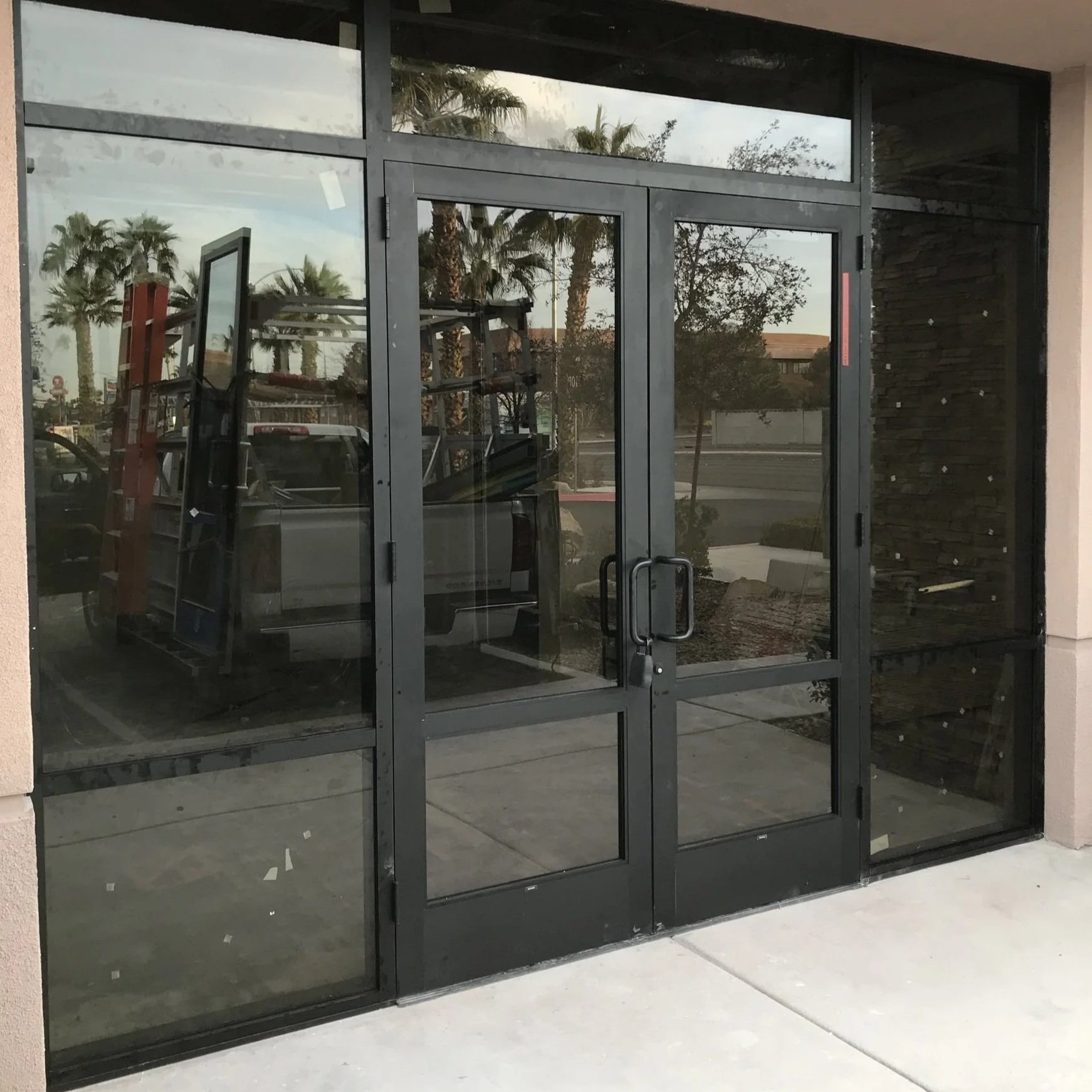
You walk in Monday morning, and there is a crack running from the lower left corner of your front panel straight up toward the frame. The glass is still in place. Nothing fell overnight. The alarm didn't trip. Now you are standing there wondering two things: is it safe to open for business, and what is this going to cost you?
That's the moment this question matters. And the answer isn't always obvious — not because it's complicated, but because several different failure modes look similar until you know what to check.
Here's how to read what you're actually dealing with.
What Glass Repair Actually Does — and Doesn't Do
Before you can make the call, it helps to understand what repair means at the physical level, not just the price level.
Storefront glass repair typically means one of three things: resin injection for chips and non-penetrating surface cracks, silicone resealing for drafts and moisture intrusion around the frame, or hardware adjustment for misaligned doors. That's the complete list. If the damage falls outside those three categories, you're not repairing — you're delaying a replacement.
Resin injection works by filling a surface crack with a UV-curing acrylic compound. The resin bonds to the glass surfaces on both sides of the crack, restores optical clarity to roughly 85–90%, and stabilizes the crack against further propagation. It requires drilling a small entry point into the glass. That's why it works on surface damage — and why it's completely useless on tempered glass.
Tempered glass is manufactured under 10,000–24,000 PSI of surface compression. That prestress is what makes it stronger than ordinary glass and what makes it shatter into small pebbles instead of sharp shards when it breaks. But the moment you drill into a tempered pane to inject resin, you release that stored energy in an uncontrolled way. The panel doesn't crack further — it shatters.
There's no repair for tempered storefront glass once it cracks. It gets replaced.
Most commercial storefronts use tempered glass. If you're not sure what you have, look at the corner of the panel. You should see an etched or printed bug — a small stamp showing the manufacturer, the glass type, and the ANSI or SGCC certification. 'T' or 'Tempered' in that stamp means repair is off the table.
The Four Tests to Run Before You Call
The difference between a repair call and a replacement project usually comes down to three physical characteristics of the damage: where it is, whether it penetrates the full thickness, and how far it runs.
Test 1: The fingernail drag.
Run your fingernail slowly along the crack from one end to the other. On a surface scratch or surface star, your nail catches in only one direction — it slides smoothly the other way. If your nail catches in both directions, the damage goes all the way through the glass. Through-penetration on tempered glass means replacement, no further assessment needed.
Test 2: The edge distance.
Measure from the crack endpoint to the nearest frame edge. If any part of the crack comes within 2 inches of the frame, the damage has entered the structural load zone. The glazing tape and setting blocks transfer load from the glass to the frame in that border area. A crack in that zone is not cosmetic — it's structural, and the pane needs to come out.
Test 3: The corner check.
A crack that originates from a corner — not from an impact point in the field of the glass, but from the corner itself — is almost always a thermal fracture or a frame stress fracture. These cracks don't stay stable. They propagate. Corners are the most vulnerable point in a tempered panel because that's where stress concentrations from the manufacturing process are highest.
Test 4: The condensation test.
If the damage is between the panes on a double-pane insulated panel, you won't see a crack. You'll see fogging, haze, or water streaks that don't wipe off. That's a failed insulating seal — the argon fill has escaped and moisture has infiltrated the airspace. There is no repair for a failed IGU. The entire unit needs replacement.
Damage Type Quick Reference
| Damage Type | Repair Possible? | Reason |
|---|---|---|
| Surface chip, < 1 inch across | Yes | Doesn't penetrate full thickness |
| Surface crack, < 3 inches, away from edge | Yes | Resin can stabilize |
| Any crack within 2 inches of frame edge | No — Replace | Load-transfer zone compromised |
| Corner crack (any size) | No — Replace | Thermal/stress fracture; will propagate |
| Through-penetrating crack (tempered glass) | No — Replace | Resin injection destroys tempered glass |
| Fogging between panes (IGU failure) | No — Replace | Seal cannot be restored |
| Laminated glass, interlayer intact | Case by case | May hold temporarily; replacement recommended |
Why Crack Location Tells You More Than Crack Size
Most business owners focus on crack length. Experienced glaziers focus on the crack origin.
A 6-inch crack running across the middle of a panel that started from a rock chip is a fundamentally different situation than a 2-inch crack that started from the corner. The first one is stable — it came from external impact, the crack energy is spent, and it's not going anywhere. The second one is a fracture that found a natural propagation path and will keep finding it.
And it shows up in a predictable pattern. Corner fractures typically start with a short horizontal or vertical run from the corner, then angle into the field of the glass at roughly 45 degrees. If that's what you're looking at, call for replacement the same day. If the panel is still in the frame and holding, it may stay that way for a few days — but corner fractures don't stabilize, they extend.
But that's not the whole story. Direction matters too. A crack running parallel to the frame edge is more structurally stable than a crack running perpendicular to it, because a perpendicular crack is crossing load paths. As a first read before a glazier arrives: horizontal cracks across the middle of a tall panel are less urgent than vertical cracks running edge to edge.
Panels can stay in service for three days with a mid-field crack while we waited on fabricated replacement glass — and that's fine as long as you know what you're watching. also had customers come in wanting to repair a 'small' corner crack that had grown to 18 inches by the following morning. The glass was telling them what was coming. They just hadn't learned to read it yet.
When Repair Makes Sense: The Short List
Repair makes sense when all of these are true: the glass is not tempered, the damage is on the surface only (fingernail test passes), the crack or chip is shorter than 3 inches and located at least 4 inches from any frame edge, and the frame itself is sound — no visible warp, no seal gaps, no movement when you press the glass lightly.
If those conditions hold, a qualified glazier can inject resin, restore clarity, and stabilize the crack for $200–$400 depending on complexity and access. That's the realistic repair cost range for surface damage in good conditions.
One more condition: repair only makes economic sense if the glass is worth saving. A 15-year-old single-pane storefront with a surface chip and a drafty frame is not worth a $300 repair. The frame integrity and thermal performance questions will come back around within a year. That's a case where replacement delivers better long-term value even though the immediate damage is technically repairable.
The 50% rule is a reasonable guide: if your repair estimate runs within 50% of what a full replacement would cost, go with replacement. You'll spend the repair money and then spend the replacement money within the year anyway.
When to Replace: The Clear Decision Points
Any tempered glass with a crack.
No exceptions. Resin injection is off the table. The glass gets replaced. If you're not sure whether it's tempered, look for the bug stamp at the corner.
Edge or corner damage.
Damage within 2 inches of the frame edge, or originating from a corner, means the structural envelope is compromised. Don't patch it. Replace it.
Failed IGU.
Fogging between panes means the seal is gone and the insulating value is gone. There's no way to re-fill the argon or reseal the unit in place. Replacement is the only path.
Frame failure.
A crack caused by frame movement — settlement, warp, differential thermal expansion — will return even after you replace the glass. The frame issue has to be addressed first, and that requires pulling the glass anyway. Fix the frame cause before you put new glass in.
Laminated glass with interlayer damage.
Laminated glass holds together after impact because of the polyvinyl butyral (PVB) interlayer bonded between the two glass plies. When that interlayer delaminates or shows visible bubbling, the safety function is gone even if the outer surface looks intact. The panel needs to come out regardless of what the glass itself looks like.
Age and efficiency.
Single-pane storefront glass over 20 years old is an energy problem. Commercial buildings lose more than a third of their heating and cooling load through inefficient glazing, according to DOE data. Modern storefront glass with insulated glazing units and Low-E coatings cuts that substantially. If you're already replacing damaged glass, have the whole envelope assessed while the frame is open.
What the Replacement Process Actually Looks Like
This is where business owners get surprised — not by the cost, but by the timeline.
Tempered glass is not stocked off a shelf. It's fabricated to order. The process involves cutting float glass to exact dimensions, running it through a tempering furnace at around 1,200°F, then quench-cooling it to build the surface compression layer. That process takes 24–48 hours at the tempering plant. Add shipping, site measurement confirmation, and scheduling, and a standard replacement runs 5–10 business days from initial call to completed installation.
If the glass is a custom size, add more time. If it's a large panel — 8 feet tall by 4 feet wide, for instance — it requires a crew with lifts and suction rigs because panels over a certain size weigh 300 pounds or more. Single-pane installation on the day of service typically takes 4–6 hours. A full entrance vestibule with multiple panels and door hardware can run a full workday.
If the damage is severe and the space can't be secured overnight, a glazier can board it temporarily with plywood while you wait on fabricated glass. This is standard practice and doesn't affect the replacement timeline. Get the board-up done the same day the damage is discovered — leaving compromised commercial glass exposed overnight is a liability and a security gap.
Do not attempt to remove or stabilize a cracked large-format storefront panel on your own. Panels over 24" x 36" can weigh 150–300+ pounds, and a destabilized pane can drop without warning.
Repair vs. Replacement: What to Expect
| Factor | Repair | Full Replacement |
|---|---|---|
| Typical cost range | $200–$400 | $800–$3,000+ |
| Timeline | Same day to 1–2 days | 5–10 business days |
| Works on tempered glass? | No | Yes |
| Restores insulating value (IGU)? | No | Yes |
| Addresses frame issues? | No | Can address alongside |
| Best for | Surface chips/cracks < 3", non-tempered | Any tempered glass, edge/corner damage, failed IGU |
Frequently Asked Questions
Not reliably. Any company telling you 'probably repair' without seeing the damage is guessing. A good glazier will want to see the crack origin, measure its distance from the frame, and determine whether the glass is tempered or annealed before making a call. A site visit is quick — 15–20 minutes — and it gives you an accurate answer instead of an optimistic estimate.
It depends on the crack. A mid-field surface crack on a stable panel is a low immediate hazard — the glass is still structurally sound. A corner crack or an edge crack is a higher hazard because those propagate under thermal and mechanical stress. Tempered glass that has been structurally compromised can shatter suddenly. If you're unsure whether the damage is stable, treat it as unstable until a glazier assesses it.
A standard commercial panel replacement typically runs $800–$3,000, depending on glass type, panel size, frame condition, and access requirements. Large custom panels or specialty glass, like laminated security glass, push costs higher. Phone estimates for storefront glass are rarely accurate — get an on-site quote.
Sometimes, with limits. Laminated glass cracks differently from tempered — the PVB interlayer holds the broken pieces together, so the panel stays in place. A surface crack in the outer ply can sometimes be stabilized with resin. But if the interlayer shows any bubbling, delamination, or visible separation between the plies, the panel needs replacement regardless of how intact the glass looks from the outside.
Not necessarily new glass — but something needs attention. Drafts from a commercial storefront frame usually point to failed sealant or a failed gasket at the perimeter, not the glass itself. A glazier can reseal the perimeter in a few hours, which is a repair job. If the frame has physically warped or pulled away from the surrounding wall, the frame system needs to be rebuilt — that's a construction call, not a glazing call. Have it assessed before it becomes a bigger problem.
Look for the bug stamp in the corner of the panel — an etched or printed mark showing the manufacturer, glass type, and certification standard. Tempered glass shows a 'T' or the word 'Tempered' alongside the ANSI Z97.1 or SGCC mark. Laminated glass shows 'L' or 'Lam.' If there's no stamp or you can't read it through weathering, a glazier can do a quick polarized-light check on-site. That stamp takes 10 seconds to find and answers half your questions before you've even picked up the phone.
Get a same-day assessment on your damaged storefront glass — Luxe Residential and Commercial Glass handles storefront glass repair and replacement throughout Las Vegas, Henderson, North Las Vegas, and the surrounding metro. Call (702) 825-7463 (License #0090853) to schedule.
