
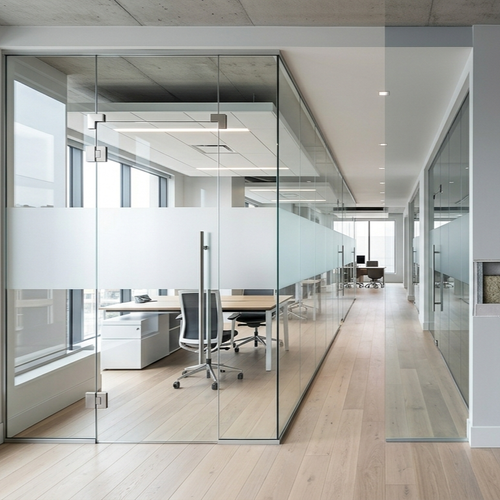
You sign the lease on a new suite, and the first question from your contractor is a simple one: glass walls or drywall? Most business owners answer on instinct — one feels modern, one feels cheaper — without understanding what they're actually trading off. The choice matters more than it looks. It determines how much natural light your team gets every day, how well your conference rooms contain a heated conversation, and what it costs when you need to move a wall three years from now.
Here is how the two materials actually compare, at the component level.
What You are Really Deciding
This isn't just a style choice. Glass partitions and drywall operate on completely different physical principles, and those principles drive real-world performance.
Drywall is a composite assembly. A standard stud-framed drywall partition consists of two layers of 5/8-inch gypsum board, a 3.5-inch stud cavity, and acoustic insulation fill. The combination of mass, an air gap, and absorptive material is what blocks sound — not any single layer working alone.
Glass is a monolithic pane. A standard single-pane tempered glass partition — typically 3/8 to 1/2 inch thick — is one homogeneous layer. It has mass, but no cavity and no absorption. Sound passes through it more easily than through a properly assembled drywall partition.
Understanding that difference is the foundation of every practical decision in this article.
Acoustic Performance: The Numbers
Most comparisons say drywall is "better for sound" and glass is "better for light." Both are true, but the gap is wider than most people expect — and the reason why matters.
The standard unit is STC — Sound Transmission Class. Higher is better. A partition rated STC 50 reduces a normal conversation on one side to a faint murmur on the other. A partition at STC 35 lets you hear what's being discussed, just not every word.
| Partition Type | Typical STC | Practical Meaning |
|---|---|---|
| Single-pane tempered glass (3/8") | 28–32 | Normal speech clearly audible |
| Double-glazed glass (two panes + air gap) | 38–44 | Speech audible; words less distinct |
| Acoustic laminated glass | 42–50 | Raised voices audible |
| Standard drywall (single layer, no insulation) | 33–40 | Similar to double-glazed glass |
| Drywall with acoustic insulation + double layer | 44–52 | Near-full speech privacy |
Here's the detail most articles miss: a basic single-layer drywall partition without insulation actually performs close to double-glazed glass. The acoustic advantage of drywall comes entirely from the full assembly — insulated stud cavity, double-layer gypsum, acoustic caulk at every penetration and gap. Skip any of those components during construction and the advantage disappears.
But there's a second problem with glass partitions that no competitor article explains clearly: flanking paths. Sound doesn't just travel through a wall. It travels around it — through suspended ceiling tile grids, under raised floors, around gaps in the partition channel where it meets the deck above. A well-installed double-glazed partition may be rated STC 44 in the lab. But if the ceiling plenum above it is open and unaddressed, the field-measured STC in that same office can test closer to STC 30. Same glass, same frame. Completely different result. This is why any acoustic spec for a glass partition system should ask for the installed field STC — not just the panel's rated STC.
When comparing glass partition quotes on acoustic performance, ask specifically: "What STC does this system achieve after accounting for ceiling plenum treatment?" If the supplier can't answer that, budget for a hard ceiling return or batt insulation above the partition.
Light and Productivity: Where Glass Wins
In offices, where the perimeter suites were completely wrapped in drywall and the interior desks had no access to exterior daylight. The people sitting in the middle of that floor spent eight hours a day under fluorescent light with no visual connection to the outside. When those same offices get glass partitions installed, the change in how the floor feels is immediate — people notice it the first morning they walk in.
Natural light matters at a physiological level. The mechanism is straightforward: the spectral content of daylight tells your circadian system what time of day it is. Artificial office lighting doesn't carry the same signal. An office that traps all its window light behind opaque walls is creating a low-grade physiological mismatch for everyone working in the interior. That shows up as fatigue, not inspiration.
Glass partitions let daylight reach interior desks. Frosted or fritted glass diffuses direct visibility while still transmitting light. Drywall blocks it entirely. There's no workaround short of installing borrowed-light windows into the drywall, which adds framing cost and rarely looks clean.
For open offices where the goal is collaboration and the floor has perimeter window lines, glass is the stronger choice for daylighting alone.
Cost: Upfront vs. Lifecycle
The upfront difference is real and significant. Expect to pay $15–$25 per square foot installed for a standard drywall partition. A comparable glass partition system runs $40–$80 per square foot installed, depending on glass specification, framing type, and hardware selection.
But that's only the first number in the calculation.
| Cost Factor | Drywall | Glass Partitions |
|---|---|---|
| Initial installation | $15–$25/sq ft | $40–$80/sq ft |
| Reconfiguration / removal | $8–$15/sq ft demolition + landfill fees + rebuild cost | Uninstall and reinstall; panels typically reusable |
| Ongoing maintenance | Patching, repainting as walls take damage | Cleaning only |
| Acoustic upgrade after install | Difficult once the wall is closed | Must spec correctly before installation |
The reconfiguration cost is where the math often flips. Drywall generates debris — gypsum dust, framing scraps, and disposal fees. Modular glass partition systems can be uninstalled in a day and reinstalled in a new configuration without generating construction waste. For any business on a 3–7 year lease that anticipates a layout change, the demolition cost of drywall should be factored into the initial cost comparison. For most mid-market commercial tenants who reconfigure once during a lease term, the lifecycle cost of glass is lower than it appears at the original quote.
Privacy: What Each Material Actually Provides
Glass privacy depends entirely on what type of glass you specify.
Clear glass gives you zero visual privacy. Frosted glass diffuses visibility but doesn't eliminate it — a person standing close to frosted glass can still make out shapes and outlines. Fritted glass (a ceramic dot or line pattern baked into the surface) offers more obscuration but is still partially translucent. Smart glass — electrochromic or PDLC switchable film — goes from fully clear to opaque on command, but adds $50–$100 per square foot to the glass cost.
Drywall is total visual privacy by default.
That matters for specific occupancy types. Legal offices, HR suites, medical consultation rooms, and executive spaces where sensitive conversations happen regularly — these spaces genuinely need full visual and acoustic privacy. Glass with acoustic treatment and smart privacy film can achieve it, but the cost adds up. For those applications, drywall is the practical answer, and there's no point pretending otherwise.
A lot of offices get glass meeting rooms because they photograph well for a leasing brochure. But if your team regularly handles personnel discussions, legal conversations, or client financials, a glass-walled conference room without acoustic treatment is a liability — not a feature.
When to Use Each (and When to Use Both)
The best installations use each material where its performance actually fits the requirement. Choosing one for the entire floor is almost always a compromise in the wrong direction.
| Use Case | Better Choice | Why |
|---|---|---|
| Perimeter offices with exterior windows | Glass | Preserves daylighting to interior; collaboration |
| HR, legal, or executive suites | Drywall | Full sound and visual privacy required |
| Open team areas with flexible layout | Glass | Reconfiguration, light, collaborative feel |
| Server room or storage | Drywall | Cost; no daylighting benefit |
| Conference room with sensitive meetings | Drywall or acoustic glass | STC 44+ required; flanking paths addressed |
| Retail or lobby partition | Glass | Aesthetics, light, visual connection |
The hybrid approach is also more cost-efficient than going all-glass. Glass fronts on private offices with drywall enclosing the sides lets you capture daylighting benefits while keeping acoustic performance high and overall cost lower than full glass throughout.
The Installation Detail That Determines Long-Term Performance
Most comparison articles stop at material selection. But the difference between a glass partition system that holds up for 15 years and one that starts showing problems in two often comes down to a single installation spec: the edge gap.
Aluminum framing expands and contracts with temperature. Tempered glass does too, but at a different rate. In climates with significant temperature swings — hot summers, cool winters — that differential movement adds up over years of cycling. The standard allowance is 3/16 inch of clearance between the glass edge and the interior of the aluminum channel on each side. That gap gives both materials room to move independently.
Go tighter than that — which happens when a framer cuts dimensions close, or when a partition gets installed during a cool day and then exposed to summer heat — and the channel starts loading the glass edge. Glass is weakest at its edges. It's not unusual to see stress fractures appear in partition glass within 18 months of installation for exactly this reason, on jobs that looked fine when the crew packed up and left.
It's not a glass quality problem. It's a dimensional problem. And it's entirely preventable if the installer knows what to check.
Frequently Asked Questions
Not to the partition itself. Once installed, the STC of a glass panel is fixed to that spec. You can add acoustic treatment to the ceiling above the partition — batt insulation in the plenum, a hard gypsum return to the structural deck — to reduce flanking transmission. You can also add acoustic perimeter seals at the floor channel and any gaps where the frame meets adjacent surfaces. But the core panel performance doesn't change. Spec the glass correctly before installation: laminated acoustic glass costs 20–30% more than standard tempered, but retrofitting afterward is far more expensive.
Minimum 3/8 inch (10mm) tempered for any structural partition. Most commercial installations use 1/2 inch (12mm) for single-pane systems — better acoustic mass and more impact resistance. Double-glazed systems typically use two 1/4-inch panes with a 3/4-inch or 1-inch air gap between them. For double-pane acoustic performance, it's the air gap and any laminated interlayer that drive STC, not just glass thickness. Thicker single panes don't perform as well acoustically as a proper double-glazed assembly.
No. A basic single-layer drywall partition without insulation runs STC 33–38, which is comparable to standard double-glazed glass. The acoustic advantage of drywall comes from the full assembly: double gypsum layers, acoustic insulation in the stud cavity, and acoustic caulk sealing all gaps. If any of those elements are skipped during construction — and they often are on budget builds — the advantage disappears. Ask your contractor for the full assembly spec, not just the wall type.
In most commercial settings, glass is lower maintenance. Drywall accumulates scuffs, dings, and cart marks over years of office use — it needs patching and repainting regularly. Glass can scratch, but scratch damage is less frequent than drywall surface damage in a typical office environment. Clean with a squeegee and diluted glass cleaner; inspect hardware fasteners and perimeter seals annually. Drywall looks clean when new; glass stays looking clean with less effort.
When you're on a short-to-medium lease and anticipate any layout change. Drywall demolition runs $8–$15 per square foot, plus disposal and rebuild — costs that rarely appear in the original partition estimate but show up when you reconfigure. Glass partition panels uninstall and reinstall without generating construction waste. For most tenants on a 5-to-7-year lease who reconfigure once, the total glass cost is lower than it first appears. Run the demolition math before you sign a drywall quote — that number changes the comparison.
Schedule a commercial glass partition consultation — Luxe Residential and Commercial Glass handles glass office partition installation, custom glass walls, and commercial partition systems throughout Las Vegas, Henderson, North Las Vegas, and the surrounding metro. Call (702) 825-7463 (License #0090853) to schedule.
