
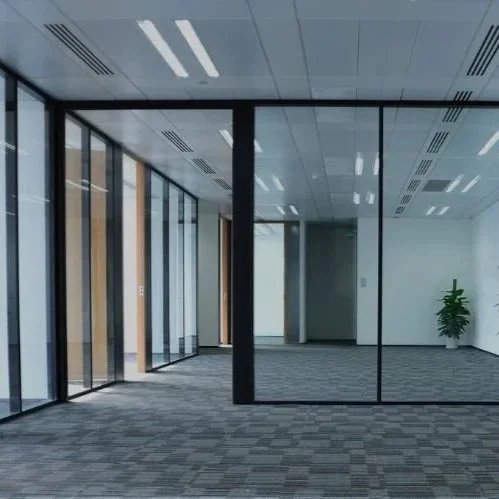
You have got two quotes on your desk. One says $14,500 for a glass conference room partition. The other says $8,200 for the same space. Both describe "frameless glass partitions" with "aluminum hardware." Before you call the lower bidder back, understand what separates those numbers. In commercial glass work, the price gap almost always reflects components you can't see until the system is installed and either holds up or doesn't.
Glass office partition systems span a wide range: from framed single-glaze panels priced under $90 per square foot to frameless laminated systems that exceed $180 per square foot. The spread makes sense once you understand what drives cost — glass type, frame hardware spec, site conditions, and what the quote does and doesn't include.
Cost at a Glance
Installed cost per square foot, based on current commercial market pricing:
| System Type | Installed Cost Range | Typical STC Rating | Best For |
|---|---|---|---|
| Framed single-glaze | $65–$90 per sq ft | STC 35–40 | Open offices, light visual separation |
| Framed double-glaze | $90–$120 per sq ft | STC 45 | Standard conference rooms, commercial build-outs |
| Frameless tempered | $120–$160 per sq ft | STC 40–45 | Executive offices, high-end aesthetics |
| Frameless laminated | $140–$185 per sq ft | STC 50+ | Boardrooms, legal/medical, acoustic-critical spaces |
For a standard 10-linear-foot conference room divider with a 9-foot ceiling — roughly 90 square feet of glass — that puts the installed range at $5,850 to $16,650. A larger open-plan run of 40 linear feet at the same ceiling height runs $23,400 to $66,600 across those same options.
Those are wide ranges. The sections below break down what moves the number — and what the low bid might be, quietly leaving out.
Framed vs. Frameless: The Biggest Cost Split
Framed systems use an aluminum extrusion around each glass panel. The frame carries the structural load, so the glass doesn't need to be as thick. Most commercial framed partitions use 3/8-inch (10mm) tempered glass, the code minimum for most partition applications. The frame is visible, which opens up design options in color and finish, and the system handles 90-degree corners, T-intersections, and integrated door frames without custom engineering.
Frameless systems put the structural demand on the glass and its mounting hardware. Panels typically need to be 1/2 inch (12mm) thick — heavier per panel, with hardware (spiders, patch fittings, or slim U-channel clips) that costs considerably more than framed components. A frameless install also requires more precise site work, since there's no frame to absorb minor misalignments. The look is cleaner, but the cost premium is real — typically 30 to 50 percent more than a comparable framed system.
The Aluminum Profile: Where Budget Systems Actually Fail
In failed partition systems where the glass was fine — not a scratch on it. But the aluminum track had deformed at the base and the panels were loose. The profile, the extruded aluminum channel the glass panel seats into, is what almost nobody asks about. It's also where inexpensive systems cut corners.
The profile fails first. Not the glass.
Commercial-grade profiles need a minimum wall thickness of 0.070 inches (1.8mm) to hold shape under lateral load — leaning, door swing, or minor building flex. Budget systems use 0.050-inch profiles. That difference doesn't show up in a photo. But after two or three years, the glass clips loosen, the panel develops play, and what was a clean system starts to wobble. Some clients come back a year later wondering why their partition feels unstable. Nine times out of ten, it's the profile.
Aluminum grade matters too. The 6061 series is the right spec for most commercial applications — it handles heat cycling and impact without deforming. The 3003 series is softer; it dents at exposed corners and can bow under thermal stress. Ask any glazier what aluminum series is in the profile. If they can't answer off the top of their head, that's your first signal.
Ask for the aluminum profile spec before signing. Commercial grade = 6061 series, 0.070" minimum wall thickness. That one question filters out a lot of underspec hardware.
Glass Type and What the STC Numbers Mean
Sound Transmission Class (STC) measures how much a partition reduces airborne sound. A wall rated STC 35 to 40 — typical of single-glaze tempered glass — reduces normal conversation to a murmur. You'll hear that a meeting is happening; you won't make out words at normal volume. A wall rated STC 45 or better cuts that further. At STC 50, adjacent conversation becomes largely inaudible.
The jump from single to double glaze comes from the air gap between panes. That trapped air column interrupts the sound wave's path through the assembly. The jump from double glaze tempered to laminated glass comes from the vinyl interlayer bonded between panes — it absorbs mid-range frequencies that standard tempered glass passes right through.
Glass type also dictates compliance threshold. The spec you choose determines what fire ratings, impact classifications, and egress glazing requirements you can meet. That's not a design decision. It's a code decision.
Layout Complexity and Site Conditions
Standard layouts — straight runs, 90-degree corners, consistent ceiling height — are the most efficient to install and quote. Non-standard geometry adds labor fast. An angled corner, a curved run, or a column transition can each add 15 to 25 percent to the installed cost. Each requires custom-cut glass and modified framing instead of stock panel sizes.
Floor condition matters too. The base track needs to be within 5mm of level over any 10-foot span. A fresh concrete slab in a new build is usually fine. In older office buildings, the floor may slope at transitions or have surface irregularities requiring leveling compound or shim work. That adds time, and time is labor.
But the item that surprises most clients is ceiling height. Every foot above the standard 9-foot spec requires heavier glass, stronger hardware, and more precise installation. A floor-to-ceiling frameless system in a 12-foot space isn't 25 percent more expensive than the same system at 9 feet. It's typically 40 to 60 percent more — glass thickness, hardware load rating, and on-site handling all step up at once.
Demountable vs. Fixed Systems
Demountable partition systems are engineered to be taken down and reinstalled without major damage to the floor, ceiling, or adjacent walls. They cost 10 to 15 percent more upfront than comparable fixed systems. But when a tenant relocates or a layout changes, a demount-and-reinstall runs $8 to $12 per square foot. Removing and replacing a fixed partition costs $15 to $25 per square foot — and the original installation is gone entirely.
For office tenants, demountable is almost always the right call. The upfront premium pays back quickly if there's any realistic chance the layout will change. For owner-occupants with a stable floor plan, fixed systems are simpler and slightly cheaper. One question to ask yourself: if you had to move this partition in three years, what would that look like? The answer usually settles it.
What's Typically Not in the Quote
Most glazier quotes cover glass panels, frame or hardware components, and installation labor. Several items are commonly excluded and need to be asked about explicitly:
| Line Item | Typical Add-On Cost | Notes |
|---|---|---|
| Electrical/data raceways in mullion | $8–$15 per linear foot | Power or data pass-through inside partition columns |
| Integrated blinds between panes | $20–$40 per linear foot | Blinds sandwiched in double-glaze units |
| Fire-rated glazing upgrade | Can double the glass cost | Required in egress corridors and certain occupancies |
| Building permit and engineering review | $1,500–$4,000 | Typical timeline: 2–4 weeks ,depending on scope |
| Leveling or subfloor prep | $3–$8 per sq ft | Required when the floor is out of tolerance for track installation |
Any quote that lumps glass, hardware, and labor into a single number makes it hard to compare bids or find where to trim. Ask for a line-item breakdown before you commit. The difference between an $8,000 bid and a $14,000 bid for the same project typically comes down to glass spec, profile grade, and scope items, the cheaper number excluded.
Frequently Asked Questions
For a single framed partition wall — 10 linear feet, 9-foot ceiling — expect at least $6,500 to $8,500 installed. Below that, you're generally looking at residential-grade product, which lacks the hardware spec for commercial use. It might photograph similarly. It won't hold up the same way over time.
In most commercial buildings, yes — when the partition affects an egress path, requires fire-rated glazing, or involves electrical rough-in. Many standard interior partition installs in open office spaces don't trigger a permit, but that depends on the municipality and building classification. Your glazier should advise based on experience with local requirements, but the permit obligation is the building owner's. Don't skip that check.
A single conference room divider — 10 to 15 linear feet — typically installs in one to two days. A system covering 40 to 60 linear feet might run three to five days. Demountable systems often go in faster than fixed installs because the track and panel components are engineered for quick assembly. Integrated doors, electrical channels, or complex corners add a day or two.
Yes — significantly. High-rise commercial buildings often have stricter fire and egress requirements that push you toward rated glazing. Buildings with raised-access floors need different base track specs. Older buildings with non-standard ceiling heights or irregular slabs add measurable labor. The quote for a ground-floor suburban office won't translate directly to a mid-rise tower floor.
A complete quote should specify glass type and thickness, frame system and series, aluminum grade, linear footage, a clear scope with inclusions and exclusions, and any permit or engineering allowances. If a quote lists only a total with a brief description, ask for the breakdown before signing. A glazier who can name the aluminum profile series and wall thickness they're specifying knows what they're quoting. That's the first question to ask.
The glass panels themselves need almost no maintenance beyond routine cleaning. Hardware — pivot hinges, door sweeps, patch fittings on frameless systems — may need adjustment every few years, especially on frequently used doors. Budget $200 to $500 for a hardware tune-up after the first three to five years. Integrated blind mechanisms are the most common service item. The glass holds up for decades. The hardware is what you'll actually be maintaining.
Schedule a site visit — Luxe Residential and Commercial Glass handles glass office partition design, fabrication, and installation throughout Las Vegas, Henderson, North Las Vegas, and the surrounding metro. Call (702) 825-7463 (License #0090853) to schedule.
