
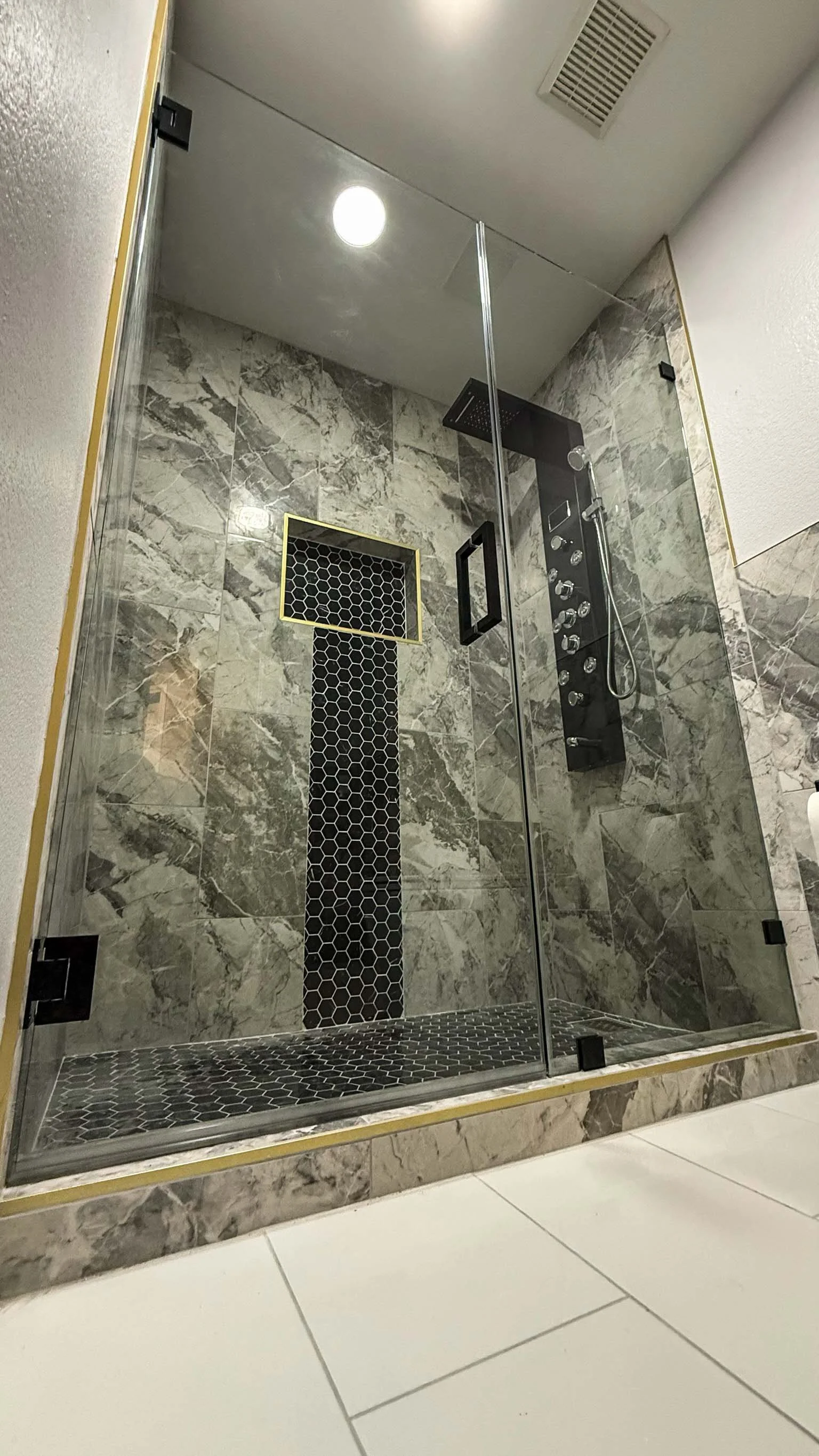
Walk into two showrooms and look at a frameless door and a semi-frameless door side by side. At first glance, they look almost identical — clear glass, minimal hardware, clean lines. Most people have to look twice to see the difference. But they are built very differently, they behave differently over time, and the right choice depends on factors most showroom salespeople won't walk you through.
Here's what actually separates them.
The Core Structural Difference
A frameless shower door has no metal around the glass at all — except for hinges, a handle, and sometimes a small U-channel at the floor to guide the door. The glass panel itself provides the structural rigidity. To do that without a frame, the glass has to be thick: typically 3/8" or 1/2" tempered glass, depending on door width and hardware weight.
A semi-frameless door uses an aluminum channel or extrusion around part of the glass — almost always the top and sides of a swinging door, or the vertical posts on a bypass slider. That metal framework does structural work, so the glass inside it doesn't have to. Semi-frameless doors typically use 1/4" tempered glass, which is thinner and lighter.
That's the fundamental difference. Everything else flows from it.
The Hardware
In a frameless door, the hardware carries all the load. Heavy cast stainless steel or solid brass hinges bolt directly through the glass and into the tile or substrate on the wall. A pivot bar or patch fitting at the top and bottom can substitute for traditional hinges on some configurations. Because the glass is doing the work, the hardware has to be oversized and precisely installed — the torque on those hinge points accumulates over years of use.
Semi-frameless hardware is lighter. The hinges attach to the aluminum channel, not directly to the glass, so the glass itself isn't under the same stress. This makes semi-frameless installation somewhat more forgiving — the channel accommodates minor wall irregularities that would require custom shimming on a frameless installation.
Both types use the same range of finish options: polished chrome, brushed nickel, matte black, oil-rubbed bronze. But frameless fixtures are generally heavier and more expensive because they're doing more structural work.
Glass Thickness and Why It Matters Beyond Strength
The thickness difference — 1/4" vs. 3/8" or 1/2" — does more than determine strength. It affects how the door feels, sounds, and closes.
A 1/2" frameless panel is noticeably heavier than a 1/4" semi-frameless door. When you open a well-installed frameless door, there's a satisfying weight and solidity to it. It swings with resistance. It doesn't rattle. Some people prefer this; others find a heavy door inconvenient in a small bathroom.
The thickness also affects acoustic behavior. A thicker panel transmits less sound, which matters in open-plan bathrooms or when you want the shower to feel like a contained space.
Semi-frameless doors at 1/4" glass feel lighter and more like a standard door. They work fine for most residential applications. The frame compensates for what the thinner glass can't do on its own.
Water Sealing: Where the Real Differences Live
This is where the comparison gets practical.
Semi-frameless doors seal along the channel edges. The aluminum extrusion runs along the top and sides of the door, and a continuous rubber gasket compresses against the glass inside the channel. When installed correctly, this creates a reliable seal with no gaps. Water doesn't get past the frame.
Frameless doors seal differently. There's no channel to compress against. Instead, the door relies on a sweep at the bottom (a rubber or plastic strip that drags across the threshold), a side seal (a flexible strip that contacts the adjacent panel or wall), and precise tolerances at the door edges. The seal is effective but depends more on installation accuracy and regular maintenance. If the sweep wears down or the side seal compresses unevenly, you'll get a slow water migration along the floor.
But here's the other side: semi-frameless aluminum channels collect water, soap scum, and mineral deposits in the corners where the metal meets the glass. That buildup is harder to clean than open glass edges. In hard water areas — where mineral content is high — that channel becomes a recurring maintenance issue that a frameless door simply doesn't have.
Installed side by side in identical bathrooms, frameless doors are consistently easier to keep looking clean over years of use, assuming the seals are maintained.
How Hard Water Affects Your Choice
This is a detail that most buyers don't think about until after installation.
In areas with high mineral content in the water supply, calcium and magnesium deposits accumulate on glass surfaces. On a frameless door, those deposits land on flat glass and can be addressed with a squeegee after each shower and occasional deep cleaning with a mild acid rinse.
On a semi-frameless door, the deposits also accumulate in the channel — especially in the corners and wherever the rubber gasket meets the aluminum. Getting mineral scale out of a tight aluminum channel is difficult. You can use a toothbrush and descaling solution, but it's tedious, and if the buildup is allowed to harden, it can lock the gasket against the metal and create leaks at the seal line.
This is a meaningful distinction in areas with notably hard municipal water. If your shower fixtures develop white scale deposits quickly, factor the channel maintenance burden into your door choice.
The Tile and Substrate Question
What your shower walls are made of matters for this decision more than most people expect.
Frameless doors anchor through tile directly into the wall substrate behind it. That substrate needs to be solid — cement board or equivalent, properly waterproofed. Soft or hollow tile spots, improperly mixed thinset, or old plaster substrates can crack under the stress of heavy frameless hardware. A good installer will tap-test the tile before drilling.
Semi-frameless channels distribute their load across the full length of the channel, which is gentler on the wall. They work well on fiberglass surrounds and acrylic systems that can't support a direct glass hinge mount. If your shower has a fiberglass or acrylic surround rather than tile, semi-frameless is often the more appropriate specification.
What They Cost
Neither option is "cheap," but the cost difference is real.
Semi-frameless doors for a standard 36" swinging door opening typically run from $600 to $1,200 installed, depending on hardware finish and glass type.
Frameless doors for the same opening generally run $1,200 to $2,500 installed — sometimes more for wide openings requiring 1/2" glass, or configurations with multiple fixed panels.
The price gap exists because frameless requires heavier glass (more material, heavier to ship), more precisely machined hardware, and a more demanding installation process. The tolerance for error on a frameless installation is small.
That said, frameless doors consistently add more to resale value than semi-frameless. Buyers who see a frameless glass shower during a walk-through notice it. It reads as a premium finish, not a builder-grade choice.
Which One Is Right for Your Shower
There's no universal answer, but here are the clearest decision points:
Choose frameless if: You want the highest-end look, your shower has solid tile walls with a sound substrate, the door width is 30" to 42", and you're comfortable with the price.
Choose semi-frameless if: Your shower has a fiberglass or acrylic surround, you're working with a tighter budget, you want a lighter door for an elderly or mobility-limited user, or the opening is unusually large (over 42"), and the glass weight of a frameless door becomes unwieldy.
Neither type is inherently prone to leaking if installed correctly. Both will last 15 to 20 years with normal use and basic maintenance. The differences are in aesthetics, maintenance character, and substrate compatibility — not durability.
Frameless vs. Semi-Frameless at a Glance
| Frameless | Semi-Frameless | |
|---|---|---|
| Glass thickness | 3/8" or 1/2" tempered | 1/4" tempered |
| Metal framing | None (hinges/hardware only) | Aluminum channels on edges |
| Sealing method | Sweeps and side seals | Continuous gasket in channel |
| Hard water maintenance | Easier (flat glass) | Harder (channels collect scale) |
| Substrate requirement | Solid tile over cement board | Works on tile and fiberglass |
| Typical installed cost | $1,200–$2,500+ | $600–$1,200 |
| Resale value impact | High | Moderate |
| Best for | Tile showers, premium finishes | Fiberglass surrounds, budget-conscious |
Frequently Asked Questions
Frameless is generally easier to maintain over time. There are no channels or gasket crevices to collect mineral deposits and soap scum. A squeegee after each shower and monthly cleaning keeps frameless glass looking clean with minimal effort.
Not inherently. A properly installed semi-frameless door with an intact gasket seals well. Leaks occur when the gasket degrades or when the channel seal fails due to mineral buildup. A frameless door can also leak if the sweeps or side seals wear down. Installation quality and maintenance matter more than the door type itself.
Yes, but it's a full replacement, not a swap. The hinge mounting points for frameless hardware are different from semi-frameless channel anchors, and the glass thickness changes. Budget for a complete new installation including any necessary substrate repair at the hinge locations.
Both 1/4" and 3/8"/1/2" tempered glass meet safety glazing requirements. Thicker tempered glass in a frameless application is specified for structural reasons — to handle the unsupported span without flexing excessively — not primarily for impact resistance. Both types shatter into small cubed fragments if they fail.
A good installer will assess this before drilling. The wall behind the tile needs to be cement board or equivalent — solid and well-anchored. Tap-testing the tile surface reveals hollow spots or debonded sections that could crack under hinge load. Older tile showers sometimes have degraded substrates that need reinforcement before frameless hardware can be installed safely.
Both frameless and semi-frameless doors come in polished chrome, brushed nickel, matte black, oil-rubbed bronze, satin brass, and other finishes. Frameless hardware tends to have more premium finish options since the hardware is more visible — there's no channel to draw attention away from the hinges and handles.
The Practical Answer
The difference between frameless and semi-frameless comes down to structure: frameless uses thicker glass and direct-mount hardware; semi-frameless uses a metal channel to do the structural work and thinner glass inside it. Frameless costs more, looks cleaner over time, and adds more resale value. Semi-frameless costs less, works on more substrate types, and is a practical choice for fiberglass surrounds or budget-sensitive projects.
Both are solid options. The choice is about your shower, your walls, and what you want the space to feel like in five years.
Schedule a measure and quote — Luxe Residential and Commercial Glass installs frameless and semi-frameless shower doors throughout Las Vegas, Henderson, North Las Vegas, and the surrounding metro. Call (702) 825-7463 (License #0090853) to schedule.
