
You pull up three quotes on your phone. One says $19,000, one says $31,000, and the third says $48,000. All three call themselves "glass pool enclosure" quotes. None of them explain why the numbers are that far apart.
Here's why: they might not be quoting the same product. Pool enclosure glass spans everything from a frameless glass barrier around a pool perimeter to a full-height walk-in structure with roof panels. Before you can evaluate a quote, you need to know which category you're buying.
Two Products Called the Same Thing
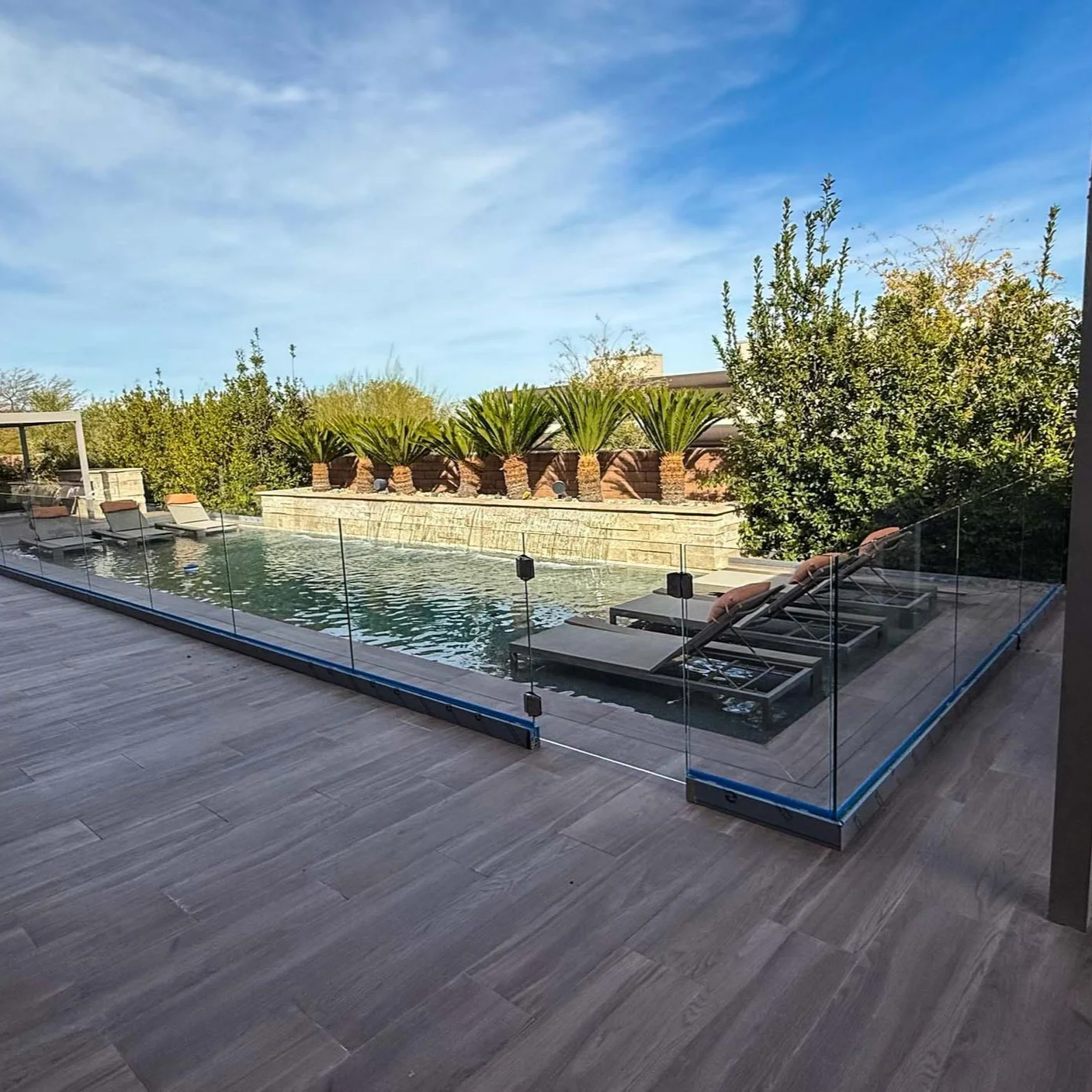
The phrase "glass pool enclosure" gets used for at least two distinct products. One is a glass fence — panels installed around the pool perimeter to meet code barrier requirements, open to the sky. The other is a full glass enclosure — a structural frame with glass wall panels and glass or polycarbonate roof sections that covers the pool area entirely.
They're not the same project at different price points. They solve different problems.
| Type | What It Is | Typical Price Range |
|---|---|---|
| Glass pool fence/barrier | Glass panels around pool perimeter — no roof | $120–$320 per linear foot installed |
| Full glass enclosure | Walls + roof on aluminum frame — walk-in structure | $35–$79 per sq ft of covered area |
A standard residential pool perimeter runs 60 to 80 linear feet. A full enclosure covering the pool and surrounding deck typically spans 700 to 1,500 square feet of structure. Know which one you're asking about before comparing bids.
Glass Pool Fence Costs
For a glass fence system — panels around the pool perimeter with no roof — the installed cost runs $120 to $320 per linear foot, depending on the system type and hardware specification.
| System Type | Cost Per Linear Foot (Installed) |
|---|---|
| Semi-frameless (posts between panels) | $120–$200 |
| Frameless — spigot/standoff mount | $160–$280 |
| Frameless — channel-base mount | $180–$320 |
| Glass gate (single swing, frameless) | $600–$1,200 each |
For a 65-linear-foot pool perimeter with one gate: a semi-frameless system typically runs $8,000–$14,000 total. A fully frameless spigot-mount system for the same pool runs $11,000–$19,500. That's not a quality gap — it's a system difference. Both can be done well.
Pool fence panels in high-UV desert climates should be 1/2" (12mm) tempered at minimum — not 3/8". The thicker panel is stiffer at mid-span, which matters when someone leans against it at full force. Don't accept thinner glass in a fence application.
Full Glass Enclosure Costs
A full glass enclosure — glass walls plus roof panels on a structural aluminum frame — runs $35 to $79 per square foot of covered area. For a 30x40-foot enclosure over a pool and deck, that's roughly $42,000 to $94,000 installed.
| Enclosure Configuration | Cost Per Square Foot |
|---|---|
| Basic fixed glass enclosure | $35–$55 |
| Mid-grade fixed, better hardware | $50–$65 |
| Premium fixed — low-e or tinted glass | $60–$79 |
| Retractable glass enclosure (manual) | $65–$120 |
| Retractable glass enclosure (motorized) | $90–$165 |
Retractable enclosures can collapse into themselves to open the space entirely. They cost roughly 40 to 80 percent more than fixed glass for the same footprint. The trade-off is flexibility — you get a fully open outdoor pool when you want it and a covered enclosed space when you don't.
What the Glass Itself Costs — and What Drives It Up
The glass panels are usually 15 to 25 percent of the total project cost. Hardware, frame, labor, and site prep make up the rest. But glass spec affects everything downstream.
Thickness is the starting point. Pool fence panels typically use 1/2" (12mm) or 5/8" (15.9mm) tempered glass. Enclosure wall panels are often 3/8" (9.5mm). Roof panels can be as thin as 1/4" (6mm) for short spans with tight frame support. Thicker glass is heavier, needs heavier hardware, and costs more to fabricate — but it performs better under wind load and point-impact stress.
Glass type is the second driver. Standard clear tempered is the baseline. Low-e coating reduces solar heat gain — relevant when summer sun beats on an enclosure for 12 or more hours a day. Tinted glass cuts glare. Low-iron glass removes the greenish cast you see in standard glass and improves visual clarity. Each upgrade adds $4 to $15 per square foot to the glass cost alone.
But there's a glass spec detail that almost nobody talks about — and in hot climates, it matters. Standard tempered glass can contain microscopic nickel sulfide inclusions that cause the panel to shatter spontaneously, sometimes weeks or months after installation. It's not a defect you can see. The solution is heat-soaked tempered glass: the panel is placed in a chamber at 290°C (554°F) for at least two hours, which forces any defective panels to break in the chamber rather than in your enclosure. It adds cost — typically $3 to $8 per square foot — but it eliminates the field failure risk.
Hardware Grade Is Where Cheap Bids Fall Apart
It's a pattern that plays out too often: a homeowner picks the low bid, the installer uses 304-grade stainless hardware instead of 316-grade, and by year four there's rust staining bleeding onto the pool deck. The enclosure looks aged, the hardware loosens, and the repair cost often exceeds the original savings on the bid.
For pool environments — chlorine air, UV exposure, hard water — 316-grade marine stainless is the correct specification. It lasts 15 to 20 years without corrosion problems. 304-grade shows visible rust staining within three to five years in sun-intensive, chlorine-adjacent environments. The price premium for 316 over 304 is roughly $8 to $15 per linear foot on the hardware — a small number relative to the total project.
When reviewing quotes, ask directly: "What grade of stainless are you using on hardware and fasteners?" If the answer is 304, or if they can't answer, weigh that against the lower price.
Site Conditions That Change the Final Number
The conditions on your specific site affect the installed price in ways that aren't visible in a phone estimate. Most of the variables below don't show up until someone measures on-site.
| Site Variable | Impact on Cost |
|---|---|
| Poured concrete deck | Baseline — most straightforward |
| Pavers over concrete | Paver removal and reset adds $400–$900 depending on extent |
| Tile over concrete | Cracking risk during drilling; tile repair may be required |
| Rectangular pool | Baseline — standard panel widths work |
| Freeform or L-shaped pool | Custom fabrication required; 10–20% cost premium |
| Limited equipment access | Hand-carry labor adds time; may increase labor by 15–25% |
| Older deck with unknown substructure | Engineering review required before full enclosure install |
Warning: If your deck has a wood substructure, or if the deck is more than 10 years old and hasn't been inspected recently, get a structural assessment before signing an enclosure contract. A full glass enclosure adds significant dead load — a compromised deck won't support it safely.
How to Get a Quote You Can Actually Evaluate
The gap between an $18,000 estimate and a $46,000 estimate often comes down to scope definition. A rough number given over the phone isn't a quote — it's a category.
To get a number you can evaluate and compare, come to the conversation with: the pool perimeter in linear feet (or overall pool and deck square footage), the deck material and approximate age, the height requirement (fence only, or full walk-in enclosure), whether you want walls only or walls plus roof, and any glass preferences such as clear, low-e, or tinted.
Get at least two quotes from glaziers who actually come to the site. On-site measurement catches the site conditions that phone quotes ignore. And ask both contractors to specify — in writing — the glass thickness, glass type (tempered, heat-soaked, or standard), hardware grade, frame material, gate hardware spec, any concrete work required, and how permitting is handled.
But comparing quotes on price alone is a trap. A quote with 316-grade marine stainless, heat-soaked tempered panels, and commercial-grade aluminum extrusions is not the same product as one with 304-grade hardware and standard tempered glass — even if the scope description reads identically. The lower number may cost considerably more in five years.
Frequently Asked Questions
Significantly more. Screen enclosures run $8 to $20 per square foot installed. Glass panel enclosures run $35 to $79. But glass outlasts aluminum screen framing by 10 to 15 years and doesn't need screen replacement every five to eight years. Over a 20-year ownership period, the cost gap narrows considerably — and glass never needs patching.
The structural frame and glass panels, when installed with 316-grade hardware and commercial gaskets, typically hold for 25 to 30 years before major rehabilitation. The glazing gaskets — the silicone seals holding glass in the frame — usually need replacement at 10 to 15 years in high-UV environments. That's a maintenance item, not a full replacement project.
In most jurisdictions, yes. A full glass enclosure structure requires a building permit and typically an engineering review for wind and dead load. A glass fence or barrier usually requires a separate pool barrier permit. Budget six to 12 weeks for permitting in busy markets. Ask your contractor who handles permit pulling — some include it, some don't.
Yes, as long as the deck substrate can support the load. The most common limitation is deck condition — older pool decks with cracking or settled concrete may need remediation before an enclosure can go in. A reputable contractor will assess this before quoting, not after signing.
Hard water and calcium buildup are the primary maintenance issues — the glass needs cleaning every three to six months to prevent mineral staining that eventually etches the surface. Gaskets and seals should be inspected annually. Hardware gets checked once a year to catch loose fasteners before they become structural problems. For most homeowners, this runs a few hundred dollars a year in product cost — negligible against the project investment.
A complete quote specifies glass thickness, glass type (tempered, heat-soaked, low-e), hardware grade, frame material and finish, gate hardware spec, required concrete or footing work, and how permitting is handled. If a quote just says "glass pool enclosure, 65 LF, $18,500 installed" with no breakdown, push for a line-by-line. Any contractor who can't provide one hasn't measured the job yet — and that number will change.
Schedule a site visit for a pool enclosure glass quote — Luxe Residential and Commercial Glass handles glass pool fences, frameless panel systems, and full glass enclosures throughout Las Vegas, Henderson, North Las Vegas, and the surrounding metro. Call (702) 825-7463 (License #0090853) to schedule.
