
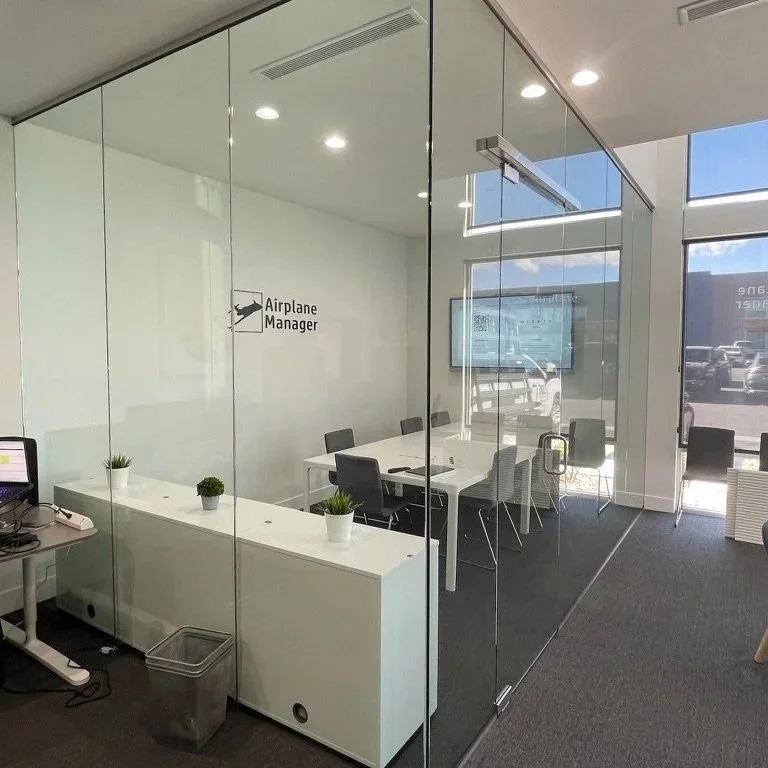
You spec'd glass partitions for the conference room, paid for laminated panels, and now employees on the other side can still follow the conversation. The spec sheet said STC 38. The experience says otherwise.
That gap — between what the specification promises and what you actually hear — is the central problem with glass partition acoustics. The glass itself can perform exactly as rated. But the glass accounts for maybe half of what determines how quiet a room actually is. The rest comes down to installation details most vendors don't bring up until after the noise complaints start.
Here's how it actually works.
What STC Means — and What It Doesn't
STC stands for Sound Transmission Class. It's a single number describing how well a material or assembly reduces airborne sound. The rating is measured in a lab: a standardized tone is played on one side, microphones measure the level on the other, and the difference is plotted across 16 frequency bands and reduced to one number.
Higher is quieter. STC 25 means normal speech is easily heard and understood. STC 45 means loud speech is barely audible.
But here's what the number doesn't tell you: the human ear doesn't perceive noise linearly. Every 10 dB of reduction is heard as roughly half as loud. That means the difference between STC 30 and STC 40 isn't "10 points better" — it sounds like cutting the noise level in half. The difference between STC 40 and STC 50 halves it again. That's why the gap between a basic partition and a properly spec'd acoustic system isn't subtle. It's dramatic.
And it's also why falling short by 10 points — which is easy to do with poor installation — isn't a minor inconvenience. It's the difference between a functional private office and one where everyone outside can follow the conversation.
STC by Glass Type: What the Numbers Actually Are
The STC rating depends on how the glass is made, how thick it is, and whether it's monolithic, laminated, double-glazed, or a combination.
| Glass Type | Typical STC Range | What You'll Hear Through It |
|---|---|---|
| Standard single-pane (1/4") | 27–31 | Normal speech clearly audible and intelligible |
| Thicker single-pane (3/8"–1/2") | 32–36 | Loud speech audible; normal speech harder to follow |
| Single-pane laminated | 35–38 | Normal conversation reduced to murmur |
| Double-pane standard IGU | 36–40 | Speech audible at high volume only |
| Double-pane laminated | 42–50 | Speech barely audible under normal conditions |
| Specialized acoustic assemblies | 48–55 | Near-complete speech privacy |
The jump from standard single-pane to laminated single-pane is one of the highest-value upgrades available. A polyvinyl butyral (PVB) interlayer — the same material used in automotive windshields — adds 3 to 5 STC points over unlaminated glass of the same thickness. That shift moves a partition from "I can hear everything" to "I can tell someone's talking but can't make out words." In a private office, that's often enough.
For a conference room handling sensitive conversations, target STC 40 to 45. That usually means double-pane construction with at least one laminated lite.
Why Your "High STC" Partition Still Lets Sound Through
This is where most coverage stops short. The glass can be rated STC 48. The room can still fail. Here's why.
Sound doesn't behave like water — it doesn't stay in the pipe. It behaves more like a gas under pressure: it finds every gap, travels through shared structures, and arrives on the other side through paths that have nothing to do with the glass panel you paid for.
Glaziers call this acoustic flanking. And it's the most common reason a well-specified partition disappoints.
The perimeter seal. The most frequent failure point. A hairline gap between the glass panel and the frame, or between the frame and the wall, gives sound a direct path through. A partition built from STC 50-rated glass can drop into the mid-30s in real-world performance if the perimeter isn't continuously sealed with acoustic gaskets. I've seen partitions where the spec sheet looked great but the installer skipped acoustic sealant at the base channel — and the client was back on the phone within a week.
The door. A hinged door compresses against a frame and gasket when it closes, creating a relatively tight seal on all four sides. A sliding door rides on a track and has inherent gaps — at the bottom edge and where the panel meets adjacent glass. Without drop seals and slam posts, a sliding door can reduce your effective STC by 8 to 12 points compared to the rest of the partition. The door is almost always where noise gets in.
The ceiling plenum. If the partition stops at the suspended ceiling line instead of running full height to the structural deck above, sound travels over the top. The plenum — the open air space between the ceiling tiles and the actual floor deck — is acoustically open. Sound goes up, over, and down into the next room. In offices with exposed ceilings or open ductwork, this is frequently the primary failure point. Not the glass. The air above the partition.
Shared HVAC ductwork. Adjacent rooms sharing a duct run allow sound to travel through the duct itself. A perfectly sealed partition with STC 48 glass and acoustic door seals will still leak conversation through an unlined duct branch. This one is outside the glazier's control, but it needs to be addressed before installation if acoustic performance matters.
The Resonance Problem That Trips Up Even Good Specs
Here's a detail that catches experienced specifiers off guard: standard double-pane assemblies have a built-in acoustic weak spot called the mass-air-mass resonance dip.
When an air gap separates two glass panes of identical thickness, they share the same resonant frequency. At that frequency — typically somewhere in the 100 to 250 Hz range, where low voices and office noise concentrate — both panes vibrate together. The air gap provides no isolation because the panes are moving in phase with each other. Sound at that frequency passes through more easily than it would through a single, thicker pane.
The fix is straightforward: use panes of different thicknesses. A 1/4-inch outer lite paired with a 3/8-inch inner lite disrupts the resonance alignment. The panes no longer share a frequency, so neither amplifies the other's weak spot. This is standard practice in acoustic glazing — but it has to be specified. An off-the-shelf double-pane unit typically uses matched thicknesses because matched panes are cheaper to produce.
But that's not the whole story. The air gap width matters too. For thermal glass, 12 to 16 millimeters is standard. For acoustic performance, increasing the gap to 100 millimeters or more can meaningfully improve the assembly's handling of low-frequency sound — the bass range that carries through walls most readily and makes conversations intelligible on the other side.
What Your Space Actually Needs
Different rooms have different requirements. Overspecifying wastes money. Underspecifying means rework.
| Room Type | Target STC | Recommended Assembly |
|---|---|---|
| Open-plan divider | 25–32 | Standard single-pane, framed |
| Manager's office | 35–38 | Single-pane laminated, framed |
| HR or general private office | 38–42 | Single-pane laminated or entry-level double-pane |
| Conference room | 42–45 | Double-pane laminated, framed, acoustic door |
| Legal or financial advisory | 45–48 | Double-pane laminated, acoustic sealant full perimeter |
| Medical or therapy suite | 48+ | Specialized acoustic assembly, full-height to deck |
The framed vs. frameless choice matters here. Framed systems — aluminum or steel channels surrounding each panel — give the installer continuous contact points for acoustic gaskets. More seal surface means fewer gaps. Frameless systems look cleaner and more contemporary, but they rely on point hardware at the edges rather than a continuous frame seal. With careful installation and the right glass spec, frameless systems can reach STC 40. But if acoustic performance is the priority, framed is the safer specification.
A Test You Can Run Right Now
If you have glass office partitions installed already and want a rough read on actual performance, you don't need a sound meter.
Stand on one side while a colleague makes a normal phone call on the other. Don't ask whether you can hear anything. Ask whether you can understand the words. Audibility and intelligibility are different things. An STC 38 partition means you might hear that someone is talking without being able to follow what they're saying. If you can track the conversation clearly, you're likely sitting at STC 30 or below — which means something in the system isn't doing its job.
What to Specify Before the Job Starts
Fixing acoustic problems after installation is expensive. The glass itself rarely needs changing — it's almost always the seals, doors, or partition height. But correcting those after the fact means undoing finished work.
The right time to get it right is before installation begins:
- Specify acoustic gaskets at every glass-to-frame junction — continuous, not spot applications
- Specify drop seals or threshold seals on every door within the partition system
- Confirm the partition runs full height to the structural deck if the room handles sensitive conversations
- Check the ceiling type: a suspended ceiling with a shared plenum will undercut any partition that stops at tile line
- Review HVAC duct routing for shared runs between adjacent rooms, and line or reroute as needed
For double-pane assemblies, specify mismatched lite thicknesses (e.g., 1/4" and 3/8") to avoid resonance frequency overlap
The glass is the easy part. The system around it is where the performance actually lives.
Frequently Asked Questions
For a standard private office where confidential conversations need to stay inside, target STC 38 to 42. Single-pane laminated glass in a framed partition with acoustic perimeter seals typically reaches this range. That's enough that a normal conversation is reduced to an indistinct murmur on the other side — words aren't distinguishable, which is the functional definition of speech privacy.
A well-spec'd double-pane laminated glass assembly in a fully sealed framed system can reach STC 42 to 50 — comparable to, or better than, a standard 3.5-inch stud wall with drywall on both sides, which typically lands around STC 33 to 38. The glass can outperform standard drywall if specified and installed correctly. But glass assemblies are less forgiving of installation gaps than drywall. Precision matters more.
The STC rating applies to the glass panel in isolation, tested under lab conditions. In the field, every gap, door seal, and flanking path degrades real-world performance. The most common culprits: an incomplete perimeter seal, a sliding door without drop seals, and a partition that stops at the ceiling tile line instead of running to the structural deck. A glazier can usually diagnose which one is failing in under an hour.
No. Film applied to the glass surface has no effect on acoustic performance — it blocks visibility, not sound. The two are completely independent. If you need both visual privacy and sound control, address them separately: frosted or etched film for visual privacy, laminated or double-pane glass for acoustic performance.
Single-pane laminated glass typically runs 20 to 40 percent more than standard clear tempered glass at the same thickness. Double-pane laminated assemblies often run two to three times the cost of standard single-pane. For most offices, single-pane laminated with a properly sealed framed system hits the performance target without the full cost of a double-pane assembly. Spend the extra money on seals and door hardware before upgrading to double-pane — the seals will do more.
Yes. Have a colleague stand on one side and make a normal-volume phone call. Stand on the other side and ask: can you understand the words, or just hear that someone is talking? If you can follow the conversation, the partition isn't performing at spec. The intelligibility test doesn't lie.
Schedule a consultation — Luxe Residential and Commercial Glass handles glass office partition installation and acoustic upgrades throughout Las Vegas, Henderson, North Las Vegas, and the surrounding metro. Call (702) 825-7463 (License #0090853) to schedule.
