You are doing a pre-opening walkthrough on a 60-room renovation, and room 214 has it — that dark shadow creeping in from the lower corner of the bathroom mirror. The silver hasn't cracked. The glass is intact. But the reflection is already compromised, and the room opens in two weeks.
That is what happens when a residential mirror gets spec'd into a commercial bathroom. The mirror that looked fine in the product photo does not hold up to steam, chemical cleaning, and daily high-traffic use. The differences between a hotel-grade mirror and a standard residential mirror are specific, measurable, and worth understanding before you order.
It Starts With the Glass
Residential bathroom mirrors typically use 3mm or 4mm float glass. For a private bathroom cleaned occasionally with household spray, that's adequate. But 3mm glass flexes under load. Mount it at a large size and you can see slight bowing in the reflection — a subtle fish-eye effect that worsens as the glass shifts with humidity changes.
Hotel-grade mirrors use 5mm glass as the minimum, with larger installations calling for 6mm. The added thickness eliminates flex, which matters for two reasons: it produces a flat, undistorted reflection, and it prevents the hairline stress fractures that develop when thinner glass is held in a rigid mount and exposed to repeated temperature swings. In climates where HVAC can swing interior bathroom temperatures 30–40°F between morning and afternoon, that flex-and-stress cycle happens every single day.
The Silvering Layer: Where Most Mirrors Actually Fail
Every mirror has a thin layer of metallic silver deposited on the back of the glass. That silver layer is what creates the reflection. Protecting it is the entire job of the backing materials.
Standard residential mirrors use a silver coating that contains trace amounts of copper. Copper adds stability during manufacturing, but it creates a long-term problem: copper is reactive. In high-humidity environments, moisture wicks in under the backing paint through microscopic gaps at the cut edges of the glass — and when that moisture reaches the silver-copper layer, oxidation begins. The reaction shows up as dark discoloration spreading inward from the corners. Glaziers call it black edge.
But it's not just the copper. Cleaning crews in commercial properties use ammonia-based and bleach-based products. The hydrogen sulfide and other compounds in those chemicals attack the silvering at its most vulnerable point — the unsealed cut edge — and the copper in the backing accelerates the damage.
The glass is fine. The backing fails.
Hotel-grade mirrors use copper-free silver coating — a manufacturing process that eliminates the copper entirely. The result is a silvering layer significantly more resistant to oxidation and chemical attack. Manufacturers test these mirrors to 300+ hours of salt spray exposure to verify that resistance. A standard residential mirror shows visible corrosion in under 100 hours of the same test.
Property managers sometimes call after 18 months because their bathroom mirrors are going black at the corners. Every time we pull the mirror off the wall, it's a residential-grade unit — 3mm glass, standard silver backing, hung with a couple of J-clips. Someone spec'd it in to save $40 per room. Now they're replacing mirrors in 60 rooms, paying labor twice, and pulling guests out of rooms during the work.
The Edge Seal: A Detail That Gets Skipped on Residential Mirrors
The cut edge of a mirror is its most vulnerable point. That's where all of the protective layers end and raw glass, silver, and backing material are exposed to whatever the environment throws at them.
Residential mirrors leave this edge unsealed or apply a thin paint layer that doesn't fully encapsulate the silvering. In a low-humidity home bedroom, that's workable. In a hotel bathroom with daily steam, it's where the failure starts.
Commercial-grade hospitality mirrors use a specialized edge-sealing process that encapsulates the silvering layer at the cut edge — a sealed perimeter that moisture has to defeat before it reaches the silver. Combined with copper-free glass, this is what gives a well-spec'd hotel mirror a usable life of 10 years or more in a high-humidity commercial bathroom.
Safety Backing: Not Optional in Commercial Installations
Standard residential mirrors often have no safety backing. If they break, they shatter into sharp shards. In a private bathroom, most homeowners accept that risk without thinking about it.
In a commercial setting, that's a liability issue — and in many jurisdictions, a code issue.
Hotel-grade mirrors require safety backing: a high-strength vinyl film applied to the back of the glass and classified as CAT I or CAT II depending on thickness and adhesion strength. If the mirror breaks — from impact, hardware failure, or seismic movement — the film holds the shards together. The glass cracks but doesn't scatter. Cleanup is manageable; guest injury is far less likely.
CAT I film is adequate for most bathroom mirror applications. CAT II provides additional containment and is often specified for large mirrors or higher-risk locations. The backing is invisible from the front — it doesn't change how the mirror looks. But it changes what happens if something goes wrong.
How It's Hung Matters More Than You'd Think
A residential mirror typically hangs from a wire or a pair of D-ring clips. The full weight rests on two small points. For a standard bathroom mirror in a private home, this works.
Hotel mirrors use a Z-bar interlocking cleat system. A horizontal metal channel — one piece mounts to the wall, the other to the back of the mirror — distributes the mirror's weight across its full width rather than concentrating it on two hooks. A security screw at the bottom locks it in place. The mirror cannot be lifted off accidentally, cannot slide, and can only be removed intentionally with a tool.
This matters because large commercial mirrors are heavy. A 48" × 36" piece of 5mm glass weighs roughly 25–30 pounds. Distributing that load across a 48-inch Z-bar is structurally better than hanging it from two small clips. And in commercial properties, tamper resistance is part of the spec — Z-bar mounting means the mirror stays exactly where it was installed.
Residential vs. Hotel-Grade Mirror: Specification Comparison
| Specification | Residential Mirror | Hotel-Grade Mirror |
|---|---|---|
| Glass thickness | 3–4mm | 5–6mm (minimum 5mm) |
| Silvering type | Standard silver (contains copper) | Copper-free silver (ASTM C1503) |
| Edge sealing | Minimal or none | Fully sealed perimeter |
| Safety backing | Usually absent | CAT I or CAT II vinyl film |
| Mounting system | Wire or D-ring clips | Z-bar interlocking cleat + security screw |
| Expected lifespan (humid env.) | 2–5 years | 10+ years |
LED and Anti-Fog Features: What Property Managers Actually Order
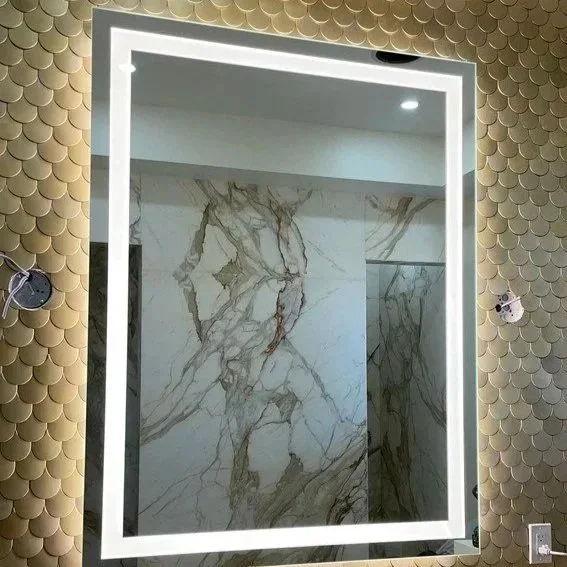
Backlit and anti-fog mirrors are now standard in mid-scale and upper-scale hotel properties. The differences between residential and commercial versions come down to electrical certification and ingress protection rating.
Residential backlit mirrors may carry basic safety certifications adequate for light-use environments. Commercial mirrors require UL or ETL-listed electrical components, and the fixture must meet a minimum IP44 ingress protection rating — sealed against water splashes from any direction. In wet bathroom zones, many specs call for IP65.
Anti-fog demister pads — heating elements mounted behind the glass that prevent condensation — are standard in hotel-grade mirrors. Wired to activate with the bathroom lights or on a timer, the pad covers the primary viewing area (typically the center 60–70% of the glass) and draws roughly 50–100 watts depending on mirror size.
And the LED color quality matters more than most property managers realize. A CRI (Color Rendering Index) of 90 or higher is the standard for hospitality because it renders skin tones and clothing colors accurately. A lower-CRI fixture makes guests look washed out — the opposite effect of what you want in a hotel bathroom.
CRI 90+ is the practical threshold for hospitality mirrors. Below 80 CRI, color accuracy degrades noticeably under artificial light — guests will notice even if they can't name why.
How to Tell What You're Actually Getting
Here's a straightforward way to evaluate a mirror before it goes on the wall. Look at the cut edge of the glass in direct light. Copper-free mirrors have a slightly bluer tint at the edge compared to standard silver mirrors, which read as warmer and more green-gray. It's subtle but visible.
Ask the supplier these questions directly: Is this copper-free? Does it meet ASTM C1503? Does it have CAT I or CAT II safety backing? What is the mounting hardware?
But if the supplier can't answer those questions from a spec sheet, that's a residential product being sold into a commercial space. The price difference between a spec'd hotel-grade mirror and a residential unit is real — typically 30–60% more per unit — but the replacement labor cost on a multi-room property makes the cheaper option significantly more expensive over a five-year horizon.
Frequently Asked Questions
You can, but the math usually doesn't hold. A residential mirror in a high-humidity hotel bathroom typically shows edge corrosion within 18–30 months and requires replacement. A commercial-grade mirror with copper-free glass and sealed edges lasts 10 years or more. The per-room labor cost of mirror replacement — especially in an occupied property — far exceeds the upfront savings.
Standard residential mirrors contain trace copper in the silvering layer. Copper is reactive and oxidizes in humid environments, causing the characteristic black-edge corrosion that spreads from the corners inward. Copper-free mirrors use a pure silver deposition process that resists moisture and chemical attack. In hotel bathroom conditions, the difference is significant: standard mirrors show corrosion in under two years; copper-free mirrors routinely last a decade or more.
Commercial bathrooms in the US generally require safety glazing meeting ANSI Z97.1 standards in locations where broken glass could cause injury. For mirrors specifically, requirements vary by jurisdiction, but most hotel operators specify CAT I or CAT II safety backing regardless of local code — for guest safety and liability protection. Confirm requirements with your local building department and your insurer before finalizing specs.
Vanity bathroom mirrors in hotel rooms commonly range from 24" × 36" up to 48" × 36", depending on the vanity and the property tier. Full-length mirrors in guest rooms or suites are often 24" × 72" or larger. At these dimensions, 5mm glass is the practical minimum — thinner glass at those sizes introduces flex and reflection distortion that show up immediately on installation.
Request the following in your spec: minimum 5mm copper-free silver glass; ASTM C1503 compliance; CAT I safety backing; fully sealed edges; Z-bar or security cleat mounting hardware; IP44-rated electrical components for any illuminated mirrors. Get the glazier to confirm these specs in writing before fabrication — not after delivery.
Yes, and it's usually the better approach. Custom fabrication from copper-free glass stock is standard for commercial glaziers. Ordering locally means exact dimensions, your choice of edge profile (polished, beveled, flat-seamed), and a glazier who handles installation — so the Z-bar is set correctly for the actual wall substrate. Shipping large mirrors across the country introduces damage risk that local fabrication eliminates. A glazier who fabricates and installs in-house controls the entire job from cut to hang.
Get a commercial mirror quote — Luxe Residential and Commercial Glass handles custom mirror fabrication and installation for hotels, property managers, and commercial clients throughout Las Vegas, Henderson, North Las Vegas, and the surrounding metro. Call (702) 825-7463 (License #0090853) to schedule.
