
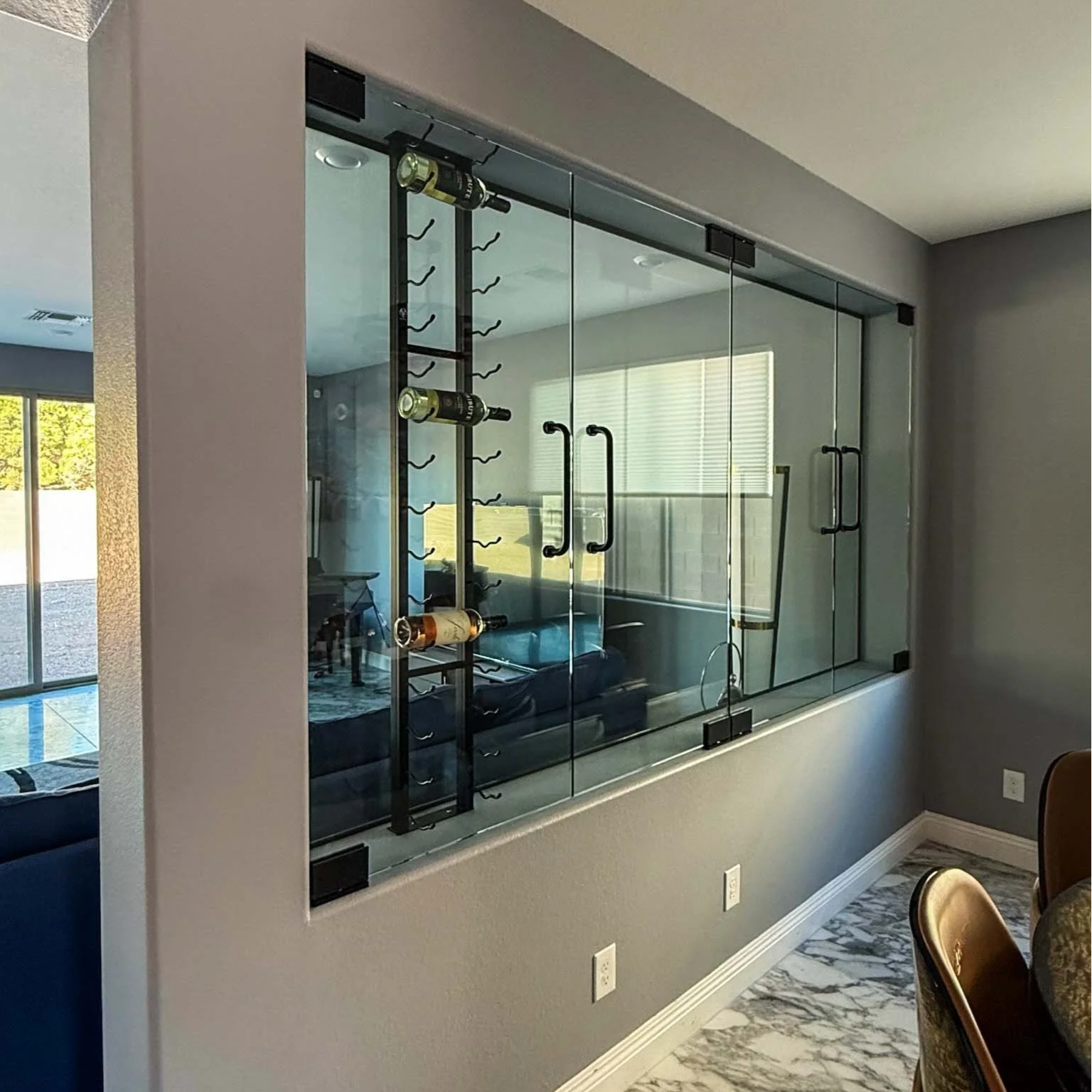
You are at dinner at a friend’s house, and through the wall behind the dining table there’s a glass enclosure — floor-to-ceiling panels, maybe 200 bottles visible, each one lit softly from below. You spend the next 20 minutes trying to figure out the price.
Here’s the short answer: a glass wine cellar costs between $15,000 and $80,000 for most residential projects, with the glass enclosure itself — panels, frame, door, and hardware — accounting for $5,000 to $35,000 of that depending on the system. Climate control, racking, lighting, and any construction work on the surrounding space make up the rest.
But the range is wide for a reason. Glass changes the engineering requirements in ways that wood walls don’t. That engineering shows up in the price.
What You’re Paying For
A glass wine cellar isn’t a room with decorative walls. It’s a climate-controlled enclosure where the glass must perform as both a visual feature and an insulating barrier — in a space that typically runs 55°F while the air outside may be 75°F or warmer.
That temperature differential is the number that drives the cost of the glass. If the glass doesn’t have enough thermal resistance, the interior surface drops below the dewpoint of the surrounding air. Condensation forms on the outer face. Water runs down the panels, warps the flooring, and — over time — damages labels, degrades corks, and introduces moisture into the racking.
The fix isn’t just thicker glass. You need an insulated glass unit (IGU) — two panes separated by a sealed air or argon-filled space, typically with a low-E coating on the inner surface. Standard single-pane or basic dual-pane won’t hold the thermal barrier a functioning wine cellar requires. The minimum gap for a wine cellar IGU in a warm climate is typically 1 inch between panes, with a low-E coating rated for the specific interior-to-exterior temperature differential.
The glass isn’t decorative here. It’s doing real thermal work.
For every 20°F of temperature differential between the cellar interior and the ambient room, you need at least one additional layer of glass performance. In a space where the cellar runs at 55°F and the room sits at 75°F, standard double-pane is borderline. At 80°F or above, a high-performance IGU with argon fill becomes the practical minimum.
Cost Ranges by Project Type
| Project Type | Glass Budget | Total Project Range |
|---|---|---|
| Glass door only (wood-walled cellar) | $800–$2,500 | $8,000–$25,000 |
| One visible glass wall + door | $3,000–$8,000 | $15,000–$40,000 |
| Two-wall glass enclosure | $8,000–$20,000 | $30,000–$70,000 |
| Full frameless room (three to four sides) | $20,000–$50,000+ | $60,000–$150,000+ |
The glass budget covers panels, the door, hardware, seals, and installation labor. It doesn’t include cooling, which is typically 25 to 40 percent of the total project.
Frameless vs. Framed Systems
This single decision affects price more than almost anything else in the glass portion of the budget.
A framed system uses aluminum or steel channels to hold the glass panels at the top, bottom, and sides. The frame carries the structural load; the glass fills the opening. These systems tolerate minor measurement variation, install faster, and cost less. Aluminum-framed wine room enclosures run roughly $80 to $140 per square foot installed, including glass.
Frameless systems use thicker glass — typically 3/8-inch or 1/2-inch tempered — with hardware-mounted brackets at the floor and ceiling and no visible vertical framing between panels. Tolerances are tighter, installation takes longer, and the glass carries more structural load. Expect $120 to $200 per square foot installed for a quality frameless system.
And that’s before you add the door. A frameless pivot door with quality hinges and a magnetic seal runs $2,000 to $5,000 by itself. A basic framed swing door on the same system is $800 to $1,800.
The steel-frame aesthetic — black welded steel with glass infill — sits in its own category. Architectural, not utilitarian. Costs run $150 to $250 per square foot installed and can push the glass portion of a full enclosure past $25,000 for a mid-sized room.
What Drives the Price Up
Size. A 6-foot-wide glass wall at 8 feet tall is 48 square feet. A 10-foot-wide version at the same height is 80 square feet. Costs scale close to linearly, though the door and hardware don’t scale as steeply.
Glass specification. Some quotes will spec single-pane glass to lower the price. That’s not a bargain — it’s a problem waiting to happen. Confirm the quote includes IGU, minimum pane thickness, and a low-E coating. Upgrading from standard dual-pane to a high-performance IGU adds $8 to $25 per square foot.
Hardware grade. I’ve seen frameless doors where the pivot hardware started binding within 18 months — always the same story: residential-grade pivot in a high-use cellar where the temperature differential puts daily stress on the mechanism. Commercial-grade hardware costs $300 to $800 more per door and eliminates that callback.
Seal quality. Wine cellars need tighter seals than most glass applications. Door base sweeps, perimeter gaskets, and compression seals all add to the hardware package. Cheap seals fail within a few years — the door leaks conditioned air, the cooling unit runs harder, and humidity swings start affecting the collection.
Access constraints. Moving large tempered panels through a finished home — around corners, up stairs, through narrow hallways — adds time and sometimes requires custom panel dimensions to fit the access path.
What Drives the Price Down
Choosing a glass door on an otherwise opaque cellar is the most direct cost lever. You get the visual appeal without the engineering complexity of glass walls. For collectors who care more about preservation than display, this is the right call.
Choosing aluminum-framed over frameless drops per-square-foot cost by 30 to 40 percent. The look is cleaner than drywall but less dramatic than structural frameless.
But the single biggest lever is managing size. A focused 150-square-foot cellar with proper glass and a correctly sized cooling unit will protect wine better than an oversized room with bargain-spec panels and an undersized unit fighting to hold temperature.
Cooling: The Other Major Line Item
Climate control typically runs 25 to 40 percent of the total project budget. A properly sized split system for a 100- to 200-square-foot glass cellar runs $4,000 to $10,000 installed. Ducted systems that keep mechanical components out of the cellar space run $8,000 to $18,000 or more.
Glass rooms lose conditioned air faster than insulated walls. The cooling unit needs to be sized for the thermal load of the glass, not just the room’s square footage. Most glaziers won’t size the cooling system for you — that’s a conversation with the HVAC contractor. But the glass spec you choose directly affects what size unit you need.
What to Ask Before You Get a Quote
Any serious glass contractor should be able to tell you the IGU specification (pane thickness, spacer width, coating type), the frame or hardware system being used, the hardware grade, and whether door perimeter sealing is included in the scope. If the quote says “tempered glass” without specifying the unit construction, ask for the IGU detail. That one line item determines whether the cellar holds temperature or fights its cooling system for years.
Don’t accept a quote that only specifies “dual-pane.” Ask for the U-value of the unit. For wine cellars in warm climates, a U-value of 0.25 or lower is a reasonable target.
Frequently Asked Questions
Most residential glass installations take two to four days on site, after the surrounding construction is finished. Custom frameless systems that require precise templating carry a fabrication lead time of two to four weeks once measurements are confirmed. Factor that into any renovation timeline.
Yes, and it’s a common request. The most practical approach is replacing one face — typically a wall visible from a living space — with a glass panel system. Existing walls stay, the cooling system usually doesn’t need resizing, and you get the display aesthetic without rebuilding the room. Expect $3,000 to $12,000 depending on the opening size and system type.
Yes. Any structural panel over about 9 square feet, any door, and any panel adjacent to a door should be tempered glass. Some configurations also use laminated glass, which holds together as a unit when broken rather than breaking into fragments. A glazier can confirm the right spec for your opening dimensions in about 30 seconds.
With a properly specified IGU, no. Single-pane glass will sweat. Under-spec’d dual-pane may sweat in summer when ambient humidity is high. If you see condensation on the exterior face regularly, the glass either lacks a low-E coating, the argon fill has degraded, or the seal has failed. Fogging between the panes — visible from an angle in bright light — confirms a failed seal.
A well-insulated, properly sealed glass cellar with a correctly sized cooling unit typically adds $30 to $80 per month to an electric bill. Oversized rooms or bargain-spec glass can push that to $120 to $180 — the glass is losing conditioned air faster than the system can replace it. Good glass pays for itself in energy savings over three to five years.
For collectors who use the cellar as a display feature in a visible location, yes. The visual access to the collection changes how guests interact with the space. For back-closet storage no one sees, wood walls with a glass door do the same job at a fraction of the cost. Spend the glass money where it gets seen.
Ready to start planning? Luxe Residential and Commercial Glass handles custom glass wine cellar enclosures, frameless panel systems, and glass door installations throughout Las Vegas, Henderson, North Las Vegas, and the surrounding metro. Call (702) 825-7463 (License #0090853) to schedule a consultation.
